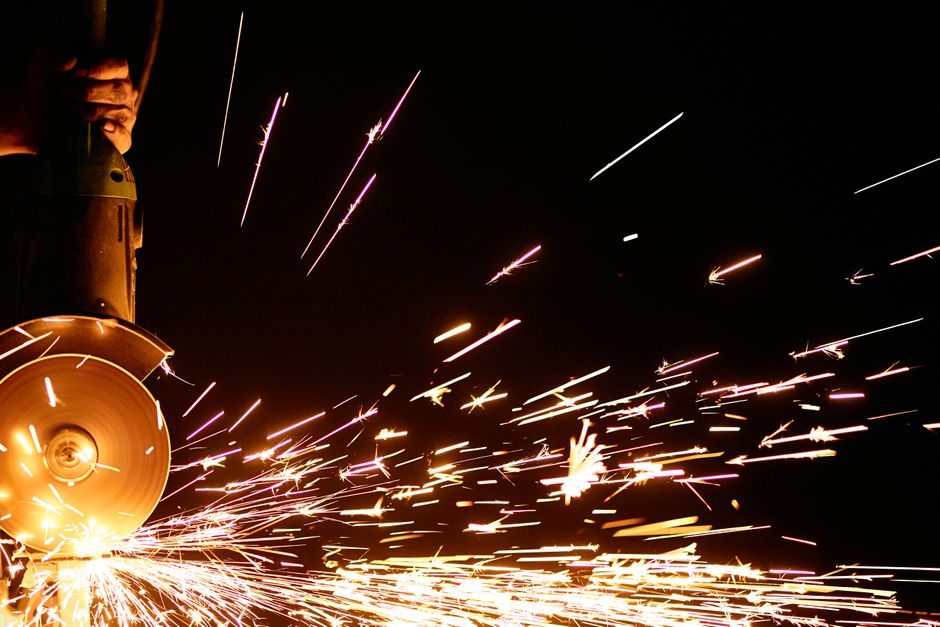
Disc diameter is the single most important sizing variable on a portable angle grinder: the larger the disc, the deeper the cut, the heavier the tool, and the higher the torque the motor has to deliver at the spindle [S1].
Selecting between them is rarely a question of preference; it is a function of workpiece thickness, required surface area contact, available grip span, and the operator's tolerance for hand-arm vibration over a shift. Each jump in disc class also raises mass by 0.4–1.0 kg, so the wrong size costs productivity in fatigue, not just in cut quality [S1].
Disc Class Mapping: 100 / 115 / 125 / 150 / 180 / 230 mm
The 100 mm (4 in) class is the lightest end of the range, typically 1.4–1.8 kg with a 500–720 W motor, and is reserved for light deburring, paint removal and tight-bodywork access where a bigger guard would not fit [S1]. The 115 mm and 125 mm classes are the workhorses: 1.7–2.4 kg body, 700–1100 W, no-load speed 10,000–12,000 min⁻¹, and a standard 22.23 mm bore — they cover rebar, sheet steel up to ~6 mm, tile, and stone [S1][S6].
Jumping to 150 mm (6 in) and 180 mm (7 in) means stepping into 1,400–1,800 W machines for fabrication and foundry fettling, where the operator needs a deeper cut but can still hold the tool one-handed for short bursts [S1]. The 230 mm (9 in) class is the top end: 2,000–2,600 W, 6,500–8,500 min⁻¹ no-load, two-handed grip mandatory, and the only practical choice for cutting 12 mm plus rebar, paving slabs and structural steel sections [S8]. As a rule of thumb, doubling the disc diameter roughly quadruples the material removal rate in steel — but also roughly triples operator fatigue, so the bigger class only wins on multi-hour, heavy-removal jobs [S1].
Motor Wattage, No-Load RPM and Cutting Speed
Wattage and no-load RPM cannot be read in isolation. A 125 mm, 1,000 W grinder running at 11,000 min⁻¹ delivers a peripheral cutting speed of ~72 m/s on a Type 27 depressed-centre disc, which is the range Type 27 abrasive manufacturers design for; pushing a 1,000 W motor below 10,000 min⁻¹ on the same disc wastes torque and burns the abrasive [S1][S6]. Industrial buyers should read both numbers together: a 2,600 W / 6,500 min⁻¹ 230 mm tool is built for torque, not for fine surface speed, and the operator should not bolt on a 125 mm cutting disc to "speed it up" — the peripheral speed collapses and the disc glazes.
Duty cycle ties to the same envelope. Continuous-rated industrial grinders specify an S2/S3 duty (e.g. S3 40% / 15 min) on the nameplate, meaning the tool can deliver rated wattage for 6 of every 15 minutes without tripping thermal protection. Light-DIY 115 mm units are often S2 5 min, suitable for intermittent trimming, not for a full fabrication shift [S1]. A common selection failure is buying a high-wattage, low-duty tool for production use; the thermal cutout will halt the shift long before the abrasive is spent.
Spindle Thread, Disc Bore and Accessory Compatibility
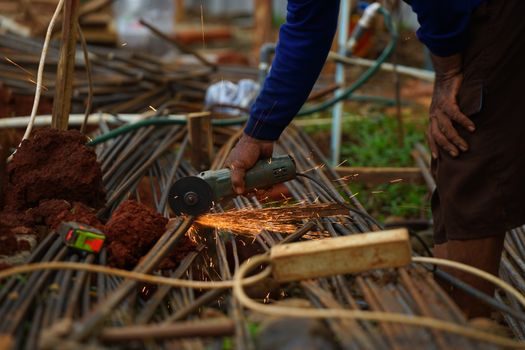
Three spindle threads cover virtually every portable grinder on the market: M10 × 1.5 (most 100/115/125 mm), 5/8-11 UNC (North-American 180/230 mm and some 7 in models), and M14 × 2 (most European 150/180/230 mm industrial) [S1]. The disc bore is 22.23 mm across the entire 100–230 mm handheld range, but the backing flange, lock nut and guard size all change with disc class — a 125 mm guard will not physically clear a 150 mm disc, and the spindle stick-out is shorter on smaller models.
Buyers should lock the spindle thread on the first RFQ and reject substitutions that mix M14 and 5/8-11 on the same platform: the 5/8-11 UNC is the imperial equivalent of M16 × 2, not M14 × 2, and an M14 lock nut threaded onto a 5/11 spindle will strip the first time the disc stalls [S1]. Type 27 (depressed-centre) cutting/grinding discs and Type 42 (flat) cutting discs share the same 22.23 mm bore; flap discs, wire wheels and diamond cup wheels use the same bore but require their own maximum-RPM rating stamped on the accessory — that number must exceed the grinder's no-load RPM by at least the safety margin printed on the disc [S6].
Power Source: Corded AC vs Brushless Cordless vs Pneumatic
Corded AC remains the default for fixed-location fab shops and shipyards: continuous rated power, no battery state-of-charge drift, and lower unit cost. In the 115–125 mm class, 800–1,100 W corded units sell at roughly one-third the price of an equivalent brushless 18 V cordless kit including two 5 Ah packs and a charger [S1][S8]. Cordless 18 V / 54 V platforms have closed the gap on convenience and now match corded no-load RPM, but a 5 Ah pack at 125 mm will only deliver 8–15 minutes of aggressive cut time before voltage sag drops the disc below its peripheral-speed design point.
Pneumatic 100/125 mm grinders are still standard in oil-and-gas, marine and ATEX-classified zones, where electric motors are excluded; they trade electrical isolation for the need for a 6–8 bar clean-air supply and an in-line lubricator. In an explosive-atmosphere refinery, a pneumatic angle grinder avoids the ATEX 2014/34/EU certification cost on the tool itself, but the air supply still has to meet zone classification for the compressor and hose reel [S1]. For most indoor metalwork, corded brushless AC remains the lowest total-cost choice over a 3-year duty cycle.
Application Fit: Cutting, Grinding, Surface Finishing, Fettling
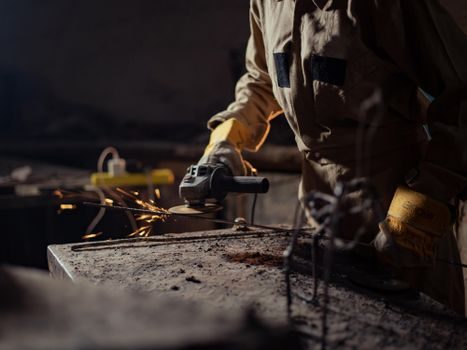
Cutting and light grinding are the same tool with a different disc: a Type 42 flat cut-off disc maximises depth-of-cut in sheet, while a Type 27 depressed-centre disc combines grinding and light cutting in one — this is the configuration the 115/125 mm workhorses are designed around [S1][S6]. For heavy stock removal on castings, welds and heat-treat scale, the relevant tool is a high-torque 180/230 mm unit running a 6–8 mm Type 27 grinding disc, with a three-position auxiliary handle mounted to the gearbox (not the body) to control torque reaction.
Surface finishing — rust and paint removal, weld blending, satin finishing on stainless — is a different duty entirely and is where fettling grinders and floor grinders diverge from standard angle grinders: fettling grinders add a wheel-guard-mounted LED and a low-vibration side handle for 4–8 hour foundry shifts, while floor grinders run on a 250–600 mm planetary or rotary head and are not handheld at all. For stainless weld passivation, spec a 125 mm unit with a Type 29 flexible grinding disc and an autobalancer: the autobalancer drops hand-arm vibration by a measurable margin on de-centred wheels, which is the single largest contributor to HAVS exposure in finishing lines [S1][S6].
Safety Gates: Guards, Disc RPM, Vibration and PPE
Four safety gates must close before any grinder goes on shift: (1) the wheel guard must cover at least 180° of the disc and must be the size stamped for that disc class — never run a 125 mm disc behind a 115 mm guard [S1]; (2) the disc's max-RPM stamp must exceed the tool's no-load RPM (e.g. an 11,000 min⁻¹ disc on a 12,000 min⁻¹ grinder is fine, the reverse is not); (3) the spindle lock must fully engage before any flange or nut is tightened, otherwise the disc will walk off the taper; (4) the operator must be in ANSI Z87.1-rated eye protection, an FFP2/FFP3 respirator for masonry or coated-steel dust, and cut-resistant gloves — gloves off when the disc is exposed, as the gloves can catch a stalled disc and pull the hand in [S1][S6].
The most common failure mode on the 230 mm class is disc shatter from a 90° plunge into a hidden aggregate in concrete or a rebar in a precast panel — both produce a kick load that exceeds the 2,600 W motor's torque reserve for one revolution, which is why the 230 mm class specifies a slow-start soft-ignition circuit and a clutch that decouples above ~8 N·m of stall reaction [S1][S8]. The second most common failure is operator burn from a stalled cut: the abrasive heats to >400 °C at the contact patch in under 2 seconds of stall, and a glove does not survive it. Slow-start and a current-limited clutch are not comfort options on 230 mm tools; they are the only thing standing between a stalled disc and a hospital visit [S1].
Selection Criteria and Total-Cost-of-Owness Math
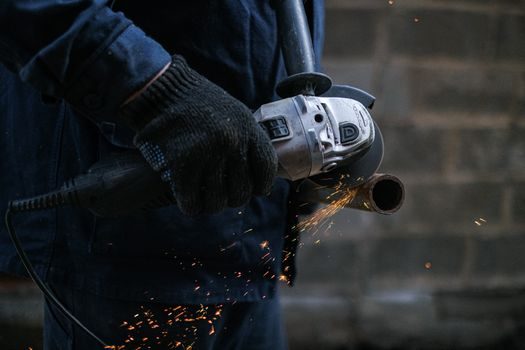
A practical selection matrix for industrial buyers lines the four main disc classes against four decision criteria: [S1]
- 100 mm / ~700 W / ~0.3 kWh per shift: light deburring, paint, bodywork; lowest tool cost, lowest fatigue, <10 mm cut depth. - 125 mm / ~1,000 W / ~0.6 kWh per shift: the default workhorse; rebar, sheet, tile, stone; ~25 mm cut depth; 1-year payback vs dedicated cutters in mixed fab. - 230 mm / ~2,400 W / ~1.6 kWh per shift: structural steel, paving, demolition prep; ~70 mm cut depth; 2-handed grip mandatory; S2 15–30 min duty; budget for 3 replacement abrasive sets per shift.
Total cost is rarely tool-plus-disc: a 125 mm industrial corded kit amortises over 3–5 years, while abrasive consumption — typically 30–60 Type 27 discs per shift at the 125 mm class in fabrication — dominates the running cost. For cross-shop fleet sizing, the same workflow covered by a 230 mm "one-size" tool burns through roughly twice the watts per cut and 2–3× the abrasive mass, so unless the 230 mm is mandatory for depth, the 125 mm fleet is the cheaper answer for steel sheet work [S1][S8]. For deeper cuts and demolition-prep, see the related cost guide for cut-off machines — they complement, rather than replace, the handheld 230 mm grinder on rebar and slab work.
Track two signals over the next procurement cycle: (1) the brushless 18 V cordless share at the 125 mm class, which is now crossing the corded price gap on 5 Ah kits in 2026 and is the leading indicator of where the industrial fleet will tip within 24 months [S1]; (2) any tightening of the EU Machinery Regulation 2023/1230 enforcement on wheel-guard coverage angle for the 180–230 mm class, which would force a SKU retool across the major brands by the 2027 model year [S1]. Buyers specifying in Q3 2026 should pin spindle thread, disc-class guard, no-load RPM and S2/S3 duty on the RFQ, and reject any quote that does not stamp a maximum-RPM disc in the box.