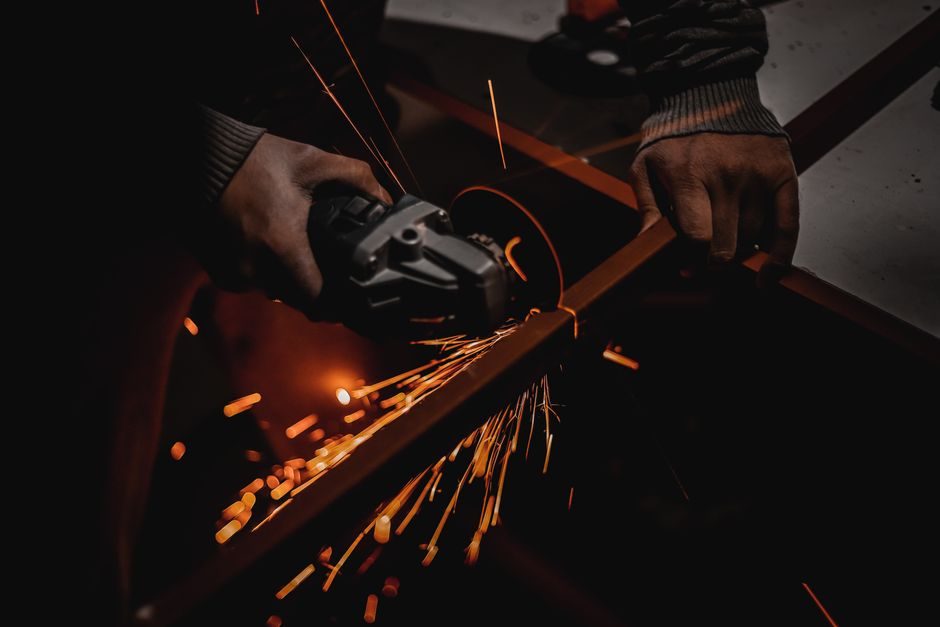
Angle grinders are classed by disc diameter, with 100mm, 115mm and 125mm being the small-format core sold in OEM export catalogues at 570W rated input and 10,000 r/min no-load speed [S3].
Selection beyond disc size is driven by three independent axes: power source (corded AC vs brushless DC cordless), spindle thread (M10, M14, 5/8-11 UNC), and the abrasive/accessory family mounted on that spindle, each carrying its own safe maximum RPM [S1][S2].
Disc-Diameter Class Bands and Their Working Envelope
The diameter band is the first selection gate: 100mm and 115mm units target light metalwork and sheet work, 125mm covers general fabrication, 150mm bridges into heavy stock removal, and 180-230mm are reserved for masonry and concrete cutting where guard geometry and wheel thickness change [S3][S5].
The HY9500 platform ships the same 570W motor and 10,000 r/min no-load speed across 100/115/125mm heads, with a 54mm motor pile that is dimensionally interchangeable with a major Japanese OEM's stator [S3]. That compatibility claim is the most concrete cross-brand spec in the small-format band — it lets a buyer swap armatures without retooling the housing.
For cutting depth, expect roughly one-third of disc diameter as a usable cut in steel: a 115mm disc reaches about 30-38mm, a 125mm disc about 35-40mm, a 180mm disc around 50-60mm, and a 230mm disc about 65-75mm — figures dictated by the geometry of a depressed-centre wheel, not by motor power [S2].
Power Source: Corded AC vs Brushless Cordless
Corded AC units in the small-format band are specified at 110/220V, 50/60Hz, 570W rated input, 10,000 r/min no-load, and remain the lowest-cost-per-watt option for shop-floor duty [S3].
Cordless 18V/20V brushless platforms dominate the DIY and rooftop-construction segment on Alibaba listings through 2026, trading continuous-run endurance for portability; battery platforms from 4.0Ah to 9.0Ah are now common [S4].
The same accessory and guard fits both classes provided no-load RPM on the cordless head equals or exceeds the wheel's printed maximum — a 125mm cutting wheel rated at 12,000 r/min must not be spun by a cordless head that falls below that floor under load.
Spindle Threads and Accessory Fitment
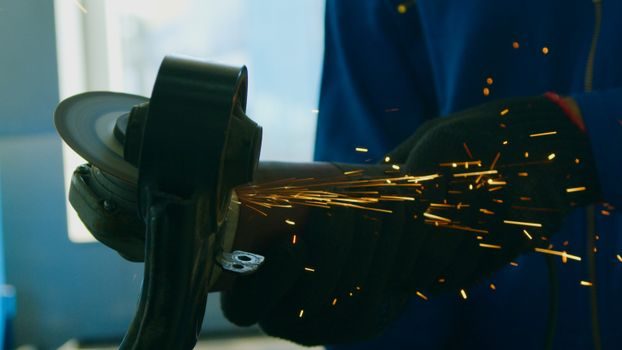
Spindle thread is the silent compatibility gate: M10 dominates 100mm-class polishers, M14 is the global default for 115/125/150/180/230mm cutting and grinding, and 5/8-11 UNC is the North American/industrial alternative for larger wheels and some backer pads [S1].
Wool-felt buffing, hook-and-loop sanding, diamond polishing, and flap discs are all sold across both M10 and M14 fitments in the 75-180mm diameter range, with 115mm and 125mm wool felt pads the highest-volume SKUs on the AliExpress accessory listing [S1].
An M14-to-M10 adapter, or an M14-to-5/8-11 reducer, is the practical fix when a single spindle must accept both EU-pattern accessories and North-American backer pads; the inverse reducer is rarely safe on a 230mm head because thread engagement drops below the safety margin for the higher torque band [S1].
Accessory Families: Cutting, Grinding, Flap, Diamond and Polishing
Cutting wheels (Type 41, flat) and depressed-centre cutting wheels (Type 42, T27) are the two geometry standards for cut-off duty — the depressed centre lets the operator cut at an angle without the flange binding, which is why T27 wheels are the default for 115/125mm in metalwork [S2].
Grinding wheels (Type 27, raised hub) are bound at lower working speeds than cut-off wheels of the same diameter because they are designed for radial load, not lateral — running a grinding wheel on a cut-off task is the most common cause of wheel shatter in shop-floor incident logs [S2].
Flap discs combine multiple abrasive-coated flaps layered radially; they are sold in 100/115/125mm diameters and in aluminium-oxide, zirconia, and ceramic grains, with zirconia the cost-effective workhorse and ceramic the high-stock-removal option on stainless and nickel alloys [S2].
Resin-fibre discs (backing-stiff, fast cut, high heat) and surface-conditioning discs (conformable, lower cut, finish-grade) round out the coated-abrasive family; both share Type 27 geometry but bond differently to the backer pad [S2].
For stone, glass, and concrete, diamond-segmented and diamond-polishing discs step in: the 80mm M10 diamond wet/dry polishing pad, 100mm nylon-flap, and 115/125mm wool-felt buff form a complete granite/marble finishing chain sold as a set in 2026 [S1].
Wool-felt polishing pads (75-180mm, 320-grit scouring) and foam backing pads close the finishing chain — the felt disc drops the surface from #4 satin to a mirror finish on stainless steel, the foam pad handles clear-coat and paint correction [S1].
Speed, Safety and Wheel-RPM Matching
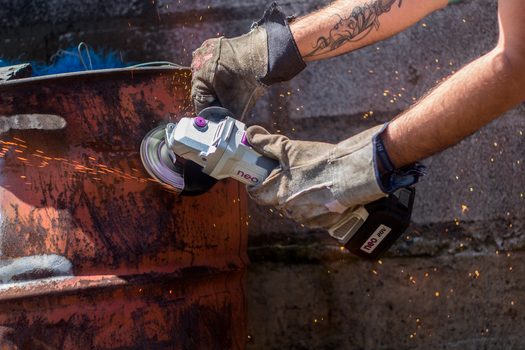
Every bonded wheel is printed with a maximum operating speed in r/min and a maximum peripheral speed in m/s; both numbers must clear the grinder's no-load speed with margin — a wheel rated at 80 m/s peripheral run at 100 m/s peripheral fails by stress, not by temperature [S2].
Operator-side, a Type 27 guard, side handle, and eye protection rated to the wheel-fragment energy are mandatory in most jurisdictions; the guard window angle is set so a shattered wheel fragment is deflected away from the operator's line of sight, which is why the guard is a wear item, not a one-time install [S2].
In hot, dust-loaded environments such as the UAE construction sector, abrasive disc life drops sharply if the disc bond is not matched to ambient grit; aluminium-oxide on metal cuts fast but wears fast, zirconia runs cooler and lasts longer on stainless, and ceramic is reserved for high-alloy and nickel-based stock where heat damage to the workpiece is the binding constraint [S5].
Where Each Class Fits and Where It Does Not
A 100-125mm corded 570W unit covers sheet-metal cutting, weld bead grinding, small-diameter pipe descaling, and DIY stone polishing — this is the workhorse band for 80% of metal-fab and rooftop-construction tasks [S3][S4].
A 150-180mm corded or large-format cordless head steps in for heavy stock removal, concrete surface prep, and rebar work, where the larger guard envelope and higher torque matter more than top-end RPM [S5].
A 230mm class is the right answer for masonry cutting, paver trimming, and deep concrete scoring, and is the wrong answer for fabrication work — the wheel speed is too low to finish stainless cleanly and the tool is too heavy to control on sheet work [S5].
Cordless 18V-20V brushless is the right answer on site with no power, on ladders, and on mobile fabrication trucks; it is the wrong answer for production-cell duty where a 570W corded head will outlast three battery cycles per shift [S4].
Selection Criteria Summary Across the Main Types
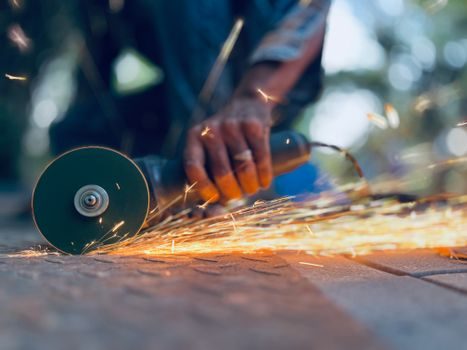
For a buyer comparing small-format corded (100-125mm, 570W, 10,000 r/min, M14), mid-format corded (150-180mm, 800-1,200W, 8,000 r/min, M14), large corded (230mm, 2,000W+ class, 6,500 r/min, M14), and cordless brushless (115-125mm, 18-20V, 5,000-8,500 r/min, M14): the corded small-format wins on cost-per-cut and continuous duty, the mid-format wins on stock-removal rate, the large corded wins on cut depth, and the cordless brushless wins on mobility at a 1.5-2x cost-per-watt premium [S3][S4].
Across accessory families, the priority order is: match spindle thread first (M14 default), match wheel diameter second (must equal grinder rating, never smaller-by-much), match abrasive grain third (Al2O3 for carbon steel, ZrO2 for stainless, ceramic for nickel alloy and high-alloy, diamond for stone/concrete/glass), and match bond hardness last to the workpiece and the operator's finish target [S2].
For procurement, watch the 100mm and 125mm wool-felt and hook-and-loop polishing disc SKUs first — they are the highest-volume accessory line in 2026 and the price spread between OEM and no-name suppliers is widest here; matching spindle thread, RPM, and diameter avoids the 80% of warranty returns that trace to a mismatched wheel [S1].
For a deeper wheel-geometry and application reference, see our angle grinder encyclopedia entry, and for heavier stock-removal work, the fettling grinder classification maps the related die- and bench-grinder envelope. For surface-prep on large slab areas, the floor grinder specification map carries the matching larger-diameter accessory chain.
Trackable signals for the next 90-180 days: cordless 18V/20V brushless head prices on the 125mm class on Alibaba/AliExpress (volume weighted), M14-to-5/8-11 reducer availability in the 230mm band, and any new ceramic-grain flap-disc SKUs at 100-125mm hitting the 10,000+ sold tier — these three metrics together read the DIY-to-prosumer pivot currently running through the small-format segment [S1][S4].
For related coverage, see Battery-Grade LiOH Smart Plants: Sensor, Control and Traceability Choices That Lock In.