
Industrial buyers specifying a new warehouse rack system in 2026 should start from the pallet and the forklift, not from the brochure: a standard EUR pallet (1200 × 800 mm, 1000 kg loaded) and a 2.5-tonne counterbalance truck define the beam length, bay depth, and aisle width that the rest of the layout must respect [S1][S3].
Industrial storage racks are the structural backbone of a warehouse, and the wrong match between SKU profile, throughput target, and frame capacity is the single most common cause of under-utilised cubic space or, worse, rack collapse incidents that the European EN 15635 and the U.S. RMI MH16.1 guidelines exist to prevent [S1].
Step 1 — Lock the Pallet, Load and Throughput Profile
Beam length and bay depth are derived from the unit load: a EUR 1200 × 800 mm pallet on two beams means a beam of roughly 2700 mm clear span (≈ 2 × pallet depth + clearance), and a bay depth of 2700–3600 mm for selective or double-deep configurations [S1].
Per-pallet weight drives the beam section: light-duty (≤ 500 kg/pallet) suits roll-formed teardrop beams; medium-duty (500–1500 kg) typically uses step-beam or box-beam profiles; heavy-duty (> 1500 kg/pallet, often for cold-rolled steel coils or automotive parts) requires structural C-channel beams with bolted end connectors and frame capacities documented against EN 15512 / RMI MH16.1 [S1].
Throughput mode separates the system family: if the SKU mix is wide and you need direct access to every pallet, the pallet rack selective configuration is the baseline; if you ship and receive in batches and can tolerate LIFO, drive-in or push-back racking compresses two to four pallets deep into the same footprint [S1].
Step 2 — Match Rack Type to Aisle Width and Building Height
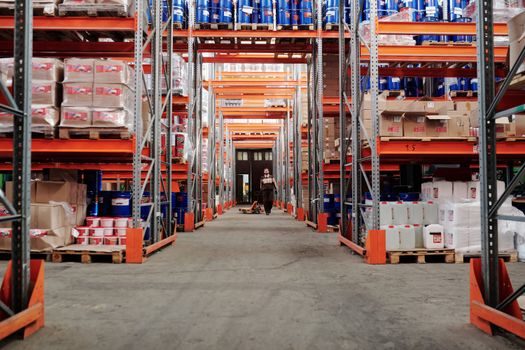
Aisle width is set by the truck, not the rack: a conventional counterbalance truck needs ≈ 3.5–4.0 m aisles; a reach truck narrows that to 2.6–2.9 m; an articulating or swing-reach truck can run at 2.0–2.4 m; VNA (very narrow aisle) trucks with wire guidance drop to 1.6–1.8 m and let you push clear height toward 12 m [S1].
For buildings taller than 8–10 m with high SKU turnover, an ASRS system (miniload or unit-load crane stacks) replaces forklift aisles with aisles as narrow as 1.0 m and uses the full clear height, at the cost of higher capex and a 99%+ uptime requirement on the stacker crane [S1].
For high-throughput case picking, a shuttle system (pallet or carton shuttle on rails) decouples storage from retrieval: the shuttle does the horizontal run on the rail while a forklift only loads/unloads at the end face, lifting effective throughput to 200–400 pallets/hour per aisle in deep-lane FIFO operations [S1].
The space-saving / access trade-off is concrete: selective racks give 100% SKU access but use only 33–40% of the cubic footprint; drive-in pushes storage density to ≈ 75–85% but drops access to the front-of-aisle block; ASRS pushes density above 90% and uses the full clear height but cuts retrieval flexibility [S1].
Step 3 — Decide Frame Material, Finish and Seismic Class
For ambient, indoor, dry warehouses, roll-formed Q235 / Q355 cold-rolled steel with powder-coat or galvanised finish is the cost-default; for cold storage below 0 °C, for food/beverage wash-down zones, or for outdoor yards, hot-dip galvanised (≥ 55 µm zinc, ISO 1461) or pre-galvanised frames are specified to slow white-rust and through-section corrosion [S1].
Frame uprights are typically 2.0–3.0 mm steel with bolted or teardrop (auto-lock) connections; thicker 3.0–4.0 mm sections are used for frames above 8 m or for high-seismic zones (China GB 50011 / Taiwan CNS 15046 / U.S. IBC seismic design categories D–F) where lateral anchorage and base-plate sizing must be documented against the project's seismic design category [S1].
Anchor spec is a safety item, not a hardware item: ≥ M12 × 100 mm mechanical anchors at every base plate, with 2 anchors per base minimum for frames up to 6 m and 4 anchors per base for taller or pallet-stop-anchored frames, per common practice aligned with EN 15512 design and EN 15635 inspection regimes [S1].
Step 4 — Apply the EN 15512 / EN 15635 / RMI Compliance Filter
EN 15512 is the European design-of-steel-static-racking standard; EN 15635 is the in-use inspection regime; and the U.S. RMI MH16.1 / ANSI MH16.1 covers specification, design, and testing of pallet stacker racks in North America. A compliant quote will state which of these the system is designed to, and will carry a load-application sign (in Europe, a green/yellow/red traffic-light plate) on every aisle [S1].
EN 15635 mandates an annual expert inspection and a weekly pallet/load-placement check; in practice that means the buyer must budget a rack-safety audit line item from year 1, otherwise the structure decays past design margin and insurance claims become contestable [S1].
For an OEM/ODM-supplied system from a China-based mill or rack factory (Made-in-China lists hundreds of storage-rack-system suppliers with ISO 9001:2015, ISO 14001:2015, OEM/ODM, and own-brand capacity), the factory should provide EN 15512 / RMI design-of-record calculations, a load-test report on a representative frame, and a beam-deflection curve — not just a sales drawing [S3].
Step 5 — Sourcing, Lead Time and Total Cost of Ownership
Supplier short-listing on Made-in-China and Alibaba breaks down by capability: 501–1000-person factories with 10–50 M USD annual revenue tend to handle multi-aisle turnkey projects; smaller workshops typically ship beam-and-upright kits without installation [S3].
For FOB-tier cost mapping of the steel side of a rack project, see this steel mill and strip-tier read — coil, strip and hot-rolled plate prices cascade into upright, beam, and base-plate cost within about 4–8 weeks of mill moves.
If the project layers a mezzanine above the rack footprint to pick from above, the mezzanine load class and support logic guide maps the framing implications, because mezzanine columns frequently land on the rack cross-aisle and must be coordinated with the rack's seismic base-plate layout [S1].
When a Standard Rack is the Wrong Answer
Freezer warehouses at –25 °C: standard powder-coat racks can become brittle and weld-cracking risks rise; use low-temperature-rated steel and pre-engineered freezer bay layouts with floor-heating channel cut-outs before any rack is anchored [S1].
High-seismic regions (China high-intensity zones, Japan, parts of the U.S. West Coast, Türkiye, Taiwan, Indonesia, Iran): selective racks are vulnerable to cross-aisle sway, and pallet stops, row spacers, and base-isolation anchors become part of the design, not an optional extra [S1].
Flammable / ATEX-classified warehouses: ordinary carbon-steel racks can spark on impact; specify stainless or non-ferrous fasteners and copper-beryllium or aluminium row spacers, and confirm the rack does not sit inside an explosion-proof motor zone without the right zone-class materials.
Single-SKU high-turnover operations (cement, bagged grain, beverage, automotive tyres): a pallet shuttle system or an ASRS unit-load stacker will out-perform selective racks by a wide margin on pallets-per-hour-per-aisle and labour per pick [S1].
Common Failure Modes and How to Pre-empt Them
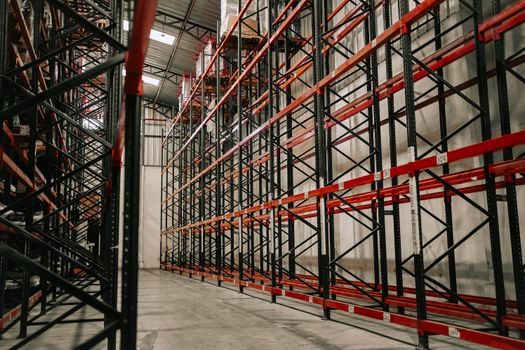
Beam-to-upright connector damage (the "ear" on a teardrop beam) accounts for a large share of in-service rack failures. Pre-empt by specifying ≥ 3 mm end-connector thickness, replacement of any beam with a deformed safety clip, and a 1 mm wire-diameter gap check during the weekly walk-around [S1].
Upright base-plate pull-out: usually traceable to under-spec anchors, missing chemical-resin anchors on seismic projects, or floor-slab compressive strength below 25 MPa. Spec the slab compressive class (C25/30 typical, C30/37 in heavy-seismic or freezer builds) on the structural drawing [S1].
Overloaded top-beam level: field practice is to mark the "do not exceed" level with a permanent load label, and to enforce the 1.5 m load-height guideline; high-stack audits show that the top beam level is the most likely site of a near-miss, because gravity and pallet-stop deflection concentrate there [S1].
Selection Criteria — At a Glance
Decision matrix for the four most common rack families: Selective Pallet Rack scores 5/5 on SKU access, 2/5 on density, 5/5 on order-pick flexibility, 3/5 on capex; Drive-In/Drive-Through scores 1/5 on access, 4/5 on density, 2/5 on flexibility, 3/5 on capex; Pallet Shuttle + Forklift scores 4/5 on access, 4/5 on density, 3/5 on flexibility, 4/5 on capex; ASRS Unit-Load Crane scores 5/5 on access, 5/5 on density, 4/5 on flexibility, 5/5 on capex [S1].
Decision matrix by SKU profile: low SKU count / high pallet count → drive-in or shuttle; high SKU count / medium velocity → selective or shuttle; high SKU count / high velocity + tall building → ASRS unit-load; manual case-pick layer above pallet rack → shuttle system + carton flow rack on a mezzanine tier [S1].
Decision matrix by truck fleet: counterbalance truck fleet only → selective; reach-truck fleet → selective or double-deep narrow-aisle; VNA wire-guided trucks → selective with VNA rails; no trucks / automated → ASRS or shuttle [S1].
What to Put in the RFQ
Send a six-line RFQ to each shortlisted rack supplier: (1) unit load, pallet footprint, weight, and height; (2) SKU count, ABC velocity, throughput target in pallets/hour; (3) available clear height and floor area; (4) truck fleet or automation plan; (5) seismic zone and floor-slab spec; (6) required design codes (EN 15512 / EN 15635 / RMI MH16.1). A supplier that cannot answer all six in writing is not a shortlist candidate [S1].
Request the rack-failure-mode envelope: maximum beam deflection at 1.5 × rated load, frame sway at 1.0 × vertical load, and base-plate pull-out force at 1.25 × design lateral load. A clean answer with EN 15512 / RMI reference numbers means the calculation was actually done, not back-fitted [S1].
Close-out: track the in-service inspection schedule (EN 15635 / RMI) as a contractual deliverable from day 1, not an after-delivery surprise.