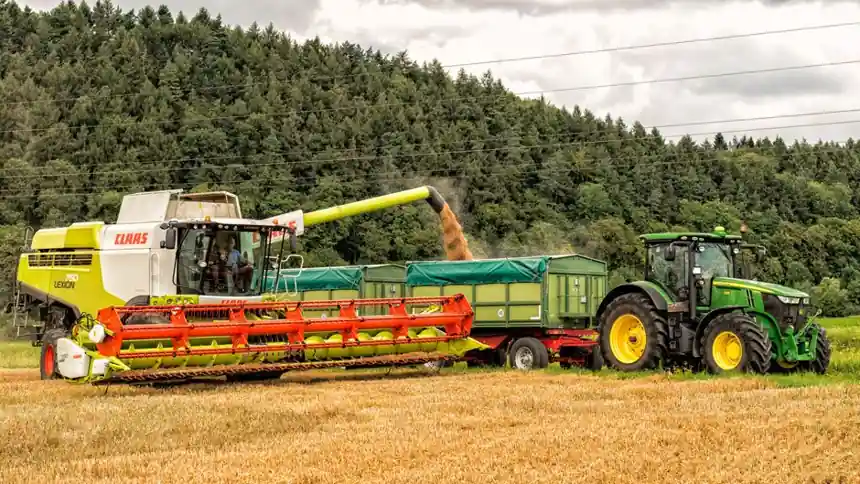
Single-row angular contact bearings remain the default for combine harvesters, tractor gearboxes, and implement disc spindles, where combined radial-plus-axial loads at 1,500-3,000 rpm are routine, per the National Precision Bearing product literature updated 2024-10 [S1].
Agriculture-machinery bearing output is concentrated among Chinese mills such as Shandong Chaoyang Bearing (CYSD), which lists a 100,000-piece-per-month supply ability across tapered, cylindrical, and precision angular contact product families, and a dedicated Agriculture Machinery Bearing line [S7]. Cross-listing on Made-in-China.com shows the same class of part at US$1.00-20.00 per piece FOB, MOQ 1 piece, with carbon-steel and stainless variants both offered [S3].
Why paired mounting, not single bearings, on most ag input shafts
Single-row angular contact bearings can only carry axial load in one direction, so field service almost always installs them as matched pairs (DB back-to-back, DF face-to-face, or DT tandem) to locate the shaft both ways, as stated in manufacturer product literature [S5]. The back-to-back DB arrangement provides higher moment resistance and is preferred on universal-joint and feeder-house shafts; DF gives shallower axial spread and is used where adjacent gear geometry constrains the stack. Tandem DT stacks axially share load and are common inside planetary hubs and rotor gearboxes where the load is steady and one-directional.
Matched-pair preload is set at the factory using ground spacers, and field engineers should not re-shim without the mill's preload chart, because a 5-10 µm shim error on a 7205-class bearing shifts contact-angle load distribution and accelerates spalling. The 7000C/7200C/7300C designation family (e.g. 7003C through 7024C and 7203C through 7222C) is the dominant envelope for ag gearboxes, with bore sizes stepping from 17 mm to 120 mm [S8].
Sealing, contamination, and the field-failure pattern
Agricultural duty is dust, water spray, and crop-residue ingress rather than clean factory lube, so contact-angle geometry must be paired with sealing that meets at least IP54 equivalent and a grease fill rated for 80-120 °C peak. Ball-rollerbearing.com lists Agriculture Bearings as a standalone category alongside Automotive and Robot lines, indicating dedicated seal/cage variants are produced rather than automotive parts being relabelled [S6].
The most common field failures on tractor and combine angular contact positions are not contact-fatigue but contaminated lubricant and seal-bypass grit, typically after 2,500-4,000 hours in dusty tillage or harvesting duty. A re-grease interval of 250-500 hours is typical for shielded 2RS variants; fully sealed 2RS designs trade top speed (commonly capped near limiting speed of the open bearing) for 3-5x longer re-lube intervals. Ceramic-hybrid ceramic bearing variants are stocked by some agriculture-focused mills for chemical-spray or fertilizer environments where moisture and salt content attack 52100 chrome steel, though at a 2-4x cost premium relative to standard 52100 units [S9].
Load rating, contact angle, and the four working criteria
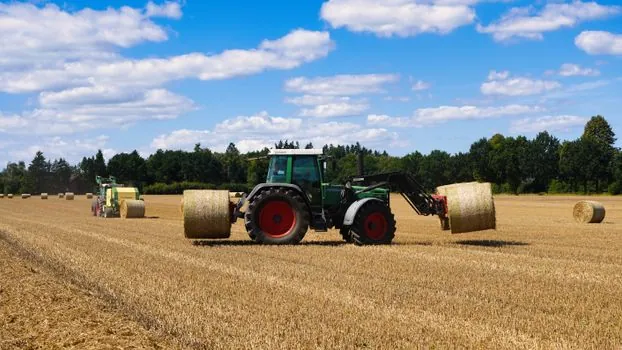
The four criteria that actually decide an ag angular contact selection are dynamic load rating C (kN), contact angle (15°/25°/40°), limiting speed (rpm), and seal/cage configuration. [S8]
For row-crop tractors in the 80-160 kW class, the input-shaft angular contact is commonly a 7208C (40 mm bore) or 7210C (50 mm bore) DB pair, dynamic rating C in the 30-50 kN range per single row, which gives adequate margin on PTO torque peaks. The matched ball bearing envelope shares the same bore series, so spare-part rationalisation is straightforward across implement lines. Where shaft deflection under shock load is a concern, roller bearing alternatives (tapered or cylindrical) carry higher radial load per millimetre of bore but lose the axial-locating function unless paired with a separate thrust member.
Material, cage, and the 52100 vs stainless decision
Chrome-steel 52100 is the workhorse material for non-corrosive ag duty and offers the best cost-to-load ratio, with a fatigue limit typically taken at 1,500-1,800 MPa under clean lubrication. Stainless steel (AISI 440C) and 304 variants are stocked by ASMI and similar suppliers for manure spreaders, fertilizer applicators, and saltwater-irrigation regions, where rust staining and post-harvest washdown attack the raceways [S9].
Cage material follows duty: pressed-steel ribbon cages suit high-speed, low-torque positions; machined brass or PEEK retainers are specified for shock-loaded or high-temperature positions such as baler knotters and rotary cutter gearboxes. Manufacturer product literature lists brass, synthetic resin, and others as standard cage options on matched pairs, with selection driven by temperature, vibration, and chemical compatibility rather than cost [S5]. For combines harvesting abrasive crops, a brass cage on a 2RS sealed bearing is the common production line.
Quality control and what an SPC-tracked production line actually buys you
Wuxi Sunye Precision Machinery supplies an angular contact bearing assembly line covering inner/outer diameter height detection, channel sorting, retainer ball loading, cleaning, bulge detection, runout detection, vibration measurement, atomisation, and SPC process monitoring, all in one in-line system [S4]. For an OEM purchasing 50,000-200,000 units per year, this level of integrated inspection translates into lot-to-lot C(r) and C(or) runout held within 2-4 µm, which is the difference between a bearing that survives 6,000 hours in tillage duty and one that fails at 2,000 hours due to vibration-induced false brinelling.
For an engineer writing a procurement spec, the practical gate is: matched pair, factory-set preload, 2RS seals, 52100 rings with optional stainless upgrade, brass or PEEK cage, ABEC-3 minimum (ABEC-5 for hydrostatic drive motors), and a manufacturer-side CPK ≥ 1.33 on bore and OD. The Made-in-China price band of US$1-20 for 1-piece MOQ confirms the indicative cost target for these configurations in the agriculture-machinery channel [S3]. Procurement should also request a sample run at full agricultural contamination exposure (dust + water spray) for 500 hours minimum, because catalogue limiting speed values assume clean, splash-lubricated conditions rarely present in field service.
Procurement benchmarks and trackable signals
For typical ag-machinery volumes (5,000-50,000 pieces per year per part number), the Made-in-China indicative price band sits at US$0.12-1.00 for small pillow-block and insert-style units and US$1.00-20.00 for precision angular contact ball bearing variants in 2026 [S2][S3]. MOQ ranges from 1 piece on catalog items to 1,000 pieces on commodity pillow-block SKUs, with payment terms across T/T, L/C, and Western Union on offer from CYSD-class suppliers [S7].
Forging sourcing strategy for the related casting and melting step is covered in specifying holding furnaces for agriculture machinery foundries, which is the upstream gate for the steel melt that ends up in these bearing races.