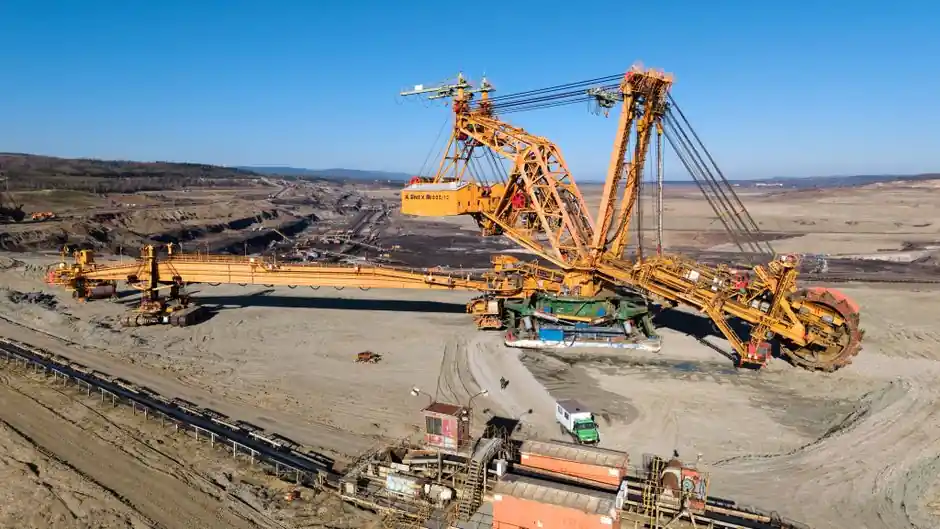
Angular contact bearings for mining equipment must be ordered as matched pairs or sets, with a 30° or 40° contact angle and at least ABEC-3 (ISO P5) running accuracy, because the combined radial-thrust loading in crushers, vibrating screens, and large gearboxes will destroy a single, open, ABEC-1 unit inside one shift [S1][S8].
For the 2026 specification cycle, the dominant variables are contact-angle class, internal clearance, sealing, and material of the rolling element and cage. Mining specifications consistently favor angular contact bearings with contact angles in the 30°–40° range, steel-on-steel or steel-on-ceramic hybrid rolling elements, and either 2RS rubber seals or ZZ metal shields to keep out dust and water spray [S1][S2][S5].
Why a Single Open Angular Contact Bearing Fails in Mining
An angular contact bearing can carry combined radial and axial load, or pure axial load, but only one direction of thrust is supported by a single unit, which is why single-row types are almost always installed in DB (face-to-face) or DF (back-to-back) pairs at the factory [S5][S8]. In a jaw crusher eccentric shaft, the load vector reverses every half rotation, so an unpaired or wrong-direction-mounted bearing loses preload within hours and brinells the raceway. A standard 7000C-series single-row angular contact ball bearing with 15° contact angle is engineered for high-speed spindles, not for the 3-15 g vibration environment of a vibrating feeder pan or SAG mill trunnion, where 40° contact angle units with higher axial load capacity are the accepted fix [S1][S5].
The base ball bearing contact geometry that all angular contact types share is described in the NPB (National Precision Bearing) datasheet family, which catalogs contact angle, cage material, and tolerance grades from ABEC-1 through ABEC-7 for the same 7000-series envelope [S1]. The Sogou Baike entry on Chinese-made double-row angular contact ball bearings confirms the operating principle: more balls in the contact zone, higher radial capacity than a deep-groove ball bearing of the same bore, and the ability to support large axial or combined loads, which is exactly the load profile of a mining drive [S8].
Contact Angle, Clearance, and Tolerance: the Three Mining Levers
For jaw crushers, cone crushers, vibrating screens, and large conveyor gearboxes, the field-tested default is a 40° contact angle (suffix B in ISO 720, AC or AJ in maker-specific codes), C3 or C4 internal clearance to accommodate thermal growth of heavy steel shafts, and ABEC-3 (ISO P5) or ABEC-5 (ISO P4) tolerance grade [S1][S5]. A 15° or 25° C-type bearing is for high-speed, low-axial applications like pumps and grinders, not for crushing equipment, where 40° B-types deliver the higher axial stiffness required to hold crusher setting under load [S1][S5].
Bore-size coverage from Chinese and US catalogs spans the small end at 17 mm (7203C, 7302C) up to 120 mm (7024C, 7320C, 7222C) in the standard 7000C series [S5]. For oversize equipment such as hydraulic mining shovels and 100–400 ton class mining dump trucks, equivalent bores climb into the 150–600 mm range and the bearing construction usually shifts from light-series 7200 to heavy-series 7300/7400 designations with cross-rolled or brass-caged rolling elements [S5]. Specification writers should treat the 7003C–7024C / 7203C–7222C / 7224C / 7302C–7320C matrix as the engineering shorthand for that bore range [S5].
Material and Sealing Choices for Abrasive, Wet, and Corrosive Sites
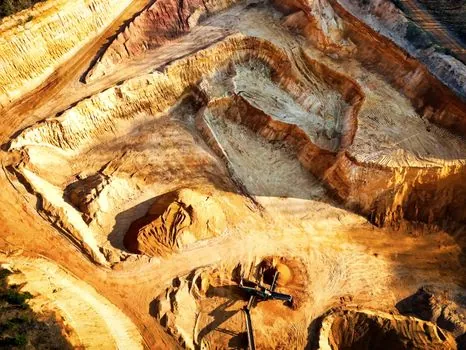
Standard through-hardened chromium steel (AISI 52100 / DIN 100Cr6) carriers run at 120°C continuous and 150°C intermittent, which covers most surface crushing plants, but slurry-exposed, acid-mine-drainage, or underground coal faces demand a step up [S2]. The ASMI Wuxi catalog groups ceramic-hybrid (Si3N4 balls on steel rings), full-ceramic ZrO2/Si3N4, and 440C or 316 stainless variants in the same product family as the standard steel series, which is useful for engineers writing one master spec to cover both dry and wet zones [S2]. Hybrid ceramic units carry about 40% lower centrifugal load, run cooler at the same speed, and survive starved lubrication better than all-steel assemblies, but they cost roughly three to five times a steel equivalent and require controlled assembly to avoid ceramic ring fracture under edge loading [S2].
For dust-heavy zones, 2RS rubber-contact seals on both faces are the minimum; ZZ metal shields are acceptable only where the bearing runs in a flooded oil bath or in a clean gearbox housing. Open bearings are not acceptable for any field-mounted mining position where airborne dust or water spray is present. Sealed units from ASMI's high-temperature and stainless-steel bearing lines (rated to 250–300°C continuous for the high-temperature line) are also the practical choice where mill lube systems are unreliable or where wash-down with high-pH process water is routine [S2].
Fit, Mounting, and Lubrication: Where the Bearing Actually Lives or Dies
Mining-duty bearings fail more often from bad mounting than from bad catalog choice. Shaft fits typically run g6 or h6 on solid steel shafts and m6 on cast iron or fabricated housings; housing bores are usually H7 or G7, with the loose fit on the stationary ring to allow thermal expansion of the shaft. Preload is applied by grinding spacers to a fixed length, not by spring-loading individual bearings; the Wuxi Sunye Precision Machinery assembly line documentation lists runout detection, vibration measurement, atomization oil coating, and SPC process monitoring as the in-process gates for single-row angular contact bearing build-up, which is the same gate set responsible suppliers run on matched pairs [S3].
Grease choice in mining plants is dominated by lithium-complex or polyurea-thickened NLGI 2 grease with ISO VG 100-220 base oil; re-grease intervals on a vibrating screen bearing typically run 200–500 operating hours, while a sealed-for-life 2RS unit on a conveyor idler will run 5,000–10,000 hours before failure if the seal holds [S1][S2]. For ball-mill pinion bearings and shovel swing gearboxes, oil-mist or flood lubrication with ISO VG 220–460 and a 60–80°C oil outlet target is the normal configuration. Field data on roller bearing and tapered-roller alternatives in the same housings is the cross-check, since a tapered roller can carry higher radial shock but lower limiting speed than a 40° angular contact ball, which is why many shovel-swing gearboxes use a TDO tapered roller on the low-speed planet pinion and an angular contact pair on the high-speed pinion shaft [S1].
Comparison: Angular Contact Ball vs. Tapered Roller vs. Cylindrical Roller in Mining
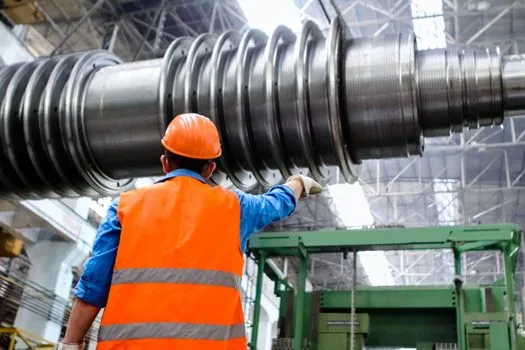
For a process engineer picking the bearing type for a specific mining position, the decision is usually speed, load direction, and shock. Angular contact ball units with a 40° contact angle carry combined radial and thrust loads at moderate speed (DN up to roughly 1.5 million for steel-ball, 2.0+ million for hybrid ceramic) and accept misalignment of only 2–10 arc-minutes. Tapered roller bearings of equivalent bore carry higher radial shock loads and slightly more thrust, but limit to lower DN and generate more heat, and they cannot match the running accuracy of an ABEC-5 angular contact ball on a precision gearbox pinion [S1][S2]. Cylindrical roller bearing types (NU, N, NJ) carry pure radial load with the highest radial capacity of the three, but offer no thrust capacity, so they only fit in mining where a separate thrust bearing, often a 511 or 522 series angular contact or spherical roller thrust unit, is mounted on the same shaft.
Cost and lead-time are the practical override: on Made-in-China.com, generic 7000C-series single-row angular contact ball bearings in 17–120 mm bores are listed from US$0.12 to US$1.00 per piece in 100- to 1,000-piece MOQs from mainland suppliers, while ceramic-hybrid and oversize heavy-series equivalents are typically 3–10 times that figure and ship on 8–12 week lead times [S4]. A pragmatic spec writes the standard steel 40° angular contact as the default, allows ceramic hybrid as an option for the wettest, highest-shock positions, and explicitly excludes open (no-shield, no-seal) units from any field-mounted position [S2][S4].
Limits, Failure Modes, and What to Verify Before Signing the PO
Angular contact bearings have hard engineering limits in mining: they tolerate only arc-minute-level misalignment, they need a controlled axial preload that the housing must provide, and they are not drop-in replacements for spherical roller bearings in pillow-block housings that have to absorb shaft deflection. Common failure modes in the field are brinelling from impact during crusher choke starts, false brinelling from vibration in idler rolls under 20 rpm, grease purge from overheating above 120°C, and seal blowout from pressure-wash operations [S1][S2]. The corrective specification items are: (a) specify matched pair or universal-matched set, not loose singles; (b) state the contact angle as 40° (B-type) for any load combining radial and axial; (c) require ABEC-3 / ISO P5 minimum, P4 for high-speed pinions; (d) require 2RS seals on all field-mounted units; and (e) require C3 or C4 clearance for shafts running above 80°C [S1][S5].
Cross-check items on the supplier datasheet, drawn from the NPB and Wuxi Sanli catalog conventions, include the ABEC grade, the actual measured bore and OD tolerances, the contact angle in degrees, the cage type and material (steel ribbon, brass machined, polyamide 66, or PEEK for high-temperature), the radial internal clearance (C2, C0, C3, C4 in microns), the limiting speed in rpm for both grease and oil, and the dynamic and static load ratings in kN or lbf [S1][S6]. Wuxi Sanli's series code "B series angular contact ball bearing" maps directly to a 40° contact angle, and their "RV" and "harmonic reducer" series map to high-precision ABEC-5/P4 and tighter grades for robot and machine-tool spindles, which are the same grades suitable for mining pinion shafts in cone crusher gearboxes [S6].
For 2026 procurement, track these three signals: (1) whether suppliers are publishing ISO P5 / P4 certificates on the standard 7000C and 7200C product page rather than only on custom RFQ responses, which would mean the mining grade is becoming a stocked item rather than a special order [S4][S6]; (2) whether ceramic-hybrid 40° angular contact units in 60–120 mm bores drop below 3× the steel price as Wuxi and Shandong capacity ramps [S2]; and (3) whether North American and Australian mining OEMs start publishing matched-pair preload specifications in their crusher service manuals, which would let engineers write a tighter, more defensible bearing spec than the generic "C3, ABEC-3" callout common in 2024–2025 service documents. For a parallel spec exercise on adjacent linear-motion hardware, see marine linear bearing selection: 2026 spec gates for salt-fog duty, which uses the same contact-geometry and sealing logic against a different contamination profile.