
Pulp and paper lines punish linear bearings with simultaneous heat, moisture, chemical exposure, and abrasive fibre contamination, so the 2026 spec map is dominated by four gates: 440C or 52100 bearing-grade steel, IP65 minimum sealing, continuous operating temperature of 80-200°C depending on dryer section position, and dynamic load capacity of 17-25 kN for the most common 25 mm shaft class on a linear bearing carrier [S3][S4].
Selection has consolidated around three families: open or closed recirculating ball bushings for general sections, crossed-roller sleeves for press and calender stacks where side-load and stiffness dominate, and polymer/PTFE-lined stainless bushings for bleach-plant and chemical-loop duty where 304/316 corrosion resistance matters more than Hertzian capacity [S2][S4]. Reference standards in scope include ISO 10285 for linear bearing test methods, ISO 10791 for machine tool linear guides, and the Chinese national standard GB/T 19673.2-2025 covering linear bearing attachment dimensions [S4].
Where Pulp and Paper Bearing Duty is Heaviest
Wet-end and fourdrinier sections expose bearings to shower water, fibre slurry splash, and pH 4-10 carryover, so closed-type ball bushings with nitrile or polyurethane end seals rated to IP65 are the baseline specification; a typical LM25UU closed bushing in this duty delivers 17.6 kN dynamic load and 29.4 kN static on a 25 mm shaft at 0.05 m/s, with the polymer cage limiting continuous temperature to about 80°C [S3][S4].
Yankee dryer doctor blade and reel spool traverse systems typically bias toward slide bushings with low-temperature black chrome shafting, which is the surface treatment NB publishes for corrosion-prone high-humidity sections and which extends 440C life by a factor of 1.5-2× versus untreated ground shafting in 90% RH service [S2].
Material, Seal, and Lubrication Selection Rules
For dry-end packaging and converting lines downstream of the paper machine, the duty relaxes and a standard linear actuator rail with 52100 carbon-steel races, rubber end seals, and NLGI #2 lithium grease operates at 80-120°C ambient with re-lube intervals of 2000-4000 hours, which is the most common configuration in box plants and sheet-stack palletisers [S4]. Where mill engineers spec polymer-composite bushings, dry-running PTFE or POM liners carry only 3-8 kN on a 25 mm shaft but tolerate pH 2-12 chemical exposure and 200°C continuous without grease, which suits doctor blade oscillators and felt-guide carriages where lube washout is routine [S2][S3]. The YTP product line, in 2026 catalogues, includes a nickel-plated LM series rated to 200°C continuous for hood-and-ventilator service near after-dryer sections, an option that closes one of the most common paper-mill failure modes: grease coking and seal extrusion on top-bearing housings [S4].
Comparison: Three Bearing Families on Paper-Mill Criteria

For a 25 mm shaft in identical mounting, the decision matrix is sharp: closed ball bushings (LM25UU / LM25UU-SS) give 17.6 kN dynamic and 0.05 m/s at 80°C continuous, IP65, lowest cost, and shortest lead time, making them the default for wet-end and most dry-end applications [S3][S4]. Crossed-roller sleeves (NB HV type / NV-SV) give 28-40 kN dynamic on a 25 mm class, IP54 with rubber seals, 150°C with high-temp grease, and roughly 5× the rigidity, so they are the right pick for calender stack backing-roll carriages, press roll side-register, and reel drum supports [S2]. Polymer/PTFE-lined stainless bushings drop to 3-8 kN dynamic but offer 200°C continuous, dry-run operation, and 304/316 corrosion resistance, which is the correct call for bleach plant, caustic, and acid-stage washdown, and for linear encoder readhead carriages in steam-filled hoods where lube contamination is unacceptable [S2][S3][S4].
Who This Bearing Map is For, and Where it Fails
Engineers specifying new calender stacks, reel drum traverses, press section side-registers, and Yankee doctor oscillators in greenfield or rebuild projects between 2026 and 2028 will benefit most from this selection logic, because the four gates (steel grade, IP class, temperature, dynamic load) align with how NB, YTP, and equivalent OEMs publish their catalogue ratings [S2][S3][S4].
The map does not cover paper-machine forming fabrics and fabric-tensioning carriages, where the failure mechanism is felt-fibre contamination under tension oscillation rather than radial load; nor does it cover roll-grinder or winder-knife carriages with sub-micron positioning tolerance, where the right pick is a linear module with crossed-roller rails and a closed-loop servo, not a stand-alone bushing. Also excluded: paper-mill water-treatment skids using FRP supports, where the bearing choice collapses to simple UHMW-PE pads rather than a metallic race. For plants already running NB HV or YTP LM-series inventories, the upgrade path is to swap polymer-cage bushings to stainless-cage variants in bleach-stage duty and to retrofit black-chrome shafts in 90% RH sections before changing the bearing series itself [S2][S4].
Limitations, Failure Modes, and Standards
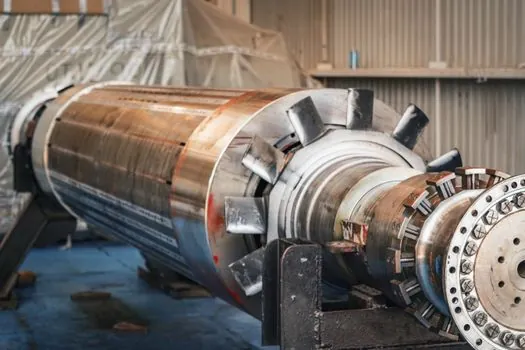
The three most common pulp-and-paper bearing failures are seal extrusion past IP65 after 6-12 months, cage coking above 120°C in carbon-steel units, and brinelling from shock load during felt-change on press sections; each one maps to a specific spec gate. Seal extrusion is solved by moving to FKM or HNBR seals and double-lip designs, cage coking by switching to a high-temperature black-chrome shaft with 200°C-rated grease or to a polymer-lined bushing, and brinelling by upsizing to a 30-40 mm shaft class or to a crossed-roller sleeve, which doubles the contact area for the same envelope [S2][S4].
The relevant reference standards are ISO 10285 (linear bearing test methods), ISO 10791 (machine tool linear guides, used for calender and wender carriages), GB/T 19673.2-2025 (Chinese national standard for linear bearing attachments, in which YTP is a drafting unit), and ISO 9001:2015 quality system certification from bearing OEMs serving the paper-mill market [S4]. For more on bearing selection logic in adjacent converting-line duty, see the Linear Bearing Selection for Packaging Lines: 2026 Spec Gates reference. Watch for two signals in 2026: YTP and equivalent Asian suppliers publishing higher-temperature nickel-plated LM25/LM30 variants for after-dryer sections, and European OEMs (NB, INA, Bosch Rexroth) releasing extended-temperature PTFE-shielded stainless bushings targeting bleach-plant and digester service [S2][S4].