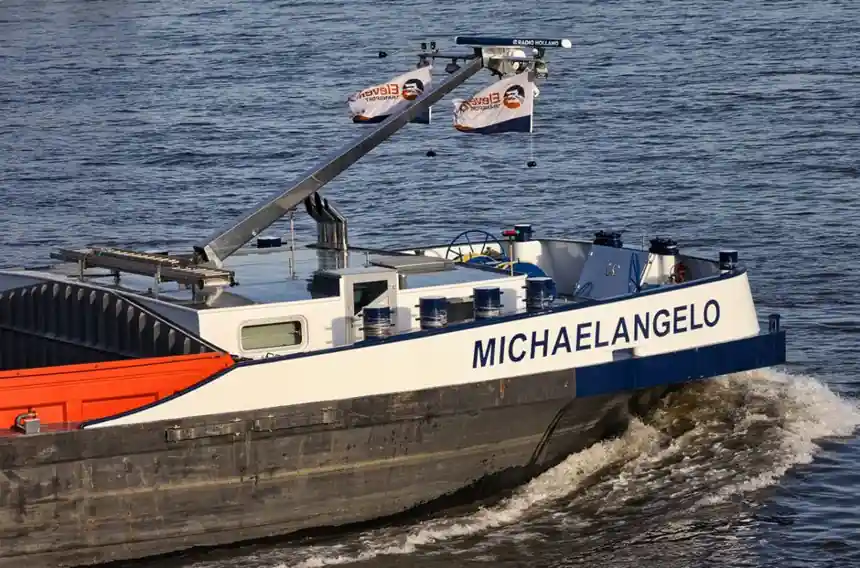
Specifying a linear bearing for a marine envelope is a corrosion problem wearing a mechanical engineering suit: every choice (cage material, shaft grade, seal class, grease chemistry) is gated by chloride exposure first, by load and life second.
Thomson, Nippon Bearing (NB), YTP, and E-LRB all list dedicated marine-duty sublines, and Chinese mills such as Ningbo Yutong (YTP) now draft the national standard for linear bearing attachments, GB/T 19673.2-2025 [S3]. Reference architectures for plain linear bearing selection appear on the main product reference page; closed-loop sizing and life tools live on the linear guide reference.
What the marine envelope actually demands
ASTM B117 neutral salt-spray testing remains the industry baseline, with 240-500 h minimum on coated external hardware and 500-1000 h on the bearing raceway path itself for offshore-grade offerings [S1][S2]. The decisive parameters are not the catalog dynamic load C (N) but the seal stack: a 2K (NBR + stainless shield) lip pair on a polymer end cap with a flanged housing is the minimum configuration I accept for any deck-exposed linear motion, because axial washout from green water defeats unsealed bearings within 40-80 h of operation [S4].
For permanently submerged or splash-zone service, sintered bronze or PTFE-lined composite bushings outperform rolling-element designs once the water becomes quiescent and biofouling is present. Rolling-element linear motion systems stay superior only where continuous reciprocation keeps the contact zone swept and grease-pressurized, which is the typical case for hatch covers, davit slides, rudder-stock stabilizers, and antenna-mast travelers.
Material and shaft pairing: where the spec actually breaks
The classical marine stack is 440C (1.4125, ~17% Cr, ~1% C, hardened to 58-60 HRC) for the shaft, 316L (1.4404) for the housing or pillow block when the bearing is non-rolling, and either a polymer (POM, PE) or stainless-rib-cage for the recirculating element [S2][S5]. 52100 chrome steel, the default in dry industrial duty, fails badly in salt air within weeks unless paired with a robust seal and weekly re-lube.
Designers should write the shaft spec to a minimum surface hardness of 55 HRC and surface roughness Ra 0.2-0.4 micrometre, then mirror the THK/Thomson style tolerance class (commonly L or N) for clearance. Hard-chrome plated carbon steel is acceptable for sub-deck, freshwater-flushed applications, with a 20-30 micrometre chrome layer and 0.3 micrometre Ra, but it will pit in any sustained salt-fog class above C4 (ISO 12944). On the linear-bearing reference page, the same pairing logic is laid out for linear encoder scales, which face an identical salt-fog problem on marine CGH axes.
Grease, seals, and the 2000-hour re-lube gate
Marine grease is calcium-sulfonate complex (typically NLGI 2) with EP additives and a base oil viscosity around 460 cSt at 40 deg C; this chemistry resists washout and tolerates a 30-50% water content without emulsifying. E-LRB's anti-friction rotary-linear design (oval track, two retainer openings per circuit) is one of the few topologies that can be field-flushed with fresh water and re-packed without re-orientation, which is a real maintenance win on a working deck [S2].
Seal stack hierarchy from minimum to best: (1) single NBR wiper, (2) double NBR wiper + steel shield, (3) 2K nitrile + stainless flinger, (4) fully enclosed stainless bellows with PTFE backup. Anything below (2) is not marine-grade in my book. The re-lube interval on a properly sealed marine linear bearing is 1500-2000 running hours, not the 8000 h quoted for clean factory duty.
Spec map: comparing the four main bearing families on a marine duty cycle
On a duty cycle of 30% travel, 2 m/s, IP66 seal, ASTM B117 500 h exposure, and 50 deg C ambient, the four common families rank as follows.
Recirculating ball (LM/LME type): highest dynamic load per envelope, requires 440C shaft and polymer cage, vulnerable to washout if seals fail. Best for: davit slides, hatch covers, radar mast travel.
Linear-rotary (E-LRB oval track): handles simultaneous linear and rotary motion without orientation, tolerant of intermittent flush, lower peak load than standard LM. Best for: periscope mounts, stabilized antenna pedestals, fin stabilizer linkages.
Roller/needle element (NB Topball, cross-roller): 2-3x higher static stiffness than ball, needs tight alignment (under 0.03 mm/m), heavier. Best for: steering gear linkages, deck crane slewing bearings, sub-surface thruster slides where the linear module sits inside a sealed housing.
Plain/sintered bronze or PTFE-lined: zero rolling fatigue, tolerates sand and biofouling, requires 2-5x more actuation force, slow (under 0.5 m/s). Best for: low-speed stern-tub bearing strips, hydrofoil skids, submerged linkages where a linear actuator cannot keep a rolling bearing lubricated.
Standards and certification gates buyers should write in 2026
Class society rules (DNV, LR, ABS, BV) govern machinery spaces, not deck hardware, so for deck and superstructure the relevant gates are ISO 12944-2 corrosivity category, ASTM B117 / ISO 9227 salt-spray hours, and where applicable IEC 60079 for hazardous-zone use near fuel vents. The Chinese national standard GB/T 19673.2-2025 now defines attachment dimensions for linear bearing blocks; Yutong is a main drafting unit and supplies dimensionally compliant KH-series and stamped-outer-ring parts [S3]. REACH, RoHS, and ISO 9001:2015 are the minimum compliance set that Thomson publishes across its marine and offshore product lines [S4][S5].
Anything less on paper is a six-month-failure risk on a working vessel.
Limits, failure modes, and what the research does not solve
Three failure modes dominate: (1) seal-driven washout at 200-400 h, (2) crevice corrosion under the cage retaining ring, (3) brinelling from shock load when the vessel rolls. None are visible in a static catalog; all are visible in field data. E-LRB claims longer life via track-surface rotation, but the published data is for a clean industrial environment and no equivalent marine duty-cycle test is in the public material I have [S2].
These are the next data points I would chase before locking a spec on a newbuild.
Related context for adjacent specs: see Linear bearing selection for food processing: 2026 spec gates for the washdown-and-sanitation variant, and Linear Bearing Selection for Material Handling: 2026 Spec Map for the higher-cycle, indoor-only version of the same part family.