Textile mills impose a specific trio of failure drivers on linear motion: airborne lint that clogs unsealed bearings, alkaline wash-down and steam that attacks unprotected steel, and high-cycle reciprocating loads on looms, stenter frames, and winding heads. Round-rail plain bushings, sealed stainless ball-bearing pillow blocks, and preloaded profile linear guides cover most of these stations, but each is wrong for at least one of the three drivers, so the choice must be driven by the worst case in the cell.
A spec map for cotton, knit, and synthetic-yarn mills has to start with the bearing format. Round-shaft linear ball bushings (LM-type) dominate the spinning and winding sections because shafting is cheap to replace and the housings are self-aligning; profile linear guides (square rail) only earn their premium on loom drop-wire and weft-feeler axes where the moment loading is non-trivial. The reference load envelope is the precision hardened-steel ball bushing at dynamic loads up to 5,000 lbf on 0.25–4 inch diameters [S3].
Round rail vs. square rail: where each format pays back
Round-rail linear bearings are typically 30–50% cheaper per metre than matched square profile guides and tolerate mild shaft misalignment, which matters in plants where frame rails were levelled to civil tolerance, not machine tolerance [S3]. Profile linear guides win on moment loading, positional repeatability, and speed: a Redi-Rail style metric assembly with hardened gothic-arch rollers and double-row sealed bearings is built specifically for high-speed, moderate-load axes, which maps directly to loom reed and let-off drives [S2]. For drafting, carding, and roving frames where the load is light, alignment is sloppy, and lint is heavy, round rail is the correct call; for creels, winders, and loom let-offs at 1,800+ ppm, square rail is the correct call.
For a deeper look at how this same round-versus-square decision maps onto conveyors, pallet transfer, and AS/RS, see this linear bearing selection for material handling spec map. The textile cell behaves like a high-lint, wash-down variant of the same problem.
Plain bushings vs. ball bushings under textile loads
Plain bushings (polymer or elastomer-lined) carry roughly 20% of the load of a comparable ball bushing, with a friction coefficient of 0.05 to 0.25, and they are the right pick on light-load, low-speed axes: drafting arms, doffer tracks, and packaging conveyors downstream of the loom [S3]. Polymer plain bushings are also lint-tolerant: with no rolling elements, there are no raceways for fibre to pack into, and many grades are self-lubricating, so the weekly wash-down does not strip the lubricant film. Their ceiling is real though: static loads up to 11,000 lbf, dynamic loads up to 2,023 lbf, and surface speeds up to 100 fpm, which excludes them from any high-speed winder or loom axis [S3].
Ball bushings with double-lip seals or stainless steel housings are required once any of those three numbers is exceeded. A preloaded stainless-steel ball-bearing slide rail, in the 50–100 N load class with 1-day ship availability from a major industrial catalogue, is a representative spec for the 80-N-class instrument slides used on tenter chain tensioning and lint-doctor carriages [S2]. For a sense of how the same sealed-versus-open decision plays out in automotive-body welding cells, this linear bearing selection for automotive production guide is a useful parallel.
Materials, seals, and the lint + wash-down problem
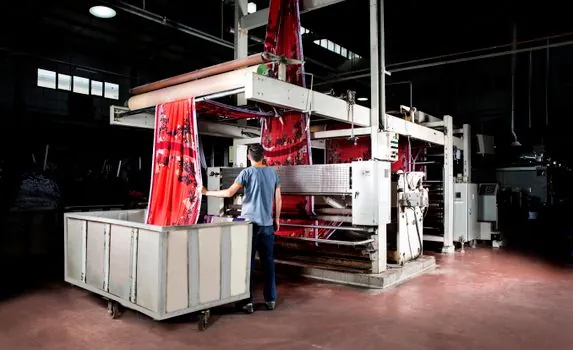
Lint and lint-laden steam are the two most under-rated failure drivers in a mill. A 440C stainless or 316 stainless ball bushing with double-lip nitrile seals is the safe default for any axis within 3 m of an open wash trough or a humidifier; nickel-plated LM bushings are a cost-effective mid-tier for dryer exit and stenter zones where the chemistry is hot, humid air, not caustic liquor. Aluminium slide rails (49–99 N load class) belong only on lightweight instrument and let-off panels where the load is trivial; the catalogue's 380–460 N stainless slide rails with five-day lead time are the more typical textile-grade pick [S2].
Compliance scope is narrower than most engineers expect. RoHS (Directive 2011/65/EU) targets six restricted substances in electrical and electronic equipment, with lead capped at 0.1% in homogeneous materials, and is enforced only on products placed on the EU market after 2006-07-01 [S5]. Plain LM bushings and pillow blocks, being primarily electromechanical hardware without integral electronics, are typically outside the directive's scope, but the moment a linear axis carries an integrated encoder or position sensor, the full RoHS 2.0 substance declarations become part of the inbound QA packet. The full linear motion components overview frames where electronics meet mechanics on a smart-textile line.
Load, speed, and lubrication reference numbers
Three spec numbers should sit on every textile-mill linear-bearing datasheet: dynamic load rating in lbf or kN, maximum surface speed in fpm or m/s, and lube interval in hours or weeks. As a baseline, sealed precision steel ball bushings deliver up to 5,000 lbf dynamic load and run on shafts from 0.25 to 4 inches; the next-tier self-aligning design with a single ball track in a conforming groove triples load handling and roughly triples life [S3]. For LM-format bushings on shafting, an LM6 to LM60 series bushing will cover most textile-frame rails, with the linear bearing format and cage options entry covering the LM, LME, and KH stamped-outer-ring families that dominate mill retrofits.
Plain-bushing ceilings for the same duty are 11,000 lbf static, 2,023 lbf dynamic, 100 fpm, which makes them the correct pick for drafting and doffing but the wrong pick for anything that moves faster than a walking pace. Where stroke length is long and the duty cycle is continuous, switch from a single LM shaft to a linear guide rail on a profile carriage, and budget for the higher unit cost against the lower lubrication and replacement-labour burden.
Standards, sourcing, and 2026 lead-time signals
The dominant spec standard for LM-format bearings in new Chinese-built mill machinery is GB/T 19673.2-2025, covering linear bearing attachments, with active industry participation in the next code-and-classification revision [S1]. For OEM sourcing, Ningbo Yutong (YTP brand) is one of the drafting units behind that national standard and supplies LM, flanged, nickel-plated, and steel-cage LM series plus KH stamped-outer-ring units under ISO 9001:2015 quality systems [S1]. Lead-time signal worth tracking: industrial-catalogue linear slide rails still publish four-, five-, and seven-day ship options across the 49 N to 18,500 N load class, which means standard sizes remain in stockable supply through 2026-08 [S2].
For a broader decision matrix that covers sensors, actuators, and other auxiliary hardware on the same line, the linear actuator selection guide and the linear encoder format reference round out the spec map. The two trackable signals to watch into the next quarter are GB/T 19673 code-and-classification revision drafts and any RoHS scope clarification covering sensor-integrated smart-bearing assemblies, both of which will reset the inbound QA checklist before the next major mill retrofit cycle.