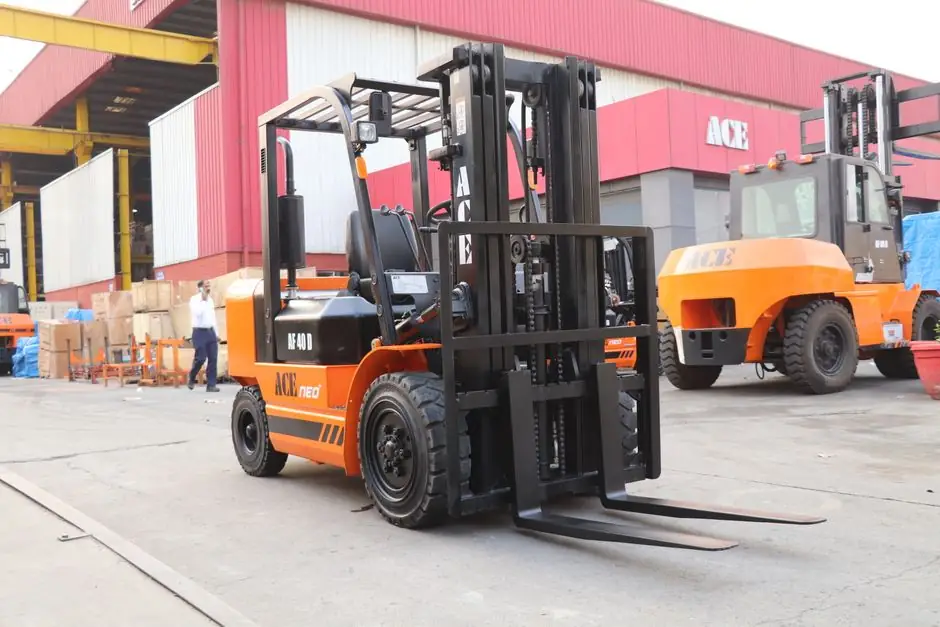
ANSI/ITSDF B56.1-2020, Safety Standard for Low Lift and High Lift Trucks, defines the safety requirements relating to the elements of design, operation, and maintenance of powered industrial trucks [S2]. It is co-published as ASME B56.1-2020 and applies to both low-lift and high-lift trucks used in general industry, warehousing, and maritime cargo handling [S6].
OSHA's general-industry Powered Industrial Trucks rule, 29 CFR 1910.178, has incorporated the 2009 edition of B56.1 by reference for over a decade and remained the enforceable baseline through the Federal Register proposed rule of 2022-02-16, document 2022-01155 (87 FR 8755) [S2]. The 2020 standard is therefore widely cited in spec sheets, training programs, and forklift safety reference material, even where enforcement still tracks the older edition.
Scope, structure, and the B56 series split
ANSI/ITSDF B56.1 covers low-lift and high-lift powered industrial trucks, while the companion standard ANSI/ITSDF B56.6 governs rough-terrain forklift trucks and was revised in May 2016 and again in 2021 (ANSI/ITSDF B56.6-2021) [S5][S7]. The 2005 edition front matter describes a 73-page document split into Part I (for the manufacturer) and Part II (for the user), with section 1 Scope, section 2 Purpose, and section 3 Interpretation as the first three clauses [S3].
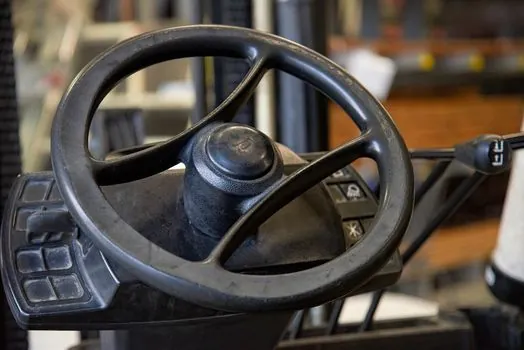
By 2009 the Part II user requirements had grown to include general safety practices (clause 4), with sub-clauses 4.2.1 through 4.2.10 covering modifications, nameplates, capacity markings, fork extensions, battery weight range compliance, and steering handwheel/knob geometry [S4]. Sub-clause 4.2.8 specifically requires that the steering knob sit within the periphery of the steering handwheel, or that the steering mechanism be of a type that prevents road-reaction-induced handwheel spin [S4].
Design rules a process engineer should know
B56.1 sections 6.2 and 6.3 (per the 2009 user section 4.2.7 cross-reference) require that modifications involving rebuild or repair of the basic unit be made in accordance with the manufacturer's established criteria and procedures, and that the original manufacturer, or its successor, give prior written approval for any change affecting capacity, stability, or safe operation [S4]. If the OEM is out of business and no successor exists, the user may modify the truck only by engaging an engineer expert in industrial-truck safety, maintaining a permanent record of the design test(s), updating the capacity plate and manuals, and affixing a permanent label stating the modification, date, and organization [S4].
For electric trucks, B56.1 requires that batteries comply with the minimum/maximum battery weight range shown on the truck nameplate, a value that directly affects counterweight, stability, and rated capacity [S4]. Sub-clause 4.2.3 mandates that trucks equipped with front-end attachments, including fork extensions, be marked to identify the attachment, show the combined truck-and-attachment weight, and show the capacity of the truck with the attachment at maximum elevation with the load laterally centered [S4].
Operators and fleet managers who need an overview of how the truck class (Class I-VII) interacts with these design rules can start with the forklift safety reference page, which links class definitions to the underlying B56 design requirements.
Operator, training, and maintenance obligations under Part II
Part II treats supervision as an essential element of safe operation (sub-clause 4.1.3) and places the user, not the manufacturer, on the hook for operator qualification, daily inspection, and maintenance practice [S4]. The OSHA 1910.178 powered industrial truck operator training standard (referenced in CPL 02-01-028, 2000-11-30) is the US enforcement hook for that training obligation [S1].
Where steering must be accomplished with one hand using a steering handwheel, B56.1 requires a steering knob or equivalent, configured to minimize the hazard from a spinning handwheel due to road-reaction feedback; the steering knob must sit within the periphery of the steering handwheel [S4]. Two-handed power-steered configurations permit a knob, but only if it can be engaged by the operator's hand from the top and remains within the handwheel periphery [S4].
Stopping distance on a descending grade will be greater than on-level operation, and the standard requires that methods be provided to allow for this difference (sub-clause 4.3.1) [S4]. This single line is the source of most fleet speed-limit-on-ramps policies and dovetails with the general machine safety hierarchy built into OSHA Subpart O and the broader consensus standards.
OSHA cross-reference and the 2022 proposed rule
OSHA's 29 CFR 1910.178 incorporates the B56.1 design and construction requirements by reference at paragraphs (a)(2) and (a)(3), and uses paragraph (a)(7) to define an "approved truck" for hazardous locations [S1]. The maritime equivalents sit at 29 CFR 1917.43, 1917.44, 1917.50, and 29 CFR 1918.65 (mechanically-powered vehicles used aboard vessels) [S1].
On 2022-02-16 OSHA published a proposed rule, 2022-01155 (87 FR 8755), to update the standards incorporated by reference in 1910.178, with the explicit intent of replacing the 50-year-old consensus baseline with newer editions including ANSI/ITSDF B56.1-2020 for low-lift and high-lift trucks, and ANSI/ITSDF B56.6-2021 for rough-terrain forklift trucks, with the new cross-references applying 30 days after publication of the final rule [S2][S7]. Until the final rule lands, the 2009 B56.1 edition remains the OSHA-enforceable baseline in most jurisdictions, a gap that compliance officers and procurement specs have to manage on paper.
Comparison: B56.1 vs B56.6 vs OSHA 1910.178
The three documents sit in a layered relationship. B56.1 (low/high-lift) and B56.6 (rough-terrain) are consensus standards from ITSDF with parallel structure; OSHA 1910.178 is the federal regulation that adopts B56.1 by reference and adds operator-training, fuel-handling, dockboard, and carbon-monoxide rules (paragraphs (f)(1), (f)(2), (i)(1), and (j)) that the consensus standard does not cover on its own [S1]. B56.6 was revised in May 2016 and again as the 2021 edition, and OSHA's 2022 proposed rule would align 1910.178 with both newer consensus documents in one step [S5][S7]. Engineers specifying a rough-terrain forklift for a construction site should consult the rough-terrain forklift reference, because the applicable design and operator rules branch at the truck-class boundary defined in the B56 series.
Inspection, modification labels, and field enforcement signals
Field inspections against B56.1-2020 typically focus on four artefacts: the capacity plate and decal legibility (4.2.4), the modification label if the truck has been altered (4.2.2), the fork-extension marking if fitted (4.2.3 and 4.2.6), and the battery-weight-range compliance for electric units (4.2.10) [S4]. A truck that has been modified without manufacturer or successor written approval is, by definition, out of compliance, regardless of how well the field modification was actually engineered, because the standard ties compliance to documented approval, not to engineering judgement alone [S4].
For shop-floor and warehouse operators, the fire safety and machine safety encyclopedia pages give the surrounding context (battery-charging ventilation, LP-gas storage under 1910.178(f)(2), carbon-monoxide limits under 1910.178(i)(1)) that the design standard assumes but does not duplicate. A safety certification review should confirm that the inspector is referencing the edition of B56.1 the site has actually adopted in its written programs, not a newer one that OSHA has not yet incorporated.
Trackable signals and what to watch next
The two signals worth tracking are: (1) OSHA's final rule on 29 CFR 1910.178, which would adopt ANSI/ITSDF B56.1-2020 and ANSI/ITSDF B56.6-2021 by reference, with the new cross-references taking effect 30 days after publication of the final rule [S2][S7]; and (2) any ITSDF interpretation published on itsdf.org, which is the formal channel for technical interpretations of B56 clauses and would override informal training-provider commentary [S3]. Fleet audits completed before the final rule should record the B56.1 edition year they used, so the gap between the 2009 OSHA baseline and the 2020 consensus standard is documented in the site's compliance file rather than discovered during the next OSHA visit.
For comparison with the operator-side training rules that sit on top of these design requirements, see the spec breakdown of AGV safety laser scanner field range, FOV, and protective zone sizing, and for the OSHA-vs-consensus enforcement pattern in a different equipment category, see the ATEX vs IECEx for process equipment certification comparison.