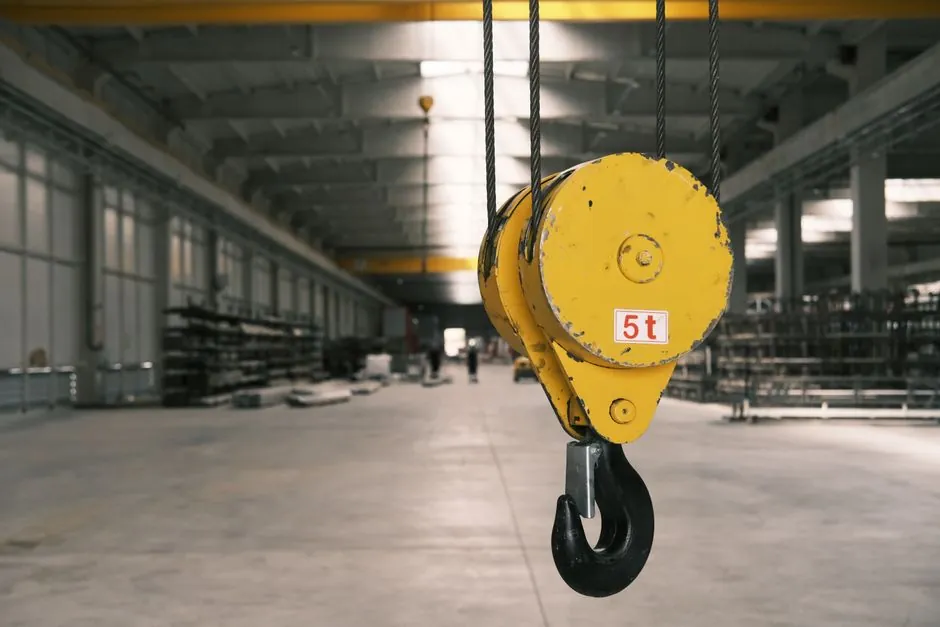
A 40 t truck crane's 80,000 lb nameplate is a minimum-radius figure, achieved only when the hook sits within about 3 m of the slewing axis, with outriggers fully deployed and counterweight rigged [S2].
Extend the boom, raise the angle, and that same machine may only lift 4-6 t at full reach: Sany's SPC400E drops to 4,900 lb at 76.1 ft radius on a 108.3 ft boom [S2], while a 50 t Tadano GR500XL-1 with comparable geometry shows 4,750 lb at 85 ft on the longest boom [S4].
What "40 ton" actually means on a load chart
Maximum rated capacity is the heaviest load the crane can pick at its minimum working radius, with outriggers set, on firm level ground, and with all counterweight in place [S2]. For a truck-mounted crane in the 40 t class, that minimum radius is usually 3 m, the Sany SPC400E names 3 m as the minimum rated working radius and 3.35 m as the tail slewing radius of the swing table [S2].
The same data sheet lists a maximum lifting moment of 1,372 kN.m on the base boom and 819.3 kN.m on the full-extend boom, with 383 kN.m on full-extend boom plus jib [S2]. The 40 t figure is not a single number the crane can hit at any reach: it is the peak of a curve that falls off as the radius grows.
How radius, boom length, and angle shape the curve
Load capacity at any configuration is governed by the load moment equation: capacity (t) equals rated moment (kN.m) divided by working radius (m), minus the weight of hook block, sling, and rigging [S7]. The Sany SPC400E encodes that relationship directly: 1,372 kN.m / 3 m ≈ 45.7 t gross, derated to the published 40 t once the 2.8 t fixed counterweight, 7.8 t full counterweight option, and rigging deductions are applied [S2].
Operators read the same physics off a range diagram. The Tadano GR500XL-1 chart maps seven boom lengths from 33.5 ft (10.2 m) to 108.3 ft (33.0 m) against radii from 10 ft to 100 ft, with capacity at 10 ft on the shortest boom at 100,000 lb, falling to 20,700 lb at 40 ft on the same boom, and to 4,750 lb at 85 ft on the 108.3 ft boom [S4]. The 40 t class sits one step below this 50 t example, and follows the same shape, scaled down.
Side-by-side: Sany SPC400E vs Elliott 40142 vs Tadano GR500XL-1
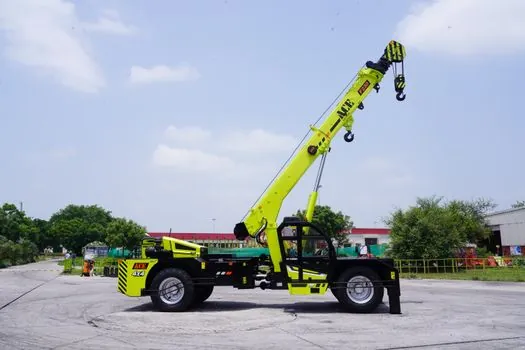
Three concrete examples frame the class. Sany's SPC400E is a true 40 t / 80,000 lb machine on a 4-section U-shape boom, 10.8 m base to 35 m full-extend, 43 m with the 8 m jib at 0°, 15°, or 30° offset, with a load moment limiter accurate to within 3% [S2]. Elliott's 40142 BoomTruck carries the same 80,000 lb (36,287 kg) nameplate, but on a 142 ft (43.3 m) boom with 207 ft (63.1 m) max tip height, reflecting the longer-reach geometry typical of North American boom trucks [S1]. The Tadano GR500XL-1, used here as a 50 t reference, runs a 33.5-108.3 ft boom and hits 100,000 lb only at 10 ft radius with all counterweight rigged [S4].
Decision criteria lined up against these units: (1) minimum-radius peak capacity, where the Sany and Elliott tie at 40 t / 80,000 lb and the Tadano leads at 50 t / 100,000 lb; (2) max boom length, where the Elliott 40142 leads at 142 ft, the Sany trails at 35 m (115 ft) plus 8 m jib, and the Tadano tops out at 108.3 ft; (3) tip height, where the Elliott reaches 207 ft, the Sany 43 m (141 ft) plus jib, and the Tadano around 110 ft with jib; (4) load moment limiter accuracy, where the Sany publishes ±3% with CAN-bus digital control [S2] and the chart-based Elliott and Tadano rely on conventional LMI with comparable industry accuracy.
Where a 40 t truck crane fits, and where it does not
40 t truck cranes are the workhorses of urban commercial construction, mechanical equipment setting on industrial sites, HVAC and generator placement, and structural steel erection up to about 4-5 stories [S3]. They pair with a dump truck class chassis and are a common sight on road-going sites because they self-deploy from the carrier.
For context, the Custom Truck One Source capacity ladder shows service-truck cranes topping out at 10,000-14,000 lb (4.5-6.3 t) in the heavy-duty bracket, and Load King engineering pushes that envelope, but the 6,000-8,000 lb (2.7-3.6 t) figure remains typical for standard applications [S5]. A 40 t machine is roughly 8-10x that capacity, and is a different machine class entirely: a telescoping boom on an outriggered commercial truck chassis, not a mechanics-truck pedestal. For construction machinery and equipment fleets, 40 t units fill the gap between 30 t city cranes and 50-60 t rough-terrain units that need to travel on dedicated lowbeds.
Reading a load chart without getting hurt
Three failure modes dominate real-world 40 t incidents. First, misreading radius: operators commonly use the boom-tip radius rather than the load-center radius, and the difference of 1-2 m can derate a 10 t pick to 7 t [S7]. Second, ignoring boom deflection: the published chart is for the unloaded, level machine, and a loaded boom sags 0.5-1.5° on long reaches, which adds 1-3 m of effective radius at full extension [S4]. Third, partial counterweight or partial outrigger extension, which roughly halves capacity on the affected side but does not register on the LMI until the operator manually inputs the configuration [S2].
The hard rule from the SPC400E documentation: rated capacities must only be used with all outriggers extended to 6.8 m longitudinal x 6.6 m transversal, counterweight at either 2.8 t fixed or 7.8 t full configuration, and the LMI set to match [S2]. On any 40 t truck-mounted crane, those four switches (outriggers, counterweight, LMI mode, hook-block weight) are the difference between a valid lift and a tip-over.
Selection checklist for a 40 t class truck crane
Match the machine to the job by checking five numbers from the OEM chart. (1) Peak capacity at minimum radius must equal or exceed the heaviest single pick, including rigging weight, with at least 15% margin. (2) Capacity at the maximum required radius must clear the heaviest pick at that reach, again with 15% margin. (3) Boom length must reach the highest hook height plus 2 m of clear headroom for shock load. (4) Outrigger spread must fit the slab or pad dimensions, the SPC400E asks for 6.8 x 6.6 m, similar 40 t units ask 6.5-7.5 m [S2]. (5) Counterweight configuration must match the heaviest chart entries, not the lightest, and the LMI must be programmed for that configuration [S2].
For lifting vehicle buyers comparing 40 t boom trucks against rough-terrain cranes, the deciding factor is usually roadability: a 40 t truck crane drives to the site under its own power at highway speed, while a rough-terrain unit of equal capacity needs a lowboy and a permit. For buyers comparing 40 t truck cranes against 50 t units, the deciding factor is usually the heaviest single pick plus a 25% capacity buffer; the 2-Fall vs 4-Fall reeving on a tower crane trolley trade-off is similar, where adding falls doubles line pull but halves line speed and raises trolley weight.
Trackable signals for the next planning window: Sany's 2020-dated SPC400E brochure still describes the 40 t/35 m/43 m envelope as current, no superseding variant has been published [S2]; Elliott continues to list the 40142, 40105, 45127, 45142, and 50105 in the 40-50 t BoomTruck catalog, all on 105-142 ft booms [S1]; and the Terex T 340 / T 340-1 XL, Grove RT 540E, Grove TMS 540E, Manitex 40124SHL, and Lift Systems 4040SC remain the commonly stocked 40 t rough-terrain and boom-truck models in North American rental fleets [S3].