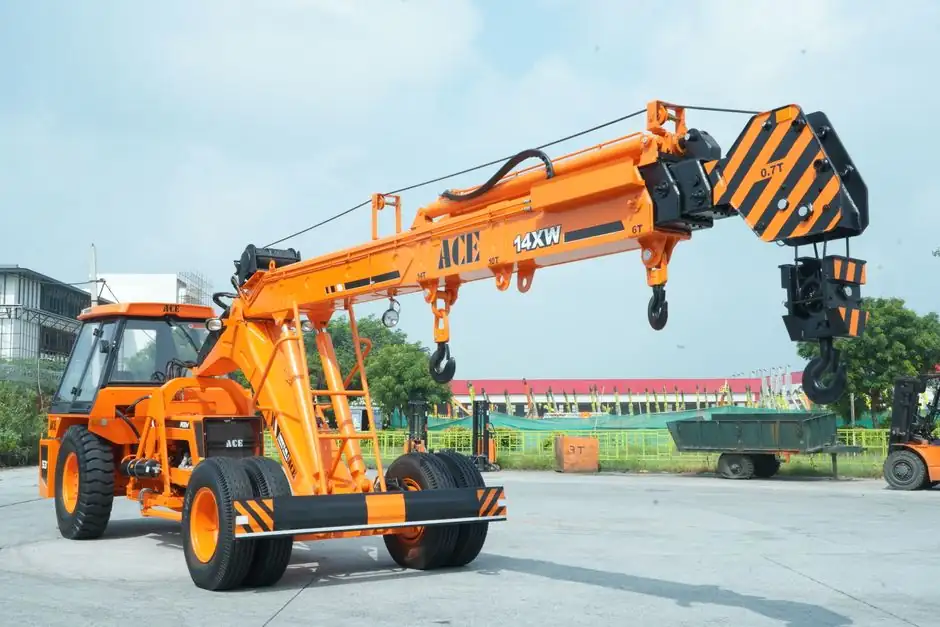
A 40-ton truck crane class, straddling the boom-truck and hydraulic-truck-crane line, generally travels on a 3- or 4-axle carrier at a gross vehicle weight rating between 58,000 lb and 80,000 lb, with weight distribution controlled by the Federal Bridge Formula once GVWR exceeds 73,271 lb [S1][S3].
Maxim's fleet places a 40 US-ton boom truck at the upper end of the boom-truck category, while a true 40-ton hydraulic truck crane sits at the lower end of the hydraulic truck crane class that extends to roughly 140 US tons in the same fleet [S2]. For U.S. roadability, the answer depends as much on the carrier axle count and per-axle limits as it does on crane nameplate capacity.
Federal Axle and Gross Weight Limits for Crane Carriers
The Federal Highway Administration compilation of state truck size and weight laws lists the canonical U.S. Interstate limits: 20,000 lb on a single axle and 34,000 lb on a tandem axle group, with state-level exemptions for construction equipment and highway machinery recognised in 28 states [S1]. A 40-ton truck crane that crosses state lines on the Interstate must respect these caps, and any state-issued overweight permit sits on top of the federal ceiling, not in place of it [S1].
For a single-unit truck silhouette, which is the regulatory class that covers straight trucks and cranes regardless of axle count, the inner-bridge calculation only kicks in once gross weight exceeds 73,271 lb and the wheelbase hits 47 ft (4 axles), 41 ft (5 axles), or 33 ft (6 axles) [S3]. A typical 40-ton truck crane on a 3-axle carrier at 60,000 lb GVWR falls below that trigger, while a 4-axle version at 78,000 lb GVWR does not, which is why fleet planners care about axle count and not just tonnage [S3].
Boom Truck vs. Hydraulic Truck Crane at 40 Tons
Maxim's published comparison puts the 40 US-ton mark inside the boom-truck envelope: boom trucks are cranes on a standard commercial truck chassis, usually retaining a flatbed for hauling, while hydraulic truck cranes ride on a purpose-built carrier with a telescopic boom and step up to roughly 140 US tons in the same fleet [S2]. Under ASME B30.5, both are truck-mounted cranes, which is why a 40-ton boom truck and a 40-ton hydraulic truck crane are governed by the same mobile-crane standard even though their road weights differ [S2].
The capacity table shows the practical split: boom trucks top out at 40 US tons in Maxim's fleet with quick setup and highway-speed driving, while hydraulic truck cranes trade that mobility for heavier lifts at 40-140 US tons and longer-duration site work [S2]. This is why a 40-ton truck crane spec sheet has to declare both nameplate lift capacity and carrier GVWR: the lift rating is at the boom tip, the road weight is on the steer, drive, and tag or pusher axles underneath.
Carrier Axle Count, GVWR Classes, and Crane Mounting
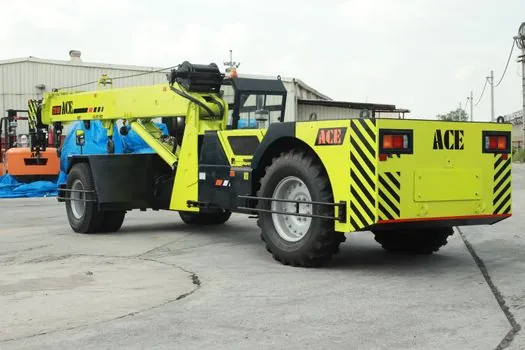
Venturo's vehicle weight class table maps the underlying truck chassis options: Class 7 covers 26,001-33,000 lb GVWR and Class 8 covers 33,001 lb GVWR and up, with crane bodies such as the HT40 (rated up to 45,600 ft-lb) and HT50 (50,000 ft-lb) typically mounted on Class 7 or Class 8 chassis [S5]. A 40-ton boom truck in this class usually sits on a Class 8 tandem-axle chassis at 58,000-66,000 lb GVWR before any auxiliary pusher axle is added, while a 4-axle configuration pushes into the 73,000-80,000 lb band that triggers the federal bridge check [S1][S3][S5].
Load King notes that the larger hydraulic truck cranes generally use multiple driving axles and run on the highway at reasonable highway speeds, sitting in the same roadable mobile-crane family as all-terrain cranes but trading some off-road agility for lower acquisition cost [S6]. For fleet planners matching a truck-mounted crane to a route, the practical question is how many axles the local bridge formula allows at the laden weight, not what the crane can lift in the yard.
GVWR-to-Crane-Capacity Matching for Fleet Buyers
For a 40-ton nameplate lift, the realistic carrier envelope is a tandem-drive chassis at 58,000-66,000 lb GVWR, or a tridem-drive chassis at 73,000-80,000 lb GVWR, with a pusher or tag axle added when state bridge limits force redistribution [S1][S5]. The truckers' forum discussion of a 40-ton removable gooseneck (RGN) on a two-axle truck illustrates the same constraint from the haulage side: the trailer-and-load weight, not the truck's nameplate, decides whether a permit is needed [S4].
Buyers should run three checks before specifying: (1) confirm the laden GVWR against the 20,000 lb single-axle and 34,000 lb tandem-axle federal limits, (2) compute the inner-bridge figure if GVWR exceeds 73,271 lb and the wheelbase hits the listed thresholds, and (3) confirm whether the operating state lists construction equipment under its non-Interstate exemption table, which 28 states do [S1][S3]. Buyers who skip the bridge check on a 4-axle 40-ton rig routinely discover that they are legal on external bridge weight but illegal on internal bridge weight, which is the most common enforcement failure on crane moves [S3].
Boom Truck vs. Hydraulic Truck Crane: 40-Ton Decision Matrix
For the same 40 US-ton lift nameplate, the boom-truck option scores higher on mobility and setup time but lower on duty cycle and long-duration reach, while the hydraulic truck crane option scores higher on lift envelope and on-road stability through additional axles but lower on day-to-day mobility [S2]. A single-axle or tandem boom truck typically delivers a faster ROI on multi-site sign, utility, and HVAC work, whereas the multi-axle hydraulic truck crane is the right call for industrial and construction machinery and equipment sites that demand full-shift lifting at a fixed radius [S2][S6].
For a 40-ton lift on a tight urban route, a boom truck on a Class 8 tandem chassis is the most common specification; for a 40-ton lift on a long-radius industrial job, the same 40-ton nameplate usually steps up to a hydraulic truck crane on a 3- or 4-axle carrier that pushes the road weight toward 78,000 lb and brings the federal bridge formula into scope [S2][S3]. Venturo's recommended truck GVWR table is the simplest way to back-calculate which crane body fits a given chassis class before the carrier is ordered [S5].
Common Compliance Failures on 40-Ton Crane Moves
The two recurring failure modes are (1) overweight on a single axle when the crane's centre of gravity shifts aft with a long boom, and (2) bridge-formula violation on a 4-axle carrier where the inner-bridge measurement slips below the legal table even though the gross is under 80,000 lb [S1][S3]. Sims Crane's legal-load reference flags a third risk: external-bridge compliance does not guarantee internal-bridge compliance, and a crane that passes on overall weight can still fail on consecutive-axle spacing [S3].
Operators who run a 40-ton boom truck across multiple states should also check whether the destination state recognises the construction-equipment exemption that 28 states extend to non-Interstate highways, since the exemption only sometimes carries over to Interstate segments and is permit-driven elsewhere [S1]. For heavy hauls paired with crane work, a dump truck complement running under the same exemption regime can share permitting paperwork, but the crane carrier still has to clear its own bridge check independently [S1][S3].
This topic is covered further in Aerial Work Platform Safety: Standards, Tilt Limits, and Operator Pre-Shift Rules.