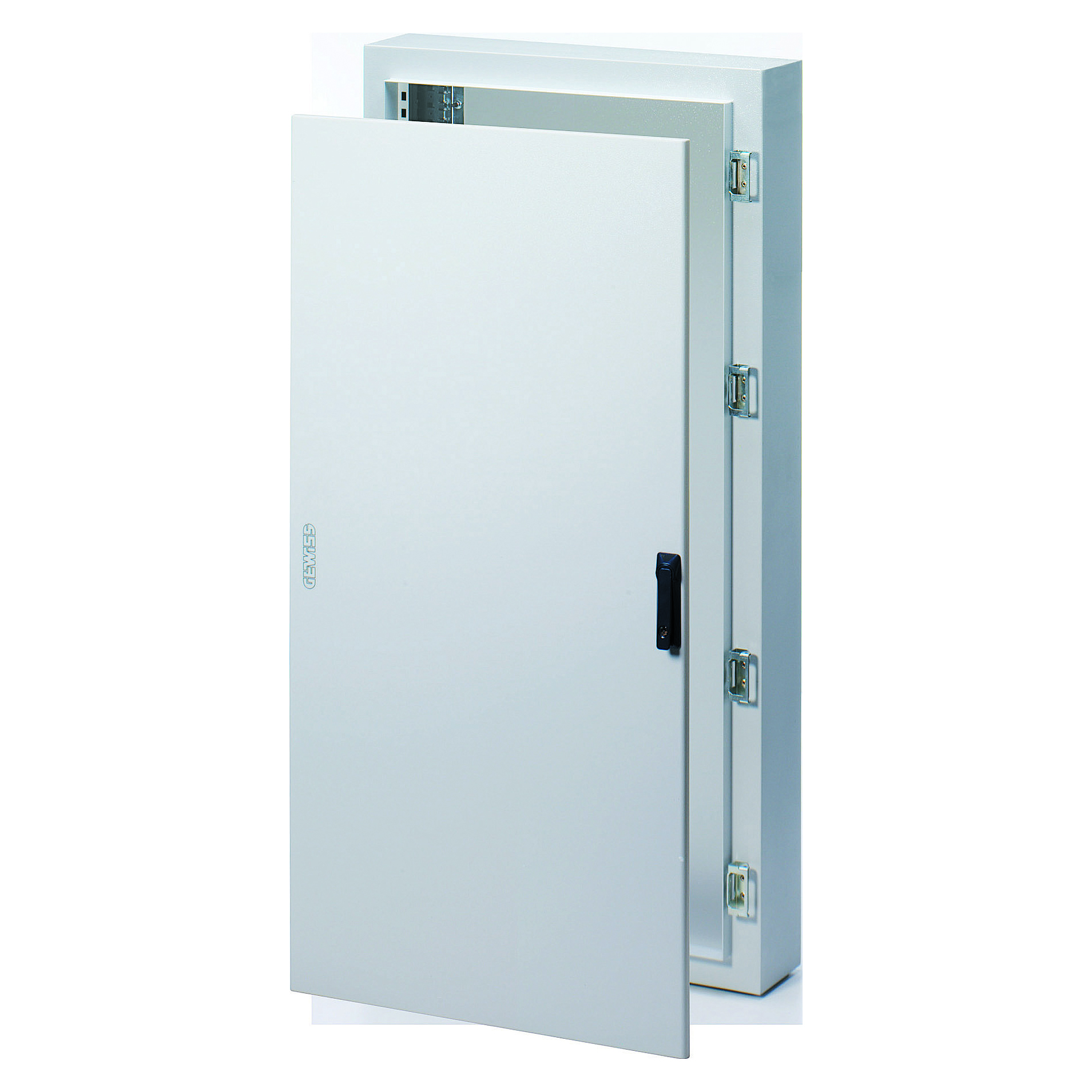
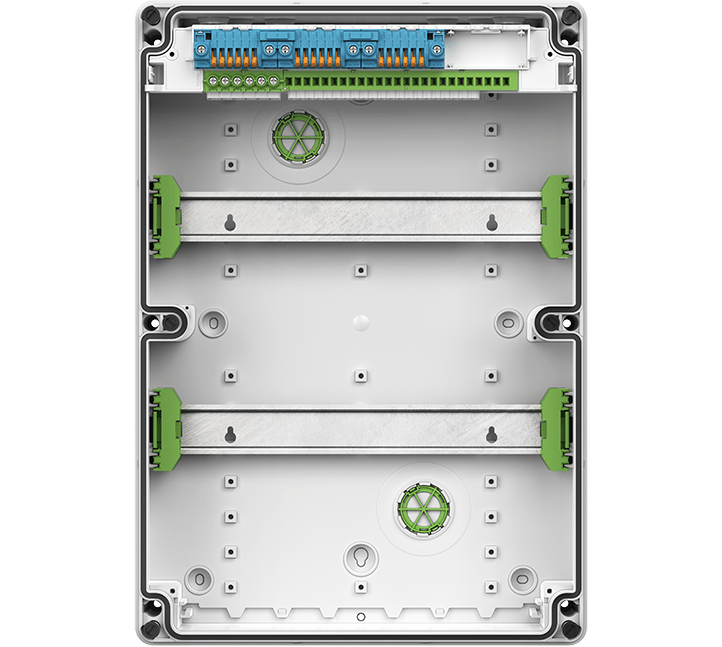
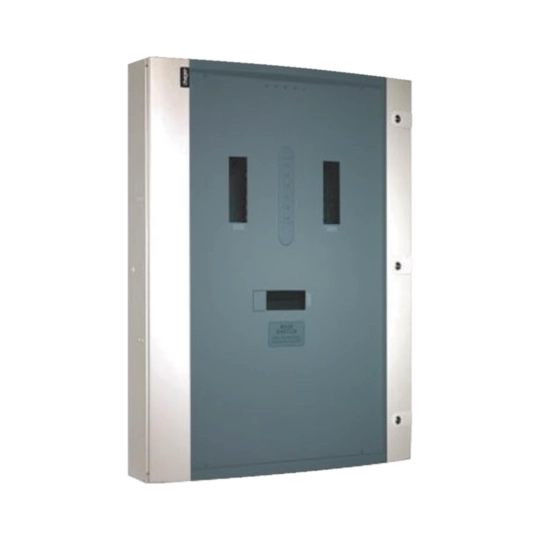
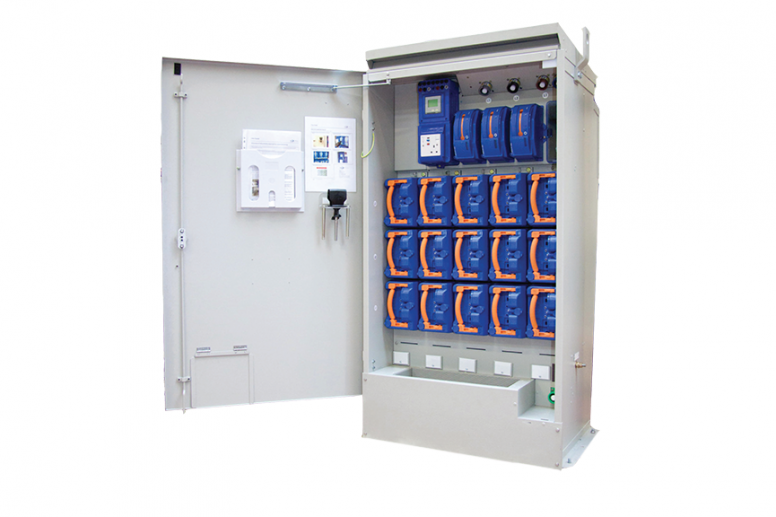
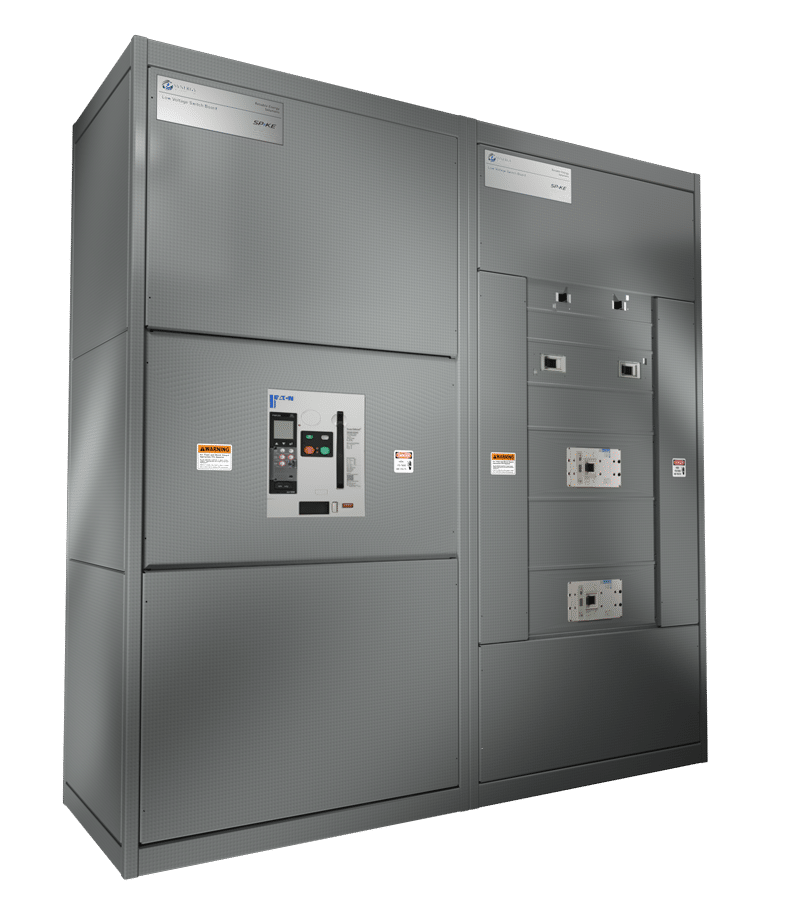
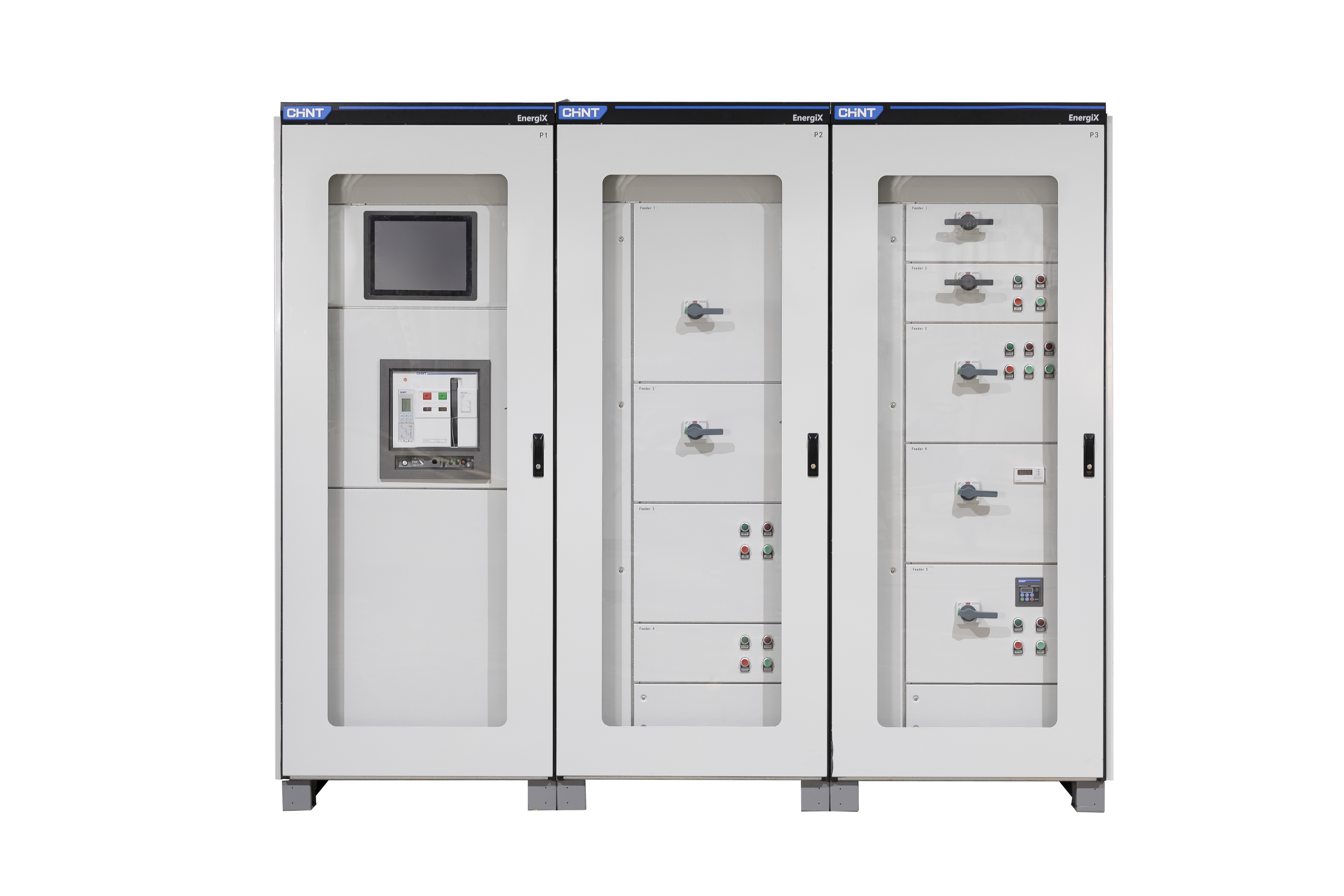
A power distribution box is a low-voltage assembly that receives one incoming electrical supply and divides it into multiple protected outgoing circuits. It houses the busbars, protective devices (circuit breakers, fuses, residual-current devices), and terminals inside a metal or insulating enclosure. The same device is called a distribution board, panelboard, breaker panel, or consumer unit depending on region and rating, but the engineering reference standard in most of the world is the IEC 61439 series.
This guide treats the distribution box as the assembly between the main switchboard and the final load circuits: the wall- or floor-mounted unit verified to IEC 61439-3 for ordinary persons, or IEC 61439-2 where skilled operators maintain it. Every rating discussed here, from rated current to short-circuit withstand to ingress protection, traces to a published IEC or UL standard.
Photo: Evry Electrical, CC BY 4.0, via Wikimedia Commons
This guide is written for procurement engineers and design engineers specifying low-voltage distribution. It covers 6 chapters: what a distribution box is, enclosure types and mounting, internal architecture and forms of separation, materials and ingress protection, the spec-sheet ratings that govern selection, and a step-by-step selection sequence, plus 7 selection FAQs. All parameters reference the IEC 61439 series, IEC 62208, IEC 60529, IEC 62262, and the North American UL 67 and UL 891 standards.
Chapter 1 / 06
What is a Power Distribution Box
A power distribution box is a low-voltage electrical assembly whose job is to take a single incoming supply, split it into several outgoing circuits, and protect each circuit against overload and short circuit. It is one node in the power chain that runs from the utility transformer, through the main switchboard, to the distribution boxes, and finally to the loads. Functionally it combines three things inside one enclosure: a set of busbars that carry the common supply, a row of protective devices (miniature circuit breakers, moulded-case circuit breakers, fuses, or residual-current devices) that branch off the busbars, and the terminals where outgoing cables connect.
The naming is regional and a frequent source of confusion. In residential use the same device is a consumer unit or fuse box. In commercial and industrial use it is a distribution board, distribution box, or DB box. In North America the wall-mounted version is a panelboard or load centre, and the larger floor-standing version is a switchboard. These are not just dialect differences: each name maps to a specific governing standard and current ceiling, which is why the rest of this guide anchors every claim to a standard designation rather than a marketing label.
The reference standard for low-voltage assemblies is the IEC 61439 series, which since 2009 has replaced the older IEC 60439. The series is split into parts that share one general rules document. IEC 61439-1 holds the common requirements and the design verification framework. IEC 61439-2 covers power switchgear and controlgear assemblies, the larger boards meant for skilled operators. IEC 61439-3 covers distribution boards intended to be operated by ordinary, unskilled persons, and it adds protective requirements suited to that audience. The empty enclosure on its own is verified separately to IEC 62208. Any low-voltage switchgear enclosure distributing or controlling electricity below 1000 V AC or 1500 V DC is expected to conform to IEC 61439-1 as the backbone.
A central concept introduced by IEC 61439 is design verification. Instead of physically destroying every variant of a board, the standard allows three routes to prove a design is safe: testing, calculation or measurement, and satisfying design rules. This lets modular and custom-built systems reach the same safety and performance level as a fully type-tested assembly, provided the panel builder stays inside the documented limits of the system family. This matters for procurement because a board badged as IEC 61439 verified is only valid when assembled within those rules; substituting an unverified breaker or busbar can void the verification.
The market scale is large because distribution boxes sit at every branch of every building and plant. A single commercial building may contain dozens, from a 1200 A main panelboard in the basement to small final distribution boards of 63 A to 125 A on each floor. Industrial sites add motor control and process power boards. This ubiquity is why a handful of system families from Schneider Electric, Eaton, Siemens, ABB, and Legrand dominate, each sold as a verified kit rather than as loose components.
Four engineering ratings ultimately decide whether a given distribution box is fit for a job: the rated current (how much it can carry continuously), the short-circuit withstand (how it survives a fault), the degree of protection (IP and IK, how it resists the environment and impact), and the form of separation (how safe it is to work on live). The chapters that follow decode each of these in turn.
Chapter 2 / 06
Enclosure Types and Mounting
Distribution boxes are first classified by where and how they mount, because mounting drives both the available space for circuits and the environmental rating you can reach. The four broad families are surface-mounted wall boxes, flush (recessed) wall boxes, floor-standing cabinets, and pole- or pillar-mounted street boxes. A second classification, used in North American practice, separates the lighter-duty panelboard or load centre from the heavier free-standing switchboard. The table below summarises the main families and their typical current ceilings.
Type
Governing Standard
Typical Rated Current
Typical Use
Consumer unit / final DB
IEC 61439-3
up to 125 A
Homes, small shops, final circuits
Wall distribution board
IEC 61439-3
up to 250 A
Floor sub-boards, commercial branches
Floor distribution board
IEC 61439-1 / -2
250 to 630 A
Building mains, plant sub-distribution
Panelboard (NA)
UL 67 / NEMA PB1
up to 1200 A
Branch and feeder distribution
Switchboard (NA)
UL 891
1200 to 6000 A
Service entrance, main distribution
Surface-mounted wall boxes bolt onto a finished wall with conduit or cable entering through removable glands or knockouts. They are the fastest to install and service and reach high ingress ratings (up to IP65 or IP66) because the enclosure is sealed all around. The trade-off is that the box projects into the room, so they suit plant rooms, basements, and outdoor walls more than finished interiors.
Flush or recessed boxes sit inside a wall cavity with only the door visible, giving a clean architectural finish for offices, hotels, and apartments. Because the back and sides are buried, achieving a high IP rating is harder and heat dissipation is poorer, so flush boards are usually limited to lower currents and indoor, dry locations.
Floor-standing cabinets rest on the floor or a plinth and provide the volume needed for higher currents, larger moulded-case breakers, and forms of separation. They are the natural home for 400 A to 630 A distribution and for assemblies needing rear or side cable access. Pillar and pole boxes are weatherproof outdoor enclosures for street lighting, traffic, and feeder pillars, typically rated IP54 to IP65 and IK10 against vandalism.
A separate and important distinction is the construction material of the enclosure, which is addressed in Chapter 4, and the form of internal separation, addressed in Chapter 3. The empty enclosure, regardless of family, is verified to IEC 62208, which sets the mechanical, thermal, and protection requirements for the box before any breakers are fitted. When a manufacturer states a board is IEC 61439-3 verified, IEC 62208 compliance of the housing is an implied prerequisite.
For the North American market the split is cleaner. A load centre is the residential panel; a panelboard is the commercial dead-front assembly listed to UL 67 and capped at 1200 A; a switchboard is the floor-standing service or main distribution assembly listed to UL 891, with main buses commonly specified from 1200 A up to 6000 A depending on the service size. Choosing the wrong listing for the application is a common compliance error, because UL 67 and UL 891 differ in construction, spacing, and short-circuit test requirements.
Chapter 3 / 06
Internal Architecture and Forms of Separation
Inside the enclosure, a distribution box is organised around a horizontal or vertical busbar system that distributes the incoming supply, a set of functional units (each comprising a protective device and its outgoing connection), and the terminals where field cables land. How these three elements are physically partitioned from one another is described by the form of internal separation, defined in IEC 61439-2. The purpose is operator safety: a higher form lets a technician work on one circuit or terminal while adjacent live parts and the busbar remain barriered off.
The standard defines four forms, each split into sub-types a and b. The table below summarises what each separates.
Form
Busbar separated from functional units
Functional units separated from each other
Terminals separated
Form 1
No
No
No
Form 2a / 2b
Yes
No
2b only
Form 3a / 3b
Yes
Yes
3b only
Form 4a / 4b
Yes
Yes
Yes
Form 1 has no internal separation at all: busbar, breakers, and terminals share one space. It is the cheapest and is acceptable only where the entire assembly is de-energised and isolated before any work, such as small final boards. Form 2 places a barrier between the busbar system and the functional units, so a fault or contact at a breaker is less likely to reach the main bus. In sub-type 2b the outgoing terminals are also separated from the busbar.
Form 3 goes further by separating the functional units from each other as well as from the busbar, so one circuit can be worked on without exposure to adjacent circuits. Form 4 additionally separates each set of outgoing terminals, giving the highest level of isolation: busbars, every functional unit, and every terminal group are individually compartmented. Within Forms 3 and 4, the a and b sub-types differ in whether the terminals sit in the same compartment as the associated functional unit (a) or in their own separated space (b).
Choosing a form is an engineering and economic decision, and IEC 61439-2 explicitly makes it subject to agreement between manufacturer and user. Continuous-process plants, hospitals, and data centres that require live maintenance without a full shutdown typically specify Form 3b or Form 4b. Simpler installations that can tolerate isolating the whole board for service often accept Form 1 or Form 2. Higher forms add barriers, glands, and assembly labour, raising cost and slightly reducing ventilation, which can lower the rated diversity factor discussed in Chapter 5.
Beyond separation, the internal architecture also defines the protective-device topology. A distribution box usually has one incoming device (a main switch-disconnector or main breaker) feeding the busbar, then a row of outgoing branch devices. Distribution-grade boards favour plug-on or comb busbar systems for fast, repeatable assembly of miniature circuit breakers, while higher-current boards use bolted copper busbars sized for the rated current and the short-circuit forces. The earth and neutral bars are separate terminal blocks, and in TN-S or TT systems the residual-current devices sit on the outgoing side.
Chapter 4 / 06
Materials, IP and IK Protection
The enclosure material and its degree of protection determine where a distribution box can be installed and how long it survives. Two material families dominate: sheet steel and insulating (thermoplastic or polyester) housings. Each is matched to an environment by its ingress protection (IP) and impact protection (IK) ratings, both defined by IEC standards that are independent of one another.
Sheet-steel enclosures, usually powder-coated mild steel or stainless steel, provide the highest mechanical strength and are standard for floor-standing and industrial boards. They tolerate high internal arc energy and heavy busbars, and stainless variants resist corrosion in food, marine, and chemical environments. Insulating enclosures made of glass-reinforced polyester or self-extinguishing thermoplastic are double-insulated by design (no exposed metal to earth), corrosion-proof, and lighter, which suits outdoor, wet, and corrosive locations and consumer-unit applications. The trade-off is lower mechanical and thermal headroom, so they are more common at lower currents.
IP ratings (IEC 60529) use two digits. The first digit (0 to 6) rates protection against solid objects and dust, where 6 is fully dust-tight. The second digit (0 to 9) rates protection against water, from 0 (none) to 9 for high-pressure, high-temperature jets. IEC 61439-3 sets a minimum of IP2XC inside a closed distribution board so that a finger or tool cannot reach live parts. The table below maps common environments to typical IP and IK targets.
Environment
Typical IP
Typical IK
Preferred Material
Indoor electrical room
IP31 to IP41
IK07
Sheet steel
Indoor dusty / industrial
IP54
IK08
Sheet steel
Outdoor sheltered
IP55 to IP65
IK08 to IK10
Steel or polyester
Outdoor / washdown
IP65 to IP66
IK10
Polyester or stainless
Public / vandal-prone
IP54 to IP65
IK10
Steel or polyester
Corrosive / marine
IP66
IK08 to IK10
316 stainless or polyester
IK ratings (IEC 62262) grade resistance to external mechanical impact on a scale from IK00 to IK10. IK08 corresponds to a 5 joule impact, suitable for accessible switchgear in corridors and public buildings, while IK10 corresponds to a 20 joule impact and is specified for vandal-prone street furniture and exposed outdoor boxes. Because IP and IK are independent, a board can be dust- and water-tight (IP66) yet only moderately impact-resistant (IK07), so both codes must be checked against the installation, not assumed from one another.
For the North American market the equivalent system is the UL/NEMA enclosure Type rating, which bundles ingress and some corrosion criteria into a single type number. NEMA Type 1 is general-purpose indoor, Type 3R is rainproof outdoor, Type 4 is watertight, Type 4X adds corrosion resistance (typically stainless or non-metallic), and Type 12 is dust-tight for industrial indoor use. The NEMA types are not exact IP equivalents, but as a rough guide Type 12 approximates IP52, Type 4 approximates IP66, and Type 3R approximates IP24. A cross-region project should confirm both the IP and the NEMA Type rather than relying on the approximate conversion.
Chapter 5 / 06
Key Specification Parameters
Reading the assembly nameplate and datasheet correctly is the core skill of distribution-box selection. IEC 61439 requires the nameplate to state the rated voltages, the assembly and circuit current ratings, the rated diversity factor, the short-circuit ratings, the IP and IK degrees, and the specific standard parts applied. The parameters below are the ones that actually drive a selection decision.
Rated operational voltage (Ue) and rated insulation voltage (Ui) define the system the board can be connected to, typically 400 V or 415 V for three-phase LV distribution, with Ui set higher to cover transient and insulation margin. The rated frequency is normally 50 Hz or 60 Hz. These must match the installation; a board rated 415 V Ue cannot be used on a 690 V system.
Rated current of the assembly (InA) is the total current the complete board can carry, while the rated current of a circuit (InC) is the limit of an individual outgoing way. IEC 61439-3 caps the rated current of a DBO assembly at 250 A and any single outgoing circuit at 125 A. The two ratings are linked through the rated diversity factor, explained next, because the busbar heating depends on simultaneous loading, not on the simple sum of breaker ratings.
Rated diversity factor (RDF) is the per-unit fraction of rated current to which the outgoing circuits can be loaded continuously and simultaneously, accounting for the mutual heating of devices packed in one box. The standard provides default assigned values that fall as the circuit count rises: roughly 0.9 for 2 to 3 circuits, 0.8 for 4 to 5, 0.7 for 6 to 9, and 0.6 for 10 or more. When a manufacturer publishes an RDF below 1.0, the sum of the actual circuit loads must not exceed the assembly rating multiplied by the RDF, otherwise the temperature-rise verification (limited to 70 K at terminals and 105 K on bare copper busbars) is no longer valid.
Short-circuit ratings prove the board survives a fault. Three values appear, and confusing them is a serious sizing error:
Icw (rated short-time withstand current): the RMS current the busbars carry for a defined time, usually 1 s or 3 s, without damage. It proves thermal stability and is the headline rating for boards with their own bus.
Ipk (rated peak withstand current): the instantaneous peak in the first half cycle that the bus must survive against electromagnetic forces. It proves dynamic stability and relates to Icw through a factor that depends on the power factor of the fault.
Icc (rated conditional short-circuit current): the highest prospective fault the assembly can take when protected by a specified upstream device (a named breaker or fuse) that clears the fault before damage occurs. Distribution boards without their own Icw are rated by Icc tied to that device.
A board fed from a transformer with a high prospective fault level must have an Icw or Icc at least equal to that level, or rely on a current-limiting upstream device. Specifying an assembly with too low a short-circuit rating is one of the most dangerous selection mistakes, because the failure mode is internal arcing rather than a benign trip.
Degree of protection (IP and IK), covered in Chapter 4, and the form of separation, covered in Chapter 3, complete the nameplate. Finally, the pollution degree (commonly 3 for industrial environments) and the installation method (free-standing, wall, or flush) round out the verification basis. Together these define not a single number but a profile that must match the installation as a whole.
Chapter 6 / 06
Selection Decision Factors
To turn the preceding chapters into a specific board, follow the decision sequence below. Most selection errors come not from one wrong number but from deciding details before fixing the fundamentals such as voltage, fault level, and form of separation. These eight steps also work as a fixed RFQ template.
System and voltage: Confirm the supply (three-phase 400/415 V or single-phase 230 V), the earthing system (TN-S, TN-C-S, TT, or IT), and the rated frequency. These fix Ue, Ui, and whether residual-current protection is mandatory.
Rated current and circuit schedule: List every outgoing circuit, its load, and its protective-device rating. Sum the loads, apply the manufacturer rated diversity factor, and confirm the result is within the assembly InA. Remember the IEC 61439-3 caps for a DBO: 250 A on the assembly and 125 A on any single outgoing circuit.
Short-circuit rating: Obtain the prospective fault level at the board (from the transformer and upstream impedance). Choose an assembly whose Icw or Icc, with its named upstream device, meets or exceeds that fault level. Verify Ipk as well for high-fault installations.
Form of separation: Decide whether live maintenance is required. Specify Form 1 or 2 where the board can be fully isolated for service, Form 3b or 4b where individual circuits must be worked on while the rest stays live.
Enclosure type and degree of protection: Pick surface, flush, or floor-standing mounting, the material (steel, stainless, or polyester), and the IP and IK targets for the environment using the Chapter 4 table. For North American projects confirm the NEMA Type and the UL 67 or UL 891 listing.
Verification basis and standard: Confirm the nameplate cites the correct IEC 61439 part (-2 or -3) and that the assembly is built within the system family verification rules. Substituting unverified components voids the design verification.
Devices and accessories: Specify the main incoming device, the branch breakers or fuses, residual-current devices, surge protection, metering, and any monitoring or communication. Confirm the protective devices are coordinated (selectivity and back-up protection) with upstream and downstream gear.
Total cost of ownership: Weigh purchase price against installation labour, spares availability, and the cost of downtime. A higher form of separation or a system kit from a major family costs more upfront but reduces maintenance shutdowns and keeps the verification valid through future modifications.
One dimension that is easy to overlook is serviceability and spare-parts continuity: whether the chosen system family will still be supplied and supported a decade later, whether plug-on breakers and busbar kits remain available, and whether a local panel builder is certified to extend the board without breaking its IEC 61439 verification. Schneider Electric (Prisma and PrismaSeT, Acti9, Isobar), Eaton (xEnergy), Siemens (SIVACON S8, ALPHA), ABB, Legrand (XL3), and Hensel all sell verified system kits with documented extension rules, which makes them dependable choices for installations expected to evolve over a long service life.
FAQ
What is the difference between a power distribution box, a panelboard, and a switchboard?
All three receive one incoming supply and split it into protected outgoing circuits, but they differ in current rating and governing standard. A power distribution box or distribution board (consumer unit in residential use) verified to IEC 61439-3 is capped at 250 A on the assembly; larger floor distribution boards of roughly 250 A to 630 A are verified instead to IEC 61439-1 and -2. A panelboard is the North American equivalent, listed to UL 67 and capped at 1200 A. A switchboard is a larger free-standing floor assembly listed to UL 891 (or IEC 61439-2), with main buses commonly from 1200 A to 6000 A. As a rule of thumb: a distribution box is the wall- or floor-mounted assembly between the main switchboard and the final load circuits.
What do IEC 61439-1, -2, and -3 each cover?
IEC 61439-1 is the general rules part: it defines the common requirements, design verification methods, and terminology that every other part references, but it is never applied on its own. IEC 61439-2 covers power switchgear and controlgear assemblies (PSC-ASSEMBLIES), the larger boards operated by skilled persons. IEC 61439-3 covers distribution boards (DBO) intended to be operated by ordinary, unskilled persons, so it adds extra protection requirements such as a minimum IP2XC against finger contact behind a closed door, a 250 A limit on the rated current of the assembly, and a 125 A limit on each individual outgoing circuit. The empty enclosure itself is verified to IEC 62208.
What is Icw and how is it different from Icc and Ipk?
These three short-circuit ratings describe how an assembly survives a fault. Icw, the rated short-time withstand current, is the RMS current the busbars can carry for a defined time, usually 1 second or 3 seconds, without damage, and it proves thermal stability. Ipk, the rated peak withstand current, is the instantaneous peak in the first half cycle that the busbars must survive against electromagnetic forces, and it proves dynamic stability. Icc, the rated conditional short-circuit current, is the highest prospective fault the assembly can take when protected by a specified upstream device (a breaker or fuse) that clears the fault before the assembly is damaged. A distribution box without its own Icw is always rated by Icc tied to a named protective device.
How do I read an IP rating and an IK rating on a distribution box?
IP (Ingress Protection, IEC 60529) is two digits: the first (0 to 6) rates protection against solids and dust, the second (0 to 9) rates protection against water. IP65 means dust-tight plus protected against low-pressure water jets; IP66 adds powerful jets; IP54 means dust-protected plus splash. IK (IEC 62262) is a separate two-digit code for mechanical impact: IK08 equals a 5 joule impact, IK10 equals 20 joules. Indoor electrical rooms typically use IP31 to IP54, outdoor or washdown locations need IP65 or IP66, and vandal-prone public areas specify IK10. IP and IK are independent: a box can be IP66 but only IK07, so both must be checked.
What is the rated diversity factor (RDF) and why does it matter for sizing?
The rated diversity factor, defined in IEC 61439-1, is the per-unit fraction of rated current to which the outgoing circuits of an assembly can be loaded continuously and simultaneously, accounting for mutual heating inside the enclosure. It exists because not every circuit runs at full load at the same time. The standard gives default assigned values that fall as the number of outgoing circuits rises: about 0.9 for 2 to 3 circuits, 0.8 for 4 to 5, 0.7 for 6 to 9, and 0.6 for 10 or more. If a manufacturer publishes an RDF below 1.0, you must multiply by it when checking that the sum of your circuit loads does not exceed the assembly rating, or the enclosure will overheat even though each breaker individually looks fine.
What are the forms of internal separation, and which form do I need?
Form of separation (IEC 61439-2) describes how far the busbars, functional units, and terminals are physically partitioned inside the assembly to protect a person working on one circuit from live parts elsewhere. Form 1 has no internal separation. Form 2 separates the busbars from the functional units. Form 3 also separates the functional units from each other. Form 4 additionally separates each set of outgoing terminals. Each form splits into a and b sub-types depending on whether terminals are in the same compartment as the busbar. Process plants and data centres that need live maintenance usually specify Form 3b or Form 4b; simple boards where the whole assembly is isolated for service can use Form 1 or 2.
Which manufacturers make IEC 61439 verified distribution box systems?
For low-voltage distribution boards and switchboards verified to IEC 61439, the established system families include Schneider Electric Prisma and PrismaSeT (with Acti9 and Isobar final distribution boards), Eaton xEnergy (Basic and Light switchboards to 1600 A, Main switchgear to 7100 A), Siemens SIVACON S8 and ALPHA distribution boards, ABB and Hensel insulated enclosures, and Legrand XL3. These are sold as type-tested or design-verified system kits, meaning the panel builder assembles within documented limits to keep the IEC 61439 verification valid. In North America, panelboards to UL 67 and switchboards to UL 891 come from Eaton, Schneider Square D, Siemens, and ABB. Always confirm the assembly nameplate carries the specific 61439 part, the Icw or Icc, and the IP and IK ratings.
Power Distribution Box Manufacturers
Source-backed product routes. Open a company dossier for procurement scope and cited evidence.