
AR500 is a through-hardened, quenched-and-tempered abrasion-resistant plate rated at 470–540 BHN, roughly 70–100 BHN harder than the 360–440 BHN band typical of AR400, which is why it is sold for severe sliding wear in mining, aggregate, and target applications [S2].
The number in the grade is the nominal Brinell hardness: AR500 aims at 500 BHN, AR400 at 400 BHN, and the higher number is bought with thinner forming margins, tighter bend radii, and more demanding welding procedure [S2][S3].
Hardness and what it actually buys you on the job
AR500 from one mill is documented at 475–535 BHN with 240 ksi (1655 MPa) tensile and 215 ksi (1480 MPa) yield, paired with only 8% elongation in 2 in., a chemistry that uses ~0.31% C, 1.00% Cr, and 0.65% Mo to push hardness into a tempered-martensite matrix [S2].
AR500 is advertised as outlasting mild steel by 5–8x in sliding or frictional wear service, and in a documented 50 mm AR500 crusher-hopper liner, service life extended by 300% versus S355JR structural steel, taking replacement intervals from quarterly to annual [S2][S3].
Through-thickness hardness uniformity is held inside ±20 HBW on Q&T product per ASTM A514 and EN 10025-6 protocols, so the surface number is also the number at mid-thickness, which matters for hopper and bucket liners that wear from both faces over time [S3].
The bending penalty, stated in real numbers
On a 1,000-ton press brake, AR400 can be bent to a 3x-thickness inside radius and AR500 only to 5x-thickness, per the Suzhou fabricator's published forming window, which is the cleanest apples-to-apples comparison available and tracks the metallurgical expectation that higher hardness shrinks the minimum bend radius [S3].
Bending on that press is offered up to 20 mm plate thickness; beyond that, the fabricator's published route is plasma or flame cutting plus welded assembly, because cold forming risks through-thickness cracking in the harder grade [S3].
Field data on AR400 with a 0.42 carbon-equivalent value shows it can be welded down to 5°C ambient without preheat, while AR500's higher CEV typically forces preheat plus low-hydrogen E7018/E11018 electrodes, which adds shop time and consumable cost on every joint [S3].
Where AR500 earns its hardness, and where it doesn't
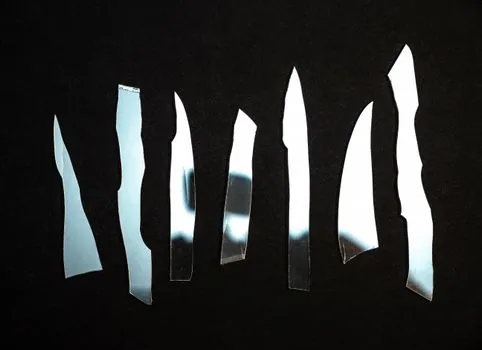
AR500 is the right call for ballistic targets, primary crusher liners, slurry pipe wear zones, and any application where the abrasive media sits at Mohs 5–7 and the liner cannot be replaced often; the 100 BHN step over AR400 is what closes the gap between quarterly and annual change-outs [S2][S3].
AR400 is the better call for truck bed liners, dump body floors, conveyor skirts, and most chute work under 20 mm, because the part still has to be formed and the wear gain from 400 to 500 BHN rarely justifies the 5x bend radius and the welding preheat that come with it [S3].
For screw conveyor troughs and formed skirts, the same logic that pushes fabricators toward AR400 over stainless also applies here, as detailed in Screw Conveyor Materials: Carbon Steel vs Stainless vs AR400, and the trough gauge decision in 10 Ga vs 3/16 in Screw Conveyor Trough Plate: Pick by Duty is a downstream consequence of that same wear-vs-formability trade-off.
Comparison: AR400 vs AR450 vs AR500 on the criteria that decide a spec
Brinell hardness bands run roughly 360–440 BHN for AR400, 430–490 BHN for AR450, and 470–540 BHN for AR500, with each step adding ~10–20% wear life in sliding abrasion but cutting elongation and tightening the minimum bend radius [S2][S3].
Minimum cold-bend radius on a 1,000-ton brake is 3x thickness for AR400 versus 5x for AR500, and the forming thickness ceiling is the same 20 mm for both grades at that facility, so the loss is in radius, not in maximum gauge [S3].
Carbon equivalent typically lands below 0.45% for AR400 (field-weldable at 5°C without preheat at CEV 0.42), versus CEV near or above 0.50% for AR450/AR500, which forces preheat, low-hydrogen E7018/E11018 consumables, and stricter interpass control per AWS D1.1 and ISO 3834-2 WPS practice [S3].
On dimensional tolerance, both grades ship to EN 10029 Class N flatness (≤4 mm/m under 50 mm thick) and are Brinell-tested per ISO 6506-1 with ultrasonic per EN 10160, so flatness and inspection are not differentiators, hardness and formability are [S3].
Cutting, welding, and shop realities on AR500
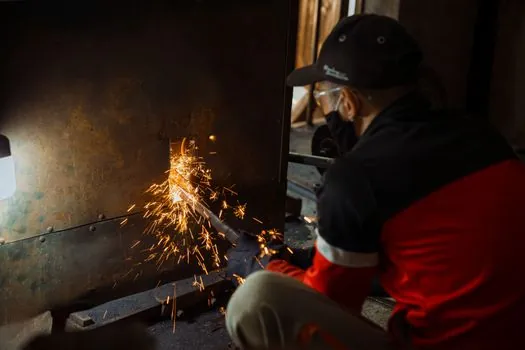
Plasma cutting is offered to 80 mm with ±1.5 mm kerf tolerance per ISO 9013, and flame cutting is used for thicker AR500 with HAZ control to limit hardness loss in the cut edge, which matters because an over-tempered HAZ reverts locally toward AR400 behaviour [S3].
Welding AR500 uses low-hydrogen E7018 or E11018 electrodes with documented preheat, a carbon-equivalent check per the IIW formula (CEV = C + Mn/6 + (Cr+Mo+V)/5 + (Ni+Cu)/15), and a WPS qualified under ISO 3834-2, so shop qualification time is non-trivial and should be priced into the AR500 vs AR400 decision [S3].
For general fabrication background on why steel plate grade selection cascades into every downstream process, the through-hardened Q&T route is the reason AR500 behaves more like a tool steel than like structural plate, and the same carbon-driven trade-off shows up in Wear-Resistant Steel Plate (AR400/AR500) mill data.
Standards, sourcing, and what to verify on the MTC
Acceptable AR500 should be certified to ASTM A6 for dimensional/tolerance delivery and ASTM E10 (the Brinell test method), with through-thickness hardness documented on the MTC, because AR500 sold without a heat-traceable hardness map is indistinguishable from a Q&T 400 that was over-tempered at the mill [S2].
European deliveries typically reference EN 10025-6 for the Q&T condition and EN 10029 Class N for flatness, with ISO 6506-1 for Brinell and EN 10160 for ultrasonic, and Chinese equivalents (NM400/NM450/NM500) are produced to GB/T 24186 with the same hardness bands [S3].
Welding procedure qualification should sit on AWS D1.1 for structural work or ISO 3834-2 for CE-marked fabrications, and the WPS has to record preheat, interpass, and the E7018/E11018 electrode class; without those on paper, an AR500 weld is a hydrogen-cracking risk, not a wear asset [S3].
One more field tip from a hands-on AR400 user: a 15/16" carbide annular cutter and even a cheap 1/8" HSS bit went through 3/16" AR400 with cutting fluid and no drama, which suggests that, below ~6 mm, shop-tool selection is a smaller barrier than published warnings imply, and the same is likely true for AR500 in the same gauge range [S1].
Next node: pull the MTC's through-thickness Brinell map (3 readings: surface, quarter, mid) for any AR500 heat above 20 mm before releasing it to the floor, and confirm the WPS preheat row matches the plate's actual CEV, not the catalogue number. Track signals: EN 10025-6 flatness class on the MTC, and the AWS D1.1 WPS preheat/interpass table matched to CEV.
For component-level specifications, see orifice plate flowmeter, and plate heat exchanger.