Para-aramid is set to hold a 68% share of the North America aramid fiber market in 2026, the largest single fiber-type segment by volume and value, according to a Persistence Market Research forecast published in August 2026 [S3]. That share is anchored by National Institute of Justice (NIJ) ballistic-rated body armor, U.S. Department of Defense procurement, and automotive lightweighting programs, with the U.S. alone accounting for an estimated 83% of regional demand [S3].
Aramid, shortened from "aromatic polyamide," is a class of heat-resistant synthetic fiber defined by amide linkages (-CO-NH-) joining aromatic rings; under the U.S. Federal Trade Commission definition adopted in 1974, at least 85% of those linkages must be attached to two aromatic rings, otherwise the material is classified as nylon [S1]. The two commercial sub-classes, para-aramid (1,4-substitution, brands Kevlar and Twaron) and meta-aramid (1,3-substitution, brand Nomex), behave very differently in service, and that difference drives how procurement teams split their spend.
Para-Aramid vs. Meta-Aramid: Structural Origin of Performance
Para-aramid chains adopt a rigid-rod conformation because the amide groups sit directly across the benzene ring (1,4), allowing millions of repeat units to align along the fiber axis and form extensive inter-chain hydrogen bonds and π-π stacking between aromatic rings [S5]. The result is a fiber with a melting point above 500°C (932°F), a value noted in the standard reference chemistry for the material [S1].
Meta-aramid, by contrast, has amide linkages at the 1,3 positions, which introduces a kink in the polymer backbone and prevents the same dense crystalline packing; tensile strength and modulus are consequently lower, but the meta structure retains useful thermal and dielectric stability, and Nomex neither melts nor ignites in normal atmospheric oxygen [S1]. For procurement, the rule of thumb is simple: specify para-aramid where ballistic or high-tension mechanical performance is required, and specify meta-aramid where heat, flame, or electrical insulation drives the design.
Body Armor: NIJ-Rated Soft Armor and the Kevlar Grade Family
Ballistic-rated soft body armor for U.S. law enforcement is built almost entirely from layers of woven para-aramid, and the National Institute of Justice (NIJ) performance standards define the threat levels the armor must defeat, which in turn dictate the number of aramid plies and the Kevlar grade selected [S3]. DuPont introduced para-aramid in the 1970s, and the U.S. Military's PASGT program of the 1980s was the first large-scale issue of Kevlar-29 helmets and flak vests, replacing ballistic nylon and fiberglass [S5].
Different Kevlar grades (Kevlar 29, 49, 119, 129, KM2, KM2 Plus, and others) are produced by varying the draw ratio during fiber spinning; higher draw ratios align the polymer chains more closely with the fiber axis and raise both tensile strength and modulus, which is the mechanism DuPont has used to deliver "better bullet-stopping power at a lighter weight" in successive generations of the fiber [S4][S5]. Procurement teams comparing armor panels should weigh areal density (kg/m² at a given NIJ threat level) against multi-hit performance and backface deformation, not just the trade name on the fiber.
Cable Sleeves, Ropes, and Mechanical Service
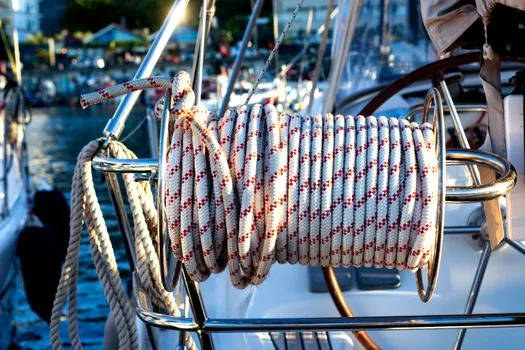
Outside of armor, aramid shows up in two main industrial formats: braided cable-protection sleeves, and rope or cordage. Techflex's Aramid Armor braided sleeve, for example, is rated at roughly five times the tensile strength of steel on an equal-weight basis and is specified for an operating temperature window of -170°C to 160°C (-274°F to 320°F), with a manufacturer note that the material will not melt or support combustion but is degraded by prolonged ultraviolet exposure [S2].
Aramid's mechanical performance in cable and rope service is what allows it to be specified for marine cordage, hull reinforcement, and the abrasion-resistant outer braid on aerospace and racing cable bundles [S1][S6]. One operational caveat is critical: aramid is sensitive to UV, so any outdoor cable or rope application should specify a jacketed or sheathed construction, or accept a service-life derating, as called out in the manufacturer's installation guidance [S2].
Telecommunications, BEV Enclosures, and Where Demand is Moving
Telecommunications is the fastest-growing end-use segment in the Persistence forecast, with the U.S. Infrastructure Investment and Jobs Act broadband buildout (US$65 billion) accelerating fiber-optic cable deployment, much of which relies on aramid yarn as the tensile strength member inside the cable jacket [S3]. Aramid yarn's low stretch and high modulus make it the standard tensile element in indoor and outdoor optical cables, and that demand layer is not tied to defense cycles.
A second emerging pocket is aramid-reinforced composite enclosures for battery-electric vehicles, with the U.S. Department of Energy and Inflation Reduction Act incentives pushing composite material integration across an estimated 3.5 million+ annual BEV units by 2030 [S3]. For both telecom and BEV enclosure work, para-aramid is the specified fiber because tensile modulus and low thermal expansion matter more than flame resistance; meta-aramid (Nomex) remains the right call for fire-resistant separators and electrical insulation paper. For other industrial enclosures and lighting equipment housings used near high-temperature zones, meta-aramid papers and laminates continue to be the specified electrical insulation class.
Selection Criteria and a Side-by-Side Comparison
When procurement has to choose between the two main aramid classes, four decision criteria do almost all of the work: tensile strength, operating temperature, flame/arc behavior, and cost/availability. Para-aramid wins the first two categories outright, with a melting point above 500°C and tensile strength on the order of five times steel by weight, while meta-aramid wins on flame resistance, arc resistance, and cost per kilogram in non-ballistic grades [S1][S2][S5].
For cable and rope, also check UV resistance and water absorption: aramid absorbs moisture (typically 3-7% by weight at standard conditions for meta-aramid, lower for para-aramid) and loses tensile strength when wet, so marine rope and outdoor cable designs typically use a jacketed construction to limit water ingress [S1]. For body armor, the controlling inputs are NIJ threat level, areal density, and multi-hit capability; para-aramid woven panels remain the default, with cross-plied or stitched constructions improving multi-hit performance [S3][S5].
Supply Chain, Standards, and 2026 Market Signals
North America consumed roughly US$1.5 billion worth of aramid fiber in 2026 and is forecast to reach US$2.1 billion by 2033 at a 5.3% CAGR, with Canada the fastest-growing national market at 6.1% CAGR on the back of Canadian Armed Forces equipment modernization and offshore oil & gas platform maintenance [S3]. Para-aramid supply is concentrated among a small number of qualified producers, which keeps lead times for high-grade ballistic fiber long and means that any Defense Production Act prioritization or trade action can move spot pricing sharply.
Two trackable signals for buyers over the next 12 months: NIJ standard revision activity (any change to the ballistic-resistance threat levels directly shifts the number of aramid plies required per panel), and U.S. broadband buildout burn rate, which sets the demand floor for aramid tensile members in fiber-optic cable. Specifiers should also treat the FTC's 85%-aromatic-linkage rule as a hard line in supplier qualification, since material below that threshold is legally classified as nylon and will not deliver aramid-class performance in service [S1].
Closing reference node: for engineering teams already evaluating aramid alongside switching power supply insulation paper or DC power supply transformer winding wraps, the practical rule is that meta-aramid (Nomex) papers are the specified class for electrical insulation, while para-aramid is the specified class for any structural or ballistic role, including aramid-reinforced composite structures where impact tolerance and low weight drive the trade. Related reading on adjacent material-spec trades is available in the analysis of EPDM seals in phosphate ester hydraulic fluid, which applies a similar paired-criterion selection framework to elastomer specification.