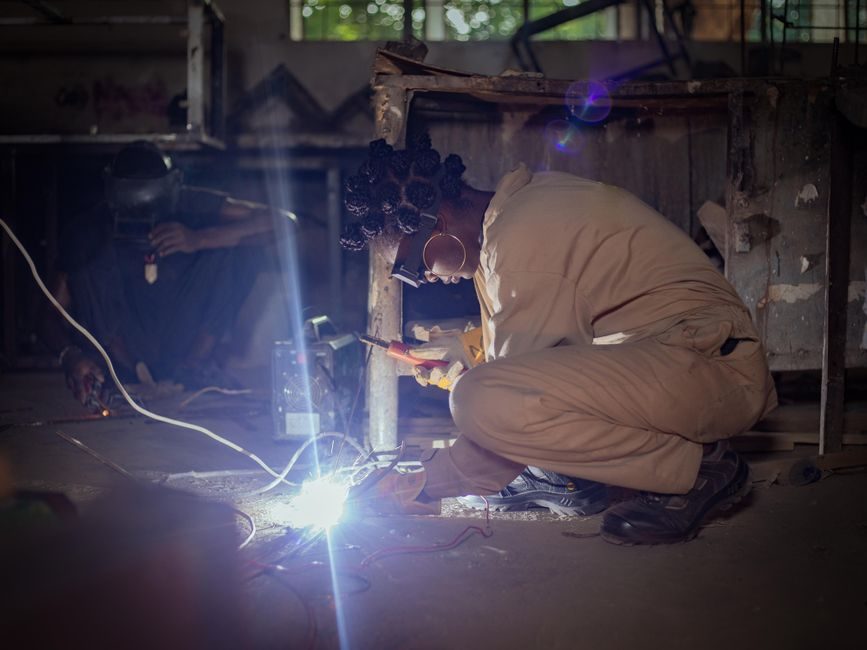
Arc welding machine selection in mid-2026 turns on five quantitative gates — process family, output amperage, duty cycle, input phase/voltage, and electrode diameter — before brand or price is even considered [S1][S4].
Chinese OEM catalogs in this window still lead on portable-inverter and multihead-robot SKUs: m.ecvv.com lists Guangdong welding-machine factories shipping 1-piece MOQ inverter welders via T/T or Western Union [S1], and en.yiwugo.com quotes a WSE-series inverter DC argon-arc machine at CN¥3,000 ex-works per piece, 50.0 kg per pc [S5]. Industrial-class WSM-500 units and DC-arc dedicated lines are also catalog items on the same channel.
Process family: SMAW, GTAW, SAW, GMAW
Shielded Metal Arc Welding (SMAW / "stick") is the most common low-cost process and dominates portable inverter catalogs on m.ecvv.com and the Alibaba "best-arc-welding-machine" showroom, where 1-piece MOQ inverter welders are the default SKU [S1][S6]. Gas Tungsten Arc Welding (GTAW / TIG) is sold as dedicated inverter-DC argon-arc units such as the WSE series, which is built around a DC arc with argon shielding for stainless and carbon-steel work [S5]. Submerged Arc Welding (SAW) and multihead automatic arc welding show up in heavy-duty and robotic cells — see the multihead automatic arc welding machine definition covering high-frequency, heavy-duty arc welding robot systems used in automotive and engineering-machinery lines [S2][S3].
The process choice locks in power-source architecture. A buyer needing field stick welding on 220 V single-phase will reject a three-phase SAW head regardless of brand, while a shipyard buyer needing long butt welds will reject a 160 A portable inverter. For deeper process background inside this site, the arc welder encyclopedia entry lays out the underlying physics.
Output amperage and duty cycle
Output class is the second gate. Portable inverter ZX7-series stick welders typically span 140–250 A, while industrial-class models such as the WSM-500 sit at the 500 A end of the catalog range [S1]. The WSE inverter DC argon-arc model is also a heavier 50.0 kg/pc floor-standing unit rather than a site-portable, which is consistent with a higher continuous-current rating [S5].
Duty cycle — minutes of arc-on in a 10-minute window at rated output, typically tested at 40 °C ambient per common manufacturer datasheets — is the spec most often misread. A 60% duty cycle at 250 A is not the same machine as a 60% duty cycle at 400 A. Buyers should anchor duty cycle to the actual joint, not to the headline maximum. If the cutting machine line in the same plant is running hot-plasma at 100 A continuously, a welding source rated at only 20% duty at the same amperage will become the bottleneck within one shift.
Input power, phase, and grid compatibility
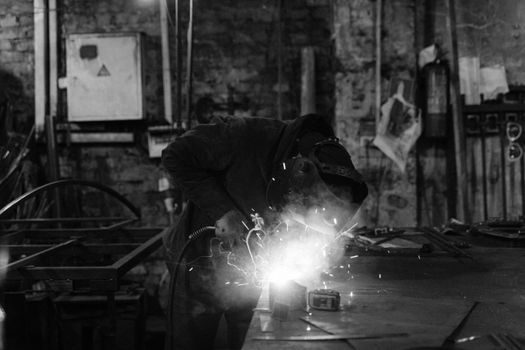
Input phase is a hard gate, not a preference. Chinese portable-inverter SKUs are predominantly 220 V single-phase 50/60 Hz to suit site generators and small-shop distribution, while multihead automatic arc welding cells and submerged-arc installations are three-phase 380 V industrial supplies [S2][S3][S5]. Mating a three-phase SAW head to a single-phase socket will not run; mating a single-phase stick inverter to a site with no neutral will trip the input rectifier.
For plants standardising on 380 V three-phase, a WSE-class inverter DC argon-arc or a multihead robotic system on the same bus simplifies spares, breakers, and EMC filtering. For field service, automotive repair, and construction sites, the 220 V portable inverter remains the only realistic option, and the 1-piece MOQ model on m.ecvv.com is a typical sourcing format [S1]. Buyers comparing this gate against adjacent equipment can also weigh it against the selection logic used for labeling machine lines, where input phase and air supply are similarly hard spec gates.
Electrode, filler, and shielding-gas compatibility
Electrode diameter is the fourth gate, and it constrains both output and process. Common carbon-steel stick electrodes for portable inverter work run 2.5 mm, 3.2 mm, and 4.0 mm, with 5.0 mm and 6.0 mm reserved for heavier industrial passes on thicker plate [S4]. Argon-arc (GTAW) work uses tungsten electrodes plus a separate filler rod, and the WSE-series inverter DC argon-arc unit is built around that workflow rather than stick-electrode use [S5].
Electrode classification — E6013, E7018, E308L, etc. — then governs the mechanical and corrosion performance of the joint, and the wrong class on a low-alloy or stainless plate will fail the weld regardless of source quality [S4]. For high-volume structural work, multihead automatic arc welding cells swap the manual electrode handling for mechanised wire feed and torch positioning, with the arc welding robot system covering automotive vehicles, spare parts, and engineering-machinery production [S3].
Automation, footprint, and total cost of ownership
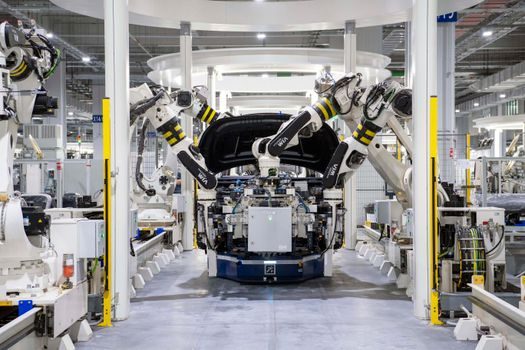
Automation grade is the fifth gate, and it is where the price spread opens up. A 1-piece MOQ portable inverter at the bottom of the m.ecvv.com catalog is a manual tool; a multihead automatic arc welding cell with a submerged-arc or robotic torch is a line-of-production capital item, with the higher output, higher duty cycle, and higher three-phase input that implies [S1][S2][S3]. The WSE-series inverter DC argon-arc machine at CN¥3,000 ex-works per piece, 50.0 kg/pc, sits between those poles as a workshop-floor dedicated TIG source [S5].
Side-by-side, the main options line up against decision criteria roughly as follows:
Portable inverter stick (ZX7 class, ~140–250 A, 220 V single-phase, 1-piece MOQ) — lowest cost, highest flexibility, lowest duty cycle, manual electrode handling. Best for site work, light fabrication, repair.
Industrial stick / WSM-500-class (~400–500 A, typically three-phase, higher duty cycle) — heavier plate, structural steel, shipyard and pressure-vessel work.
Inverter DC argon-arc / WSE-class TIG (~50 kg floor unit, 220 V or 380 V variant, dedicated TIG) — stainless, thin-wall, and precision joints where appearance and low spatter matter.
Multihead automatic arc welding / arc welding robot system (three-phase 380 V, dedicated cell) — automotive, engineering-machinery, and high-mix high-volume lines where torch positioning and repeatability outweigh unit price [S2][S3].
Plant owners standardising on packaging or assembly equipment will recognise the same five-gate logic — process, output, duty, input, and consumable — used in the carton erecting machine selection criteria write-up, which is useful for cross-checking spec discipline across very different equipment classes.
Limitations, failure modes, and verification
The dominant failure mode in arc welding machine selection is mismatched duty cycle, not headline amperage. A buyer who reads 500 A on a catalog page and ignores a 35% duty cycle at that rating will see thermal cut-outs within the first production shift, especially in summer shop floors above 40 °C. A second common failure is single-phase vs three-phase mismatch on site, which is invisible until first power-on [S1][S2][S5].
Verification should run three checks before payment: confirm the rated input voltage and phase against the actual site supply, confirm duty cycle at the amperage the buyer actually plans to use (not the headline maximum), and confirm electrode-diameter range against the joint geometry in scope [S4]. For Chinese OEM sourcing, the 1-piece MOQ listing format on m.ecvv.com, the CN¥3,000 ex-works WSE listing on en.yiwugo.com, and the WSM-500 / DC arc welding machine showrooms on Alibaba are useful as live price and spec cross-checks [S1][S5]. Standards such as IEC 60974-1 govern arc welding equipment safety and performance at the international level, and buyers exporting machines or welded product into the EU should confirm the specific revision their certification body is currently enforcing rather than assuming a generic compliance statement.
Trackable signals to watch over the next sourcing window: any catalog refresh on the WSE-series inverter DC argon-arc listing on en.yiwugo.com (current quote CN¥3,000 ex-works, 50.0 kg/pc) [S5], and any new multihead automatic arc welding cell SKUs on coldrollformingmachinery.com that broaden the automotive and engineering-machinery coverage now listed [S3].