
ASME B30.27-2019 is the controlling American National Standard for material placement systems, covering construction, installation, operation, inspection, testing, and maintenance of trailer- and truck-mounted concrete placing booms and conveyors used on placement operations [S1][S3].
Periodic inspection under B30.27 follows a tiered schedule tied to working hours and machine age: every 2,000 working hours or at least once per year during the first 5 years, increasing in frequency through the 5-10 year band and again beyond 10 years as the unit accumulates fatigue hours [S5]. Failure to document these intervals moves a well-maintained asset into a non-compliant status, which exposes the owner, contractor, and operator to liability if an incident occurs on a pour.
Scope of B30.27 and Why It Is the Right Standard for a Boom
B30.27-2019 was first issued in 2005 after the Concrete Pump Manufacturers Association (CPMA) brought a draft (CPMA-27-2000) to the ASME B30 committee, which scoped the standard to booms, outriggers, and structural and system components on placement machines, because the B30 committee had crane expertise but limited pump-process expertise at the time [S2]. The standard assigns safety responsibilities to contractors, pump and belt owners, operators, and suppliers, giving each company on a pour a defined share of ownership for compliance [S2]. For a placing boom specifically, this means the boom structure, outrigger pads, slewing ring, hydraulic piping supporting boom motion, and the controls that drive boom articulation all sit under B30.27, while the concrete pumping process itself is not covered by B30.27 [S2].
A truck-mounted concrete placing boom is therefore a B30.27-2019 asset from the moment it is commissioned, and any handover, rental, or contractor-to-contractor re-deployment on a job must include the latest inspection record for that serial number.
Periodic vs Frequent vs Annual: The Three Inspection Tiers
B30.27 distinguishes three inspection cadences on a material placement system: frequent (typically pre-shift), periodic (the schedule quoted above, tied to working hours and machine age), and annual, with the annual inspection generally performed by a qualified third party rather than the operator [S2][S5]. The periodic schedule in clause 27-2.1.3 is the most cited section in fleet procedures: years 0-5 at 2,000 working hours or 12 months (whichever comes first), years 5-10 at 1,000 working hours, and units beyond 10 years moving to an even tighter interval that many operators read as quarterly or 500-hour reviews, depending on the OEM's interpretation of the standard [S5].
Within each periodic inspection, the inspector must check the boom structure for cracking, corrosion, and deformation, verify outrigger extension and pad condition, examine pins and bushings for wear or rotation, confirm slewing-ring bolt torque to OEM specification, and pressure-test the hydraulic system supporting boom lift and articulation [S5]. Documentation of each finding is not optional: the standard expects a written record retained by the owner for the service life of the unit, and that record is what an OSHA inspector or insurance loss adjuster will request first after an incident.
Pre-Shift Checks the Operator Owns Every Day
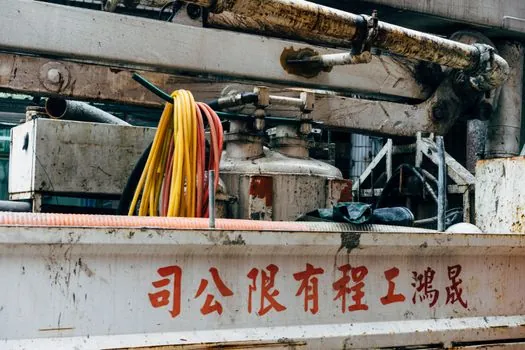
Operators carry the frequent-inspection burden, and on a placing boom the daily walk-around is where most service-introduced defects are caught before they become reportable findings. E-stop buttons must be tested at the start of every shift; pressing E-stop routes all hydraulic oil to tank and places all functions in neutral, and a button that fails to do this is an immediate red-tag item [S5]. The harness and connectors at each E-stop station are checked for fraying, loose pins, and corrosion, and the daily log must record which buttons were tested by serial number [S5].
Structural steel on the boom sections, pedestal, and outrigger boxes must be visually checked for cracking, corrosion, and deformation; any of these conditions triggers a stop-work and a call to the manufacturer before the next pour [S5]. Daily checks also cover boom-section pin engagement (no spreader bars left half-pinned), lubrication of all wear points per the OEM chart, and tire or track condition on the carrier. None of these items require a third party, but they must be logged, because the periodic-inspection record references the operator's daily logs to reconstruct the unit's recent operating history [S2][S5].
Structural Steel, Welding, and What the Inspector Looks For
Steel grade and weld quality are the two material factors that most directly drive a boom's ability to stay in B30.27 compliance across its service life. Higher-grade steel offers higher strength, better corrosion resistance, improved ductility, and better heat resistance, and it tolerates the cyclic loading of boom lift, swing, and reach cycles with less fatigue damage than lower-carbon equivalents [S5]. Carbon content is the lever that controls strength; the right carbon range, balanced with alloying elements, lets the boom absorb repeated loading without progressive deformation [S5].
Welding is the other variable the periodic inspector validates. Forming, welding, and any structural repair must be performed by personnel holding the appropriate welding and quality-control certifications, and repairs outside the OEM's published procedure require manufacturer sign-off before the unit returns to service [S5]. A boom that has been field-repaired by an uncertified welder is, for B30.27 purposes, an uninspected structural modification, and an inspector will typically red-tag it until the OEM reviews the repair procedure and the weld documentation.
What the Standard Does Not Cover, and What That Costs You
B30.27 is a placement-system safety standard, not a concrete-process standard. The pumping side of the operation, including the concrete pump, the prime mover, the pumping cylinders, and the S-tube or rock valve, was excluded from the B30 committee's scope when the standard was first formed, and that scope decision has carried forward through B30.27-2019 [S2]. Owners who treat their B30.27 paperwork as their full compliance file are exposed on the pumping side, where the OEM's recommended pump-side inspection regime, the engine service intervals, and any fleet-level DOT or EPA requirements continue to apply independently [S2].
B30.27 also does not cover the concrete itself. Slump, mix design, admixture compatibility, and placement rate are process controls that sit with the contractor and the ready-mix supplier, not with the B30.27 inspector. For a complete job-site safety review on a placement day, the B30.27 record needs to be paired with the contractor's job hazard analysis, the ready-mix supplier's mix card, and the boom operator's daily log.
Documentation, Records, and What an Auditor Will Request
The record package a B30.27 owner is expected to produce on request has four parts: the original commissioning data and nameplate information, the operator's daily inspection logs, the periodic-inspection reports including any non-conformance findings and their close-out, and the structural-repair file with weld procedures, welder certifications, and post-repair NDT where applicable [S2][S5]. A unit that has been in service for more than 5 years should show an unbroken chain of periodic inspections, each performed at or before the 2,000-hour or annual trigger for the first band and at the tighter interval required by the 5-10 year band [S5].
For owners running fleets that mix truck-mounted booms and trailer-mounted booms, the trailer units fall under the same B30.27 scope and the same inspection schedule, so a single fleet inspection procedure can cover both classes if the cadence matches the strictest machine in the fleet. For a broader equipment-context view on adjacent lifting and rotating-equipment standards, see the comparison work on crane and lifting standards alignment and the ATEX versus IECEx selection map, which cover the regulatory adjacency that a B30.27 owner is likely to encounter on the same multi-employer site.
For support equipment on a placement job, B30.27 inspections tie into the broader equipment ecosystem covered in this encyclopedia, including the concrete vibrator used to consolidate the placed concrete, the concrete tool inventory held on site, and the placement-support role of a concrete admixture in keeping the mix pumpable across the boom's reach.
The next trackable signal for any B30.27 owner is the 5-year periodic-inspection trigger, which forces a documented review at or before 2,000 working hours on a unit and is the most common point at which a marginal boom is re-rated, scheduled for repair, or retired; the second signal is any OSHA or insurance audit of multi-employer placement sites, which now consistently requests the B30.27 record before the contractor is allowed back on site.