
A demolition-to-paving handover typically pushes a 4–8 ton class tracked paver with 1.5–4 m basic screed width into service for trench reinstatement, utility-cut patches, and selective sidewalk replacement, where subgrade is uneven and truck spotting is tight [S4][S3]. The machine's basic paving width, not its maximum extension, sets the daily production ceiling on these short-cycle jobs.
Specifying for selective demolition and reconstruction requires deciding three things up front: wheeled versus tracked undercarriage, basic screed width versus maximum extension, and whether a material transfer vehicle (MTV) is required to keep head-of-material consistent in front of the augers. Screed selection criteria and self-leveling control logic are the same physics used on highway work; what changes is the operating envelope [S1].
Project Scale Bands and Matching Paver Class
Project size drives class more than any other variable. Small-scale work, including residential roads, pathways, parking-lot patching, and municipal repair, is best served by compact pavers with 1.5–4 m paving widths, which offer better maneuverability, lower fuel burn, and easier transport between scattered demolition tie-in sites [S4]. Medium municipal and commercial work typically takes a mid-size paver in the 4–8 m width band, while highway-class machines start above 8 m and are oversized for almost any selective demolition scope [S4].
For demolition-and-rebuild work in the 900 sq ft to a few thousand sq ft range, a 4–8 ft (1.2–2.4 m) compact track paver is the common utility-cut specification [S6][S7]. Cart paths, sidewalks, and trench fills fall in the same band, and buying a machine that only reaches a 4 ft minimum basic width leaves room for half-lane overlays later without renting a second unit [S7].
Undercarriage: Wheeled vs Tracked on Demolition Subgrade
Track-mounted pavers use rubber tracks on both sides and are specified for rough ground, including sand, mud, and the loose, recompacted subgrade left after a slab or pavement has been removed [S3]. Tracked machines give up some travel speed in exchange for flotation and stability over soft spots where a wheeled machine would pump or rut the base.
Wheeled pavers retain better mobility on hard, finished surfaces and are the right pick when the demolition scope is largely finished-grade paving on a sound base [S5]. For most demolition-to-paving handoffs the subgrade is variable, so a tracked undercarriage is the safer default unless the work is confined to a clean concrete or asphalt bench with no soft patches.
Screed, Hopper, and Feed-System Gates
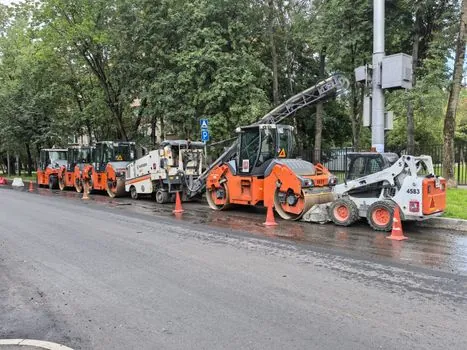
The self-leveling screed is the single most critical feature on any paver, because it determines the profile of the HMA mat behind the machine and therefore ride quality and density uniformity [S1]. Demolition patches usually demand variable-width screeds with hydraulic extensions; the basic width gates the cycle time on a utility cut, while the maximum extension handles the wider reconstruction lifts.
Hopper capacity controls how long the paver can run between truck swaps, which matters when demolition haul-off has narrowed site access and trucks cannot spot continuously. Flow into the auger chamber is regulated by variable-speed conveyors paired with augers, by raise/lower flow gates, or by an automatic feed control that holds a consistent head of material in front of the screed [S1]. Insufficient head of material in front of a center-mounted auger gearbox produces a thin longitudinal strip of lower-density mat, a defect called gearbox streak that is amplified at the slow, stop-start paving cadence typical of trench work [S1]. A broader comparison of the three undercarriage-and-class options looks like this:
Compact wheeled (1.5–4 m): lowest cost, fastest travel between sites, but limited flotation on recompacted demo subgrade; suited to clean-base parking-lot overlays under 1,000 sq ft. Compact tracked (1.5–4 m): the demolition default, balances 4–8 ton transport weight with traction on soft or uneven base; standard choice for trench reinstatement and utility-cut patches [S3][S5]. Mid-size tracked (4–8 m basic width): the right step up when demolition scope expands to half-road reconstruction, with a larger hopper reducing truck-cycle sensitivity on longer runs [S4].
Paving-Width Bands and Their Job-Site Fit
Spec sheets should be read on basic width first, maximum extension second. The 1.5–4 m band covers residential roads, pathways, and most utility trenches, and a compact tracked unit in this band can be towed between scattered tie-in points without a lowboy on many urban jobs [S4][S3]. The 4–8 m band fits urban roads and commercial parking lots where the demolition footprint is one or two lanes wide.
Above 8 m the paver crosses into highway class and is normally out of scope for selective demolition unless the project is a full-depth pavement reconstruction of an arterial corridor. Adjustable screed extensions are valuable on demolition work because the same machine can pave a 1.8 m trench patch in the morning and a 3.5 m parking-lot return in the afternoon without a second screed on site [S4].
Tractor, Conveyor, and Auger Behavior on Patch Work
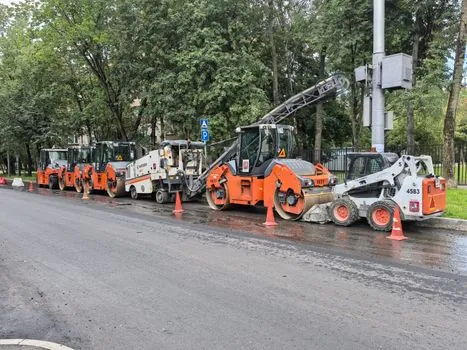
The paver tractor has four functional groups: push roller and truck hitch at the front, the hopper with fold-up wings as temporary HMA storage, the conveyor that moves mix under the chassis to the rear, and the augers that spread it across the paving width [S1]. Each one creates a specific defect pattern when mis-tuned on patch work, so the operator's feed-control discipline is part of the machine selection.
Hopper wings can be folded up to force mix toward the center where the conveyors can recover it, and hopper inserts increase volume when the work is paired with a material transfer vehicle (MTV) supplying mix at higher rate than a truck can spot [S1]. Auger direction can be reversed on most pavers, which lets the operator send all incoming HMA to one side, useful when paving against a curb line left from the previous alignment after a half-width demolition. The gearbox-streak defect mentioned earlier is most likely on pavers with a center-mounted auger gearbox when the head of material in front of it drops, and is worth confirming before committing a machine to a density-spec patch.
Material, Compaction, and Adjacent-Equipment Pairing
Material selection does not change between new-build and demolition work, but the grade of asphalt and the crushed-stone gradation should be reviewed against the demolition haul-off notes because recycled aggregate is often specified in patch work. High-quality patch asphalt needs good adhesion plus high- and low-temperature resistance, and the gradation of the crushed stone controls mat density and wear resistance [S2]. A regular mill-and-fill cycle is common on demolition tie-ins, with local milling of failed areas before re-paving rather than full-depth replacement.
Compaction is handled by steel-wheel and rubber-tired rollers working in sequence (initial, re-compaction, and final passes) to hit target density [S2]. A compact double-drum roller in the 1.5–3 ton range pairs naturally with a 1.5–4 m tracked paver for trench work, and is the typical equipment bundle on utility-cut reinstatement. Specifying the roller separately from the paver is normal, but matching drum width to basic screed width avoids overlap defects at the cold-side longitudinal joint. For deeper pipeline work adjacent to the paver, a heavier roller selected against pipe-handling loads is the safer pick, as covered in a road roller spec map for pipeline construction.
Selection Checklist, Limits, and Watch-Items
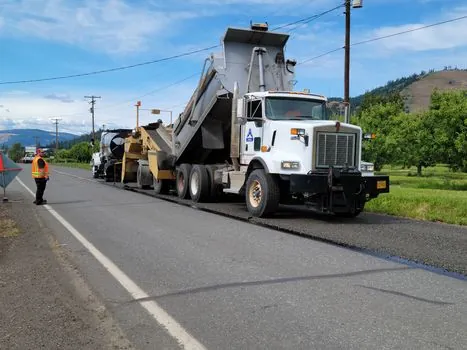
A minimum due-diligence checklist for demolition-scope paver selection: confirm basic and maximum screed width against the largest single lift expected on the project, not the average; confirm undercarriage type against the worst subgrade condition on the access route, not the paving surface; confirm hopper volume against truck spotting distance and whether an MTV will be used; verify auger gearbox location and the machine's track record on cold-joint density at the gearbox streak line; and confirm that the screed is a self-leveling unit with extension heating, because heat-soaked extensions are the difference between a clean mat edge and a torn edge on patch work [S1][S4].
Limits to flag before commitment: pavers below the 4 ft basic screed width are too narrow for any lane-width patch and will leave a longitudinal cold joint inside the wheel path; wheeled pavers should not be specified where the demo subgrade includes utility-trench backfill less than 30 days old, because the dynamic load at the auger will pump the base; and any paver specified without an automatic feed control should be evaluated against the operator's experience, because manual gate-and-conveyor control at the stop-start cadence of patch paving is the most common source of segregation and density failure. For a structured background on the paver tractor, screed, and material feed system that this article builds on, the asphalt paver reference page covers the same functional groups in more detail.
Trackable signals for the next planning cycle: OEM disclosures of factory-installed automatic feed control on compact tracked units in the 4–8 ton class, and any municipal specification updates tying utility-cut reinstatement paving to minimum screed-extension heating time before placement. These two data points will tighten or loosen the shortlist compiled from the 1.5–4 m compact and 4–8 m mid-size tracked bands above.
Spec-level background on the components involved: demolition hammer, and pressure transmitter.