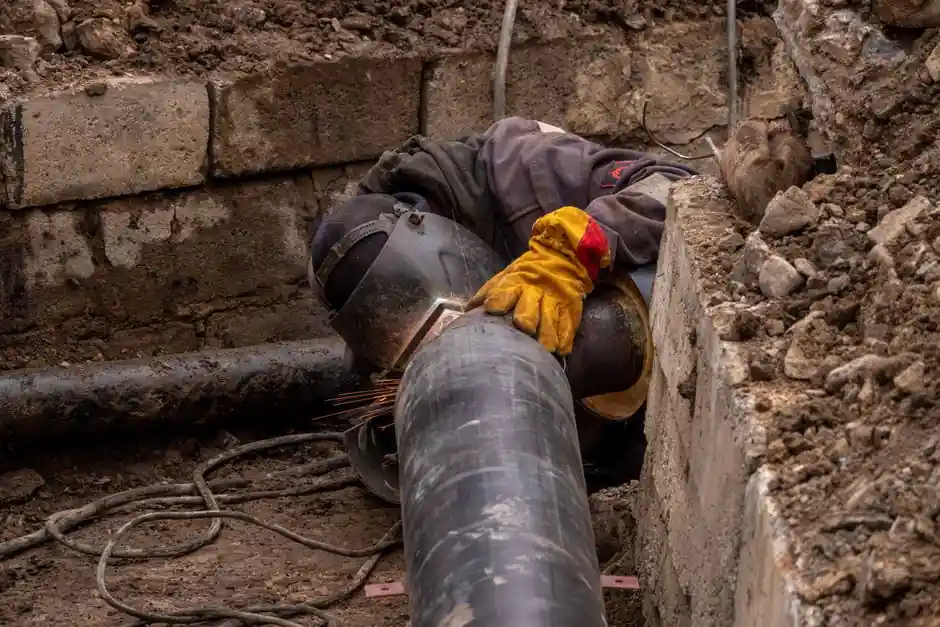
Pipeline construction compaction is not a single problem: the trench backfill directly above and around the pipe, the pipeline Right-of-Way subgrade and working pad, and the actual pipe-handling and cradling operation each call for a different machine class. Matching roller type to soil gradation, lift thickness, and trench geometry is the controlling decision, and operating weight follows from that [S1][S8].
For backfill and subgrade work, the working envelope on a pipeline spread is tight: 1-3 ton mini rollers and walk-behind trench compactors cover curb-side and trench-shoulder lifts, 3-6 ton machines handle secondary road crossings and farm-track restoration, and 6-10 ton (and up) single-drum vibratory rollers compact mainline working pads and large-diameter pipeline bedding zones [S1]. Pipe handling itself is a separate equipment class: pipeline rollers and cradles are typically offered in five load bands from 1 ton up to 40 tons, sized to the pipe diameter and stringing-lift weight rather than to the surrounding soil [S6][S8].
Roller type by material and lift: cohesive soil, granular pad, asphalt patch
Cohesive soils (clay, silt) need padfoot (sheepsfoot) rollers, because the protruding feet penetrate the loose lift, knead clods apart, and consolidate below the surface; a smooth drum on wet clay bridges over a crust and leaves the lift under-compacted [S1]. The same principle applies inside a pipeline trench where the bedding zone is silty clay: a padfoot trench roller in the 1-3 ton class is the typical choice for 200-300 mm lifts.
Granular working pads, sand bedding, and crushed-stone base around the pipe respond to high-frequency smooth-drum vibration, which rearranges particles and closes voids without the segregation risk that a kneading action would introduce on clean sand and gravel [S1]. For temporary haul-road crossings and the mainline Right-of-Way itself, a 6-10 ton single-drum vibratory smooth roller is the standard specification, giving 300-500 mm effective lift depth per pass on granular fill [S1].
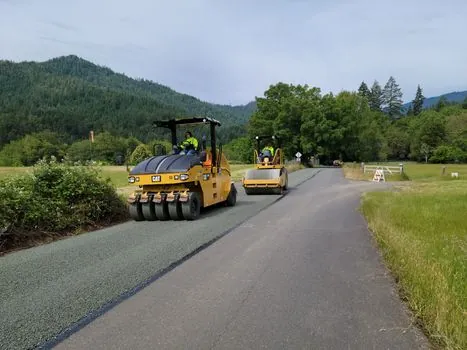
Asphalt reinstatement over the trench (road crossings, yard transitions) follows normal pavement logic: a double-drum tandem vibratory roller for breakdown and intermediate compaction, a pneumatic tyre roller for sealing the layer interfaces, and a static smooth drum for finish [S1]. A 3-4 ton tandem is the usual trench-patch size, narrow enough to straddle a 600-800 mm sawcut but heavy enough to hit target density on a 50-80 mm lift.
Weight bands and compaction depth: how to size a roller to the lift
Roller weight is not a free choice; it sets the static linear load and, with vibration, the effective compaction depth. Three bands dominate the pipeline spec sheet, and each maps to a lift thickness and a project role [S1][S2].
The 1-3 ton band covers mini rollers, walk-behind trench compactors, and remote-control trench rollers used directly in the trench above the pipe. Effective lift is roughly 150-300 mm; they fit through 800-1000 mm trench shoring and are the only practical option once the pipe is in the ditch and side-fill is being placed in shallow layers [S1].
The 3-6 ton band covers municipal and secondary-road work, including small pipeline tie-ins, urban utility replacement, and farm-track restoration. Effective lift on granular material is around 200-400 mm; on cohesive soil with padfoot configuration it falls toward the lower end. This is also the size class that doubles as the trench-patch tandem vibratory roller for asphalt reinstatement [S1].
The 6-10 ton and heavier band is reserved for mainline subgrade, working pad, and large-diameter pipeline bedding-zone construction. Effective lift on granular fill reaches 400-700 mm per pass, and these rollers carry the excitation force needed to compact thick lifts in fewer passes, which is what a 50+ km pipeline spread needs to keep pace with the trenching crew [S1][S2].
Single-drum vs double-drum vs tandem: drum configuration on a pipeline spread
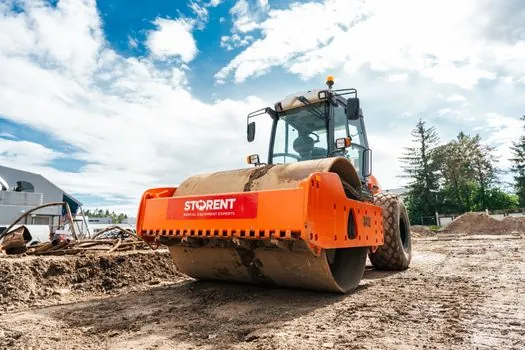
Single-drum rollers carry one large vibrating drum at the front and rubber tyres at the rear; the tyres provide traction and travel speed, so the machine moves faster and climbs grades better than a tandem, but only the drum compacts. Single-drum units dominate the 3-10 ton range and are the workhorse of subgrade and working-pad work on a pipeline spread [S1][S5].
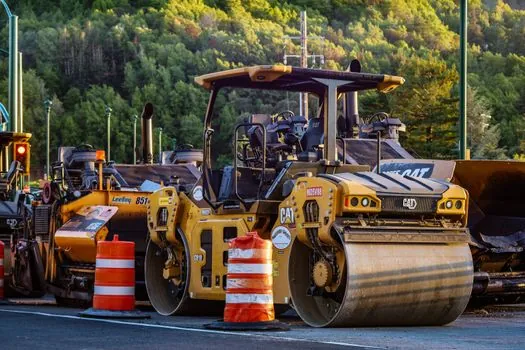
Double-drum (tandem) rollers have a steel drum at both ends, with both drums usually vibratory for breakdown and intermediate compaction and one switched to static for finish. They are the standard for asphalt compaction and for finish rolling on road crossings; the trade-off is lower travel speed and poorer gradeability than a single-drum on a soft pad [S5].
Pneumatic-tyre rollers (multi-tyre, 7-11 wheels, ballastable to 8-30 t) are used between breakdown and finish on asphalt, where the kneading action seals layer interfaces and pushes density up by 1-2% over a steel-drum pass on the same lift [S1]. On a pipeline spread they are usually a sub-contract item, but they show up on highway and airport crossings where the owner spec calls for them.
Pipeline rollers and pipe cradles: a separate equipment class
Compacting around a pipeline and actually moving the pipe are two different jobs. Pipeline rollers and cradles are low-height support stands that hold the pipe off the ground during welding, X-ray, coating, and stringing, and they are sized to pipe diameter and stringing-bead weight, not to soil density [S6][S8].
Standard pipeline-roller racks cover five load bands from 1 ton up to 40 tons, matching the range from small-diameter utility pipe (100-300 mm) up to large-diameter transmission line (900-1500 mm) [S6]. The decision between a roller and a fixed cradle is set by terrain and workflow: cradles win on uneven ground where stability matters more than rotation; rollers win in controlled fabrication yards where the pipe needs to be rotated for welding and inspection [S8].
Material of construction is typically steel with polyurethane or rubber linings on the contact face, chosen to avoid coating damage on FBE, 3LPE, or fusion-bonded concrete-coated line pipe. Load capacity per stand is what sizes the spread: count the number of stands from the rule-of-thumb spacing of 2-3 m between supports for a fully loaded 36-inch line-pipe string, then size each stand for the worst-case span load including the bending moment at the field joint [S6].
Selection criteria ranked: lift, material, trench width, haul-road access
Four criteria drive the final pick, in roughly this order of priority on a live pipeline spread [S1][S2][S7].
1. Lift thickness and density target set the roller weight class. A 200 mm cohesive lift under a road crossing is a 1-3 ton trench roller; a 500 mm granular working-pad lift is a 6-10 ton single-drum [S1][S2].
2. Material gradation sets the drum type. Cohesive clay and silt need padfoot; sand, gravel, and crushed stone need smooth vibratory; asphalt reinstatement needs a tandem vibratory plus a pneumatic-tyre pass [S1][S7].
3. Trench width and shoring set the maximum drum width and the option of in-trench compaction. A 1.2 m wide trench with sheet piles leaves no room for a ride-on roller, and a walk-behind or remote trench roller is the only option [S1][S5].
4. Haul-road access and transport weight set the practical ceiling. A 14 ton single-drum may give better density per pass, but if the right-of-way access is a single-lane farm track with a 10 t bridge rating, the realistic pick is a 6-8 ton machine hauled on a tag-along trailer [S2][S4].
Common failure modes: bridging, over-compaction, and wrong-drum choices
The most expensive mistake on a pipeline compaction job is bridging: a heavy smooth drum run over a thick lift of cohesive soil seals the top, traps pore pressure below, and leaves the lift under-dense even though the surface looks finished. The fix is to drop back to a lighter padfoot machine and roll in thinner lifts, not to add more passes with the same drum [S1].
Over-compaction of granular material is the opposite failure: a 14 ton vibratory roller run at high amplitude on a 200 mm sand lift pulverises the matrix and turns a compactable fill into a segregated, difficult-to-test zone. The cure is matching amplitude to lift thickness: low amplitude for thin lifts, high amplitude for thick lifts, and amplitude switching on machines that offer it [S1][S7].
Using the wrong drum class is the third common failure: a smooth drum on a wet clay trench, or a padfoot on clean sand and gravel, both produce low in-situ density that the quality team will catch at the trench box or nuclear gauge. Pre-mobilisation planning should pin drum type to the bedding material before the roller is loaded onto the lowboy, not after it arrives on the right-of-way [S1][S4].
Standards, testing, and documentation that govern the choice
Density and lift-thickness requirements on a pipeline spread are written into the project earthworks specification, normally referencing ASTM D698 (Standard Proctor) or ASTM D1557 (Modified Proctor) for the laboratory compaction curve, and ASTM D6938 or D1556 for the in-situ density check [S1]. The roller spec sheet, lift thickness, and number of passes are then chosen to hit a target percentage of maximum dry density, typically 95% Modified Proctor on the working pad and 90-95% Standard Proctor on the trench backfill depending on pipe material and depth of cover [S1].
Lift thickness is itself a controlled variable: the project spec usually caps cohesive lifts at 200 mm loose before compaction and granular lifts at 300-500 mm loose, with the roller weight band selected to compact that thickness in 4-8 passes [S1][S2]. Where the spec calls for moisture control (common on clay backfills to avoid shrinkage away from the pipe), a padfoot roller with a sheepsfoot-style foot pattern is specified to knead the lift rather than bridge it [S1].
For QA documentation, the contractor typically records roller type, weight, amplitude setting, number of passes, lift thickness, and in-situ density at a grid spacing set by the owner's quality plan. The same data feeds the as-built compaction report handed over at mechanical completion [S1][S2].
Related reading from the spec library
For trench-shoulder and pad work where a mini excavator feeds the roller, the wheeled excavator selection map covers the machine class that usually opens and backfills the ditch. If the spread is also doing road crossing reinstatement with a tandem and a pneumatic-tyre roller, the road-roller commissioning protocol covers drum swap, clutch set, and slope limits between machines. [S2]
For a deeper dive into roller type, drum configuration, and operating envelope across the wider earthworks fleet, the road roller reference page and the construction machinery and equipment index set out the standard categorisation. Pipe-handling rollers and cradles sit in the broader construction tools catalogue; the related pipeline pump reference covers the pumps that move product through the line once the trench is closed.
Track the next spec decision by following two signals over the next 6-12 months: (a) the trend toward remote-controlled and tandem-drum trench rollers in the 1.5-3 ton band as Right-of-Way safety rules tighten around workers in the ditch, and (b) the gradual move to amplitude-selectable single-drum vibratory rollers in the 7-12 ton range as mainline spreads push for higher productivity per pass. Either shift will change the standard fleet spec for a 2027 pipeline tender [S1][S2][S5].