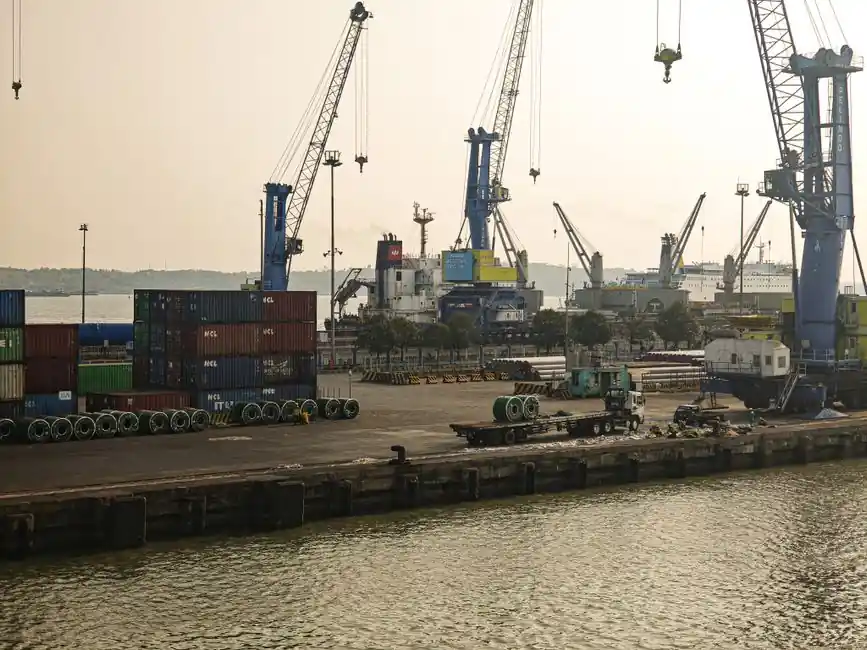
Track-mounted asphalt pavers with high-compaction screeds are the dominant choice for port and intermodal terminal yards, where the ASTM port-pavement functional index explicitly flags rutting, settlement, and surface regularity as the leading distress modes [S1].
Port and terminal asphalt work differs from highway work in three ways: the substrate is typically a cement-stabilised or heavy-duty block base, the loads are slow-moving standing axle traffic from reach-stackers and terminal tractors, and the working windows between vessel calls are short. Those constraints push the spec toward tracked undercarriage, screed widths of 6.0–12.0 m with pre- or main-compaction, and paving speeds disciplined to 3–5 m/min on the base course.
Port vs Highway Loading: What the Paver Has to Place Against
The functional assessment of port container-terminal pavements published in ASTM Journal of Testing and Evaluation, Vol. 49, Issue 3, p. 1824 identifies surface regularity, rutting, and settlement as the three distress parameters that drive rehabilitation priority at container terminals, with the index calibrated against observed apron and stack-yard condition [S1]. That framing is the key reason a standard highway wheeled paver rarely fits: terminal loadings are quasi-static, with single-axle equivalents well above the 13 t road baseline for long dwell periods, while a wheeled paver loses traction precisely when the mat requires maximum pre-compaction.
UN digital library guidance on container-terminal pavement management reinforces that unsuitable surfacing will, sooner or later, have a negative impact on terminal operations, and that container-yard pavements are engineered as a system over the box-handling equipment they support [S4]. For procurement, that means matching the paver to the terminal pavement design, not the other way round.
Tracked vs Wheeled: The First Spec Decision
Wheel-mounted asphalt pavers are often best on existing road surfaces and tend to be more maneuverable on hard, pre-compacted substrates [S2]. Tracked pavers, by contrast, deliver the flotation and continuous ground contact that a freshly laid cement-treated base or a thin bond-breaker over concrete pavers requires, which is the typical case in terminal retrofit work [S2][S5].
For new-build terminal yards the trade-off can be summarised against four decision criteria:
1. Traction on prepared base: tracked wins on cement-stabilised crushed rock; wheeled acceptable on existing concrete or asphalt.
2. Manoeuvrability around stack blocks and gantry rails: wheeled wins in tight radii under 6 m; tracked needs more swing room.
3. Mat evenness at low speed (3–4 m/min): tracked wins because the undercarriage does not slip under the auger head load.
4. Relocation between aprons without lowboy: wheeled wins on road speed between paved sections; tracked needs a transport trailer.
The practical rule: if the terminal paving is on a fresh, deep, unbound or stabilised base, specify a tracked paver; if it is an overlay on existing rigid or flexible pavement, a wheeled unit is acceptable.
Screed, Width, and Compaction Output

Selection criteria from paving-equipment buyer guides reduce to four inputs: project requirements, pavement thickness, paving width, and budget [S3].
High-compaction (tamper-bar + vibratory) screeds are the right match for port work because the standing-axle loading on the finished mat means initial density cannot be recovered later by rollers. Standard vibratory screeds are fine for sub-base lifts; main-line paving screeds with dual tamper and vibratory circuits are the spec for the binder and wearing courses on stack-yard lanes.
Hopper, Conveyor, and Working-Window Discipline
The hopper and conveyor system set the practical paving speed, and the practical paving speed sets how much mat a paver can place between two vessel calls. Typical tracked port-class pavers run a 12–17 t receiving hopper, dual slat conveyors, and augers sized for the full screed width, so the limiting factor is truck cycling, not paver throughput. [S3]
Two operational disciplines follow: first, end-dump or live-bottom truck scheduling must keep the hopper above one-third full at all times, because the auger head stalls and mat segregation appear together when the conveyor starves. Second, paving width should be chosen so each lane is completed in a single continuous run; longitudinal cold joints in a stack lane align with reach-stacker wheel paths, and the surface-regularity index penalises any joint in that zone [S1].
Where Standard Highway Pavers Fail on Terminal Yards
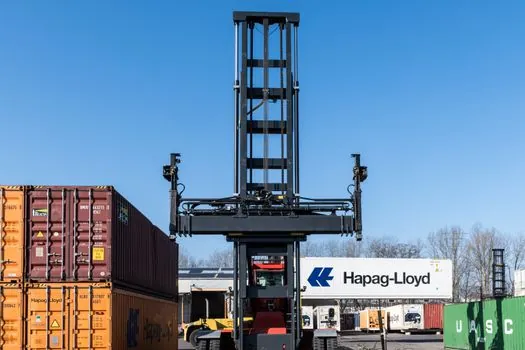
Three failure modes are worth calling out explicitly. First, a wheeled paver on a deep cement-treated base can leave shallow shear striations under the tyres that later reflect through the wearing course as 1–2 mm regular ridges; tracked undercarriage avoids this because the load is distributed across the full track footprint [S2][S5].
Second, standard highway screeds without tamper pre-compaction deliver only 75–82% initial density on a 60 mm lift, which leaves too much work for the breakdown roller given the short inter-vessel paving window; that is the standard reason terminal contractors upgrade the screed spec rather than the paver chassis [S3]. Third, asphalt paver selection for port work should not be driven by engine power alone, because what matters at the mat is screed weight, auger diameter, and conveyor slat width, not the kW on the tractor hood. Choosing the wrong paver often leads to costly rework down the line when these three are mismatched to the lift thickness and lift width [S3].
Adjacent Equipment That Affects the Paver Spec
Paver selection is rarely isolated. The milling or recycling step in front of the paver sets the bond-breaker condition of the substrate, so a project that pairs a port-class paver with an under-spec milling machine inherits a weak interface; see the cold milling machine width and drum map for the matching logic. [S3]
Earthworks beneath the paver determine whether the base is stiff enough for wheeled operation or needs a tracked undercarriage with high flotation, the same logic that drives bulldozer selection for port and terminal operations on the same site. For demolition overlays inside an existing terminal, the cold milling machine class and drum spec feed directly into the screed-width and pre-compaction choice.
Finally, on timber or wharf-deck sections, tracked pavers with reduced ground pressure are the only safe option, and the same undercarriage logic is documented in forestry road-roller picks where drum type and 2026 selection logic favour low-psi contact over travel speed.
Selection Checklist for Port Procurement

Use the following as a pre-RFP filter:
1. Define the loading case explicitly: standing axle from reach-stacker, RTG, or terminal tractor, and cross-check against the pavement design traffic class.
2. Match undercarriage to substrate: tracked for stabilised or unbound base, wheeled only for overlays on rigid existing pavement [S2].
3. Match screed to lift: tamper-bar or tamper-and-vibratory pre-compaction on binder and wearing courses; standard vibratory on sub-base [S3].
4. Lock paving width and joint layout to the stack-lane geometry so cold joints do not align with wheel paths [S1].
5. Confirm hopper capacity and conveyor throughput against the truck-supply plan before choosing between paver sizes.
6. Reuse the wider project knowledge of the asphalt paver family and the broader construction machinery and equipment taxonomy to keep option lists consistent across the yard, lighting, and lamps and light fittings packages for the same terminal upgrade.
Track-on the next pass: spec the screed pre-compaction circuit and the paving-width ladder in the RFP technical schedule, and pin the asphalt mix design at the same time; pavers and mix design must be chosen together, not in sequence.
This topic is covered further in Cold Milling Machine Selection for Road Construction: Width, Depth, Power, and Drum Map.