
Aspirating smoke detection (ASD) systems are now the default engineered choice for cold storage facilities operating down to -45°C, because the central detector is mounted outside the insulated envelope and continuously draws air through a pipe network with multiple sampling holes [S3][S4].
Typical freezer warehouses run between -40°C and -12°C, with chillers at -2°C to +4°C, and ultra-low pharmaceutical stores reaching -90°F (-68°C), all of which fall outside the 0°C to 49°C operating window of conventional spot smoke detectors recognised by international codes [S3][S4].
Why spot detectors fail in freezer warehouses
Conventional smoke detectors are usually rated only down to 0°C (32°F), and international codes cited by Xtralis explicitly restrict their use below that threshold in cold storage environments [S3]. In a freezer warehouse, even the ignition source is often a non-obvious one: high-intensity discharge (HID) lamps can run above 800°F (427°C) at the bulb surface, hot work during maintenance, ammonia refrigeration leaks, and electrical distribution faults dominate the fire cause list [S4].
Cold storage fires also behave differently from ambient-temperature fires. Stored commodities are typically Class III combustibles: cardboard, plastic meal-kit packaging, polyurethane and polystyrene insulation foams, wooden pallets, and grease-impregnated materials, and the dry sub-zero air plus high-velocity evaporator airflow rapidly dilutes and stratifies smoke before it reaches a ceiling-mounted point sensor [S1][S3]. In-rack fire detection is therefore preferred in taller cold stores, and air ducts in the ceiling void must be monitored separately because insulated panels can trap heat and accelerate fire spread [S1].
How ASD works in a freezer envelope
An ASD system uses one or more pipe runs, usually 25 mm OD ABS or PVC, with drilled sampling holes spaced to give roughly uniform coverage, and a blower that pulls a continuous air sample back to a detector head mounted in the plant room, corridor, or loading-bay annex where temperature stays inside the detector's published range [S3][S5].
Because the detector itself never sees the sub-zero air, sensitivity classes from Alert (typically 0.025% obs/m) up through Fire-2 (around 0.08% obs/m) are all available without cold-soak drift, and a monitored inline filter strips dust that would otherwise cause nuisance alarms [S3]. VESDA-E, WAGNER TITANUS, Securiton ASD 535, and the Stratos line from Sensetek all use this same aggregate-sampling topology, and the case study at Conestoga Cold Storage relies on WAGNER TITANUS heads to protect deep-freeze cells [S2][S3][S5][S6].
Decision criteria: pipework, sampling holes, detector class
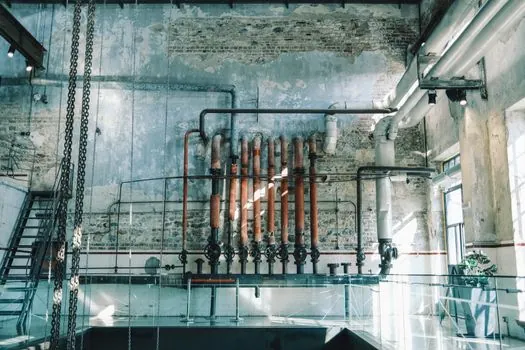
The three engineering choices that drive a freezer ASD design are pipework material, sampling-hole layout, and detector sensitivity class. ABS pipework is the most common for inside-freezer runs because it handles thermal cycling between -40°C and ambient without becoming brittle, whereas PVC is acceptable where the pipe stays in the chiller or ambient zone [S5]. Sampling-hole count is governed by the manufacturer's design tool: a single 25 mm branch typically supports 10 to 25 holes depending on transport time, and the pipe must enter the cold room through the insulated panel via a sealed gland to avoid condensation ingress [S5][S6].
On detector class, the cold-store guidance from VESDA literature recommends at least Alert plus Fire-1 dual-thresholding so the fire panel can trigger investigation at the incipient stage and evacuation or suppression release only on confirmed smoke [S3]. Compared head-to-head, ABS vs PVC pipework matters most for thermal-cycle durability, sampling-hole density matters most for transport-time uniformity, and detector class matters most for nuisance-alarm rate under heavy evaporator airflow.
Limitations, false-alarm sources, and failure modes
Condensation clouds from freezer defrost cycles are the single biggest source of nuisance alarms, which is why ASD manufacturers insist on pipe-entry glands, slope-back fall on pipe runs toward the cold side, and a monitored filter [S3][S4]. Heavy forklift activity in loading bays also generates diesel particulate that can drift into a poorly placed sampling hole, so the pipework layout must avoid the direct plume of vehicle exhaust [S1].
Failure modes are largely mechanical: a sampling pipe that ices up because the gland failed, a filter that loads with dust and drops the effective sensitivity, or a blower that stalls during a power dip, and Securiton recommends installing the detector inside the refrigerated space only where the unit itself is rated for that temperature band, otherwise external mounting is mandatory [S6]. The Securiton ASD 535 product literature explicitly notes that mounting the head outside the cold room removes the need to break the insulated envelope, which preserves vapour-barrier integrity and limits thermal bridging [S6].
Standards, installation practice, and adjacent risks
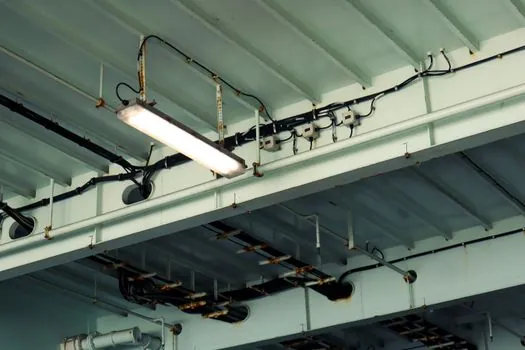
Industry guidance requires smoke detection at both the ceiling level and within the ceiling void, which is why most freezer ASD designs run a primary pipework grid at the underside of the insulated panels and a secondary set in the ceiling plenum, both feeding the same externally mounted detector [S3]. The same standards also drive the choice of aspirating smoke detector over a beam or spot type whenever the operating temperature sits below 0°C for sustained periods, and they cross-reference the broader fire and gas detection framework for any ammonia-refrigerated facility where refrigerant leak detection must be designed in parallel [S3][S4].
For sites that also handle flammable refrigerants or process chemicals, the pressure transmitter network used for ammonia leak detection and the industrial valve array on the refrigeration skid should be reviewed alongside the ASD layout so a single fire-panel event can trigger a coordinated isolation, and any change to the freezer envelope (for example adding a new loading bay door) must trigger a re-balance of the pipe network rather than a simple detector sensitivity bump [S1][S3].
The next two signals worth tracking are the publication of the next revision of NFPA 72 cold-storage annex guidance, which several ASD vendors are aligning their design tools to, and the first wave of VESDA-E VEA addressable-point retrofit installs in existing -30°C cells where adding new ceiling-level sampling holes is no longer practical. For engineers sizing a new build, the practical floor is a 25 mm ABS pipework grid, an external detector with at least Alert and Fire-1 thresholds, and a documented filter-change interval that matches the warehouse's loading-bay traffic.
Background reading: HART vs Foundation Fieldbus for Smart Valve Positioners: Protocol-Level Decision Guide.