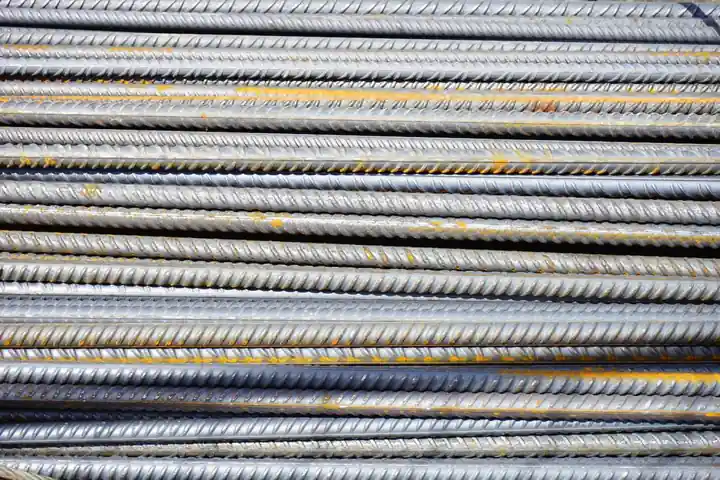
ASTM A615/A615M-26 deformed rebar is roll-embossed with two longitudinal ribs plus transverse lugs whose spacing, height, and angle are not decorative: the pattern is a controlled mechanical-interlock variable that sets the bond capacity of the bar in concrete [S2][S3].
The standard covers carbon-steel billet bars in Grade 40, 60, 80 and 100, with hot-rolled diameters typically supplied in 6-50 mm ranges, and the deformation geometry is a function of nominal bar diameter rather than a free-form manufacturer choice [S2][S5].
What the Rib Pattern Actually Is
ASTM A615 deformed bars carry two continuous longitudinal ribs running parallel to the bar axis, plus transverse lugs spaced at defined intervals around the circumference; the longitudinal ribs keep the bar aligned in the cage, while the transverse lugs resist pull-out [S1][S2].
Concrete is weak in tension, and the rib geometry is the parameter that transfers tensile load from the concrete matrix into the steel, so the pattern directly controls slip resistance and crack distribution in the surrounding concrete [S1][S3]. The five controllable parameters are rib height, rib spacing (lug pitch), rib angle, longitudinal-rib count, and the calculated relative rib area, which is the standardised metric for bonding effectiveness [S1].
Lug Spacing and Rib Height by Bar Size
Rebar lug spacing and rib height in ASTM A615 scale with nominal bar diameter: larger bars get proportionally larger lug pitch and lug height because the relative rib area, not the absolute lug dimension, is what the standard controls [S3][S5].
Nominal diameters and weights per U.S. customary units from the standard sizing chart are #3 (0.375 in, 0.376 lb/ft), #4 (0.500 in, 0.668 lb/ft), #5 (0.625 in, 1.043 lb/ft), #6 (0.750 in, 1.502 lb/ft), #7 (0.875 in, 2.044 lb/ft), #8 (1.000 in, 2.670 lb/ft), #9 (1.128 in, 3.400 lb/ft), #10 (1.270 in, 4.303 lb/ft), #11 (1.410 in, 5.313 lb/ft), #14 (1.693 in, 7.650 lb/ft), #18 (2.257 in, 13.600 lb/ft) [S5]. Lug spacing and lug height are stated as maximum- and minimum-distance values on the bar itself, with the typical industrial range on standard A615 bars running roughly 0.7-1.0 times the nominal diameter for maximum lug spacing, and lug height in the 4-6 percent of nominal diameter band on production bars [S3].
How Lug Spacing and Height Are Measured
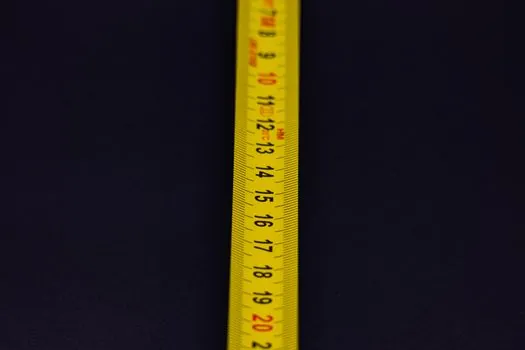
Acceptance on the production line uses a go/no-go ring gauge plus a caliper for rib height: the bar must pass through the gauge across its full length, which simultaneously checks that lug spacing is not too tight, lug height is not too low, and the bar section is not undersized [S3].
The same gauge test catches the common failure modes: missed or undersize lugs (no mechanical interlock), double-rolled or over-high lugs (stress concentration that cracks the surrounding concrete cover), and incorrect lug angle (poor force transfer at the bar-concrete interface) [S1][S3]. Relative rib area, calculated from lug spacing, lug height, and the gap between lugs, is the single number that best predicts bond performance and is what the standard's geometry is engineered to hold constant across bar sizes [S1].
ASTM A615 vs Adjacent Standards: Selection Map
ASTM A615 is the default carbon-steel billet rebar, but engineers should know the sibling specs because they are not interchangeable: ASTM A706 is low-alloy steel with controlled carbon and weldability for seismic applications, ASTM A767 is zinc-coated for corrosion resistance, ASTM A775 is epoxy-coated for chloride exposure, and ASTM A996 covers rail-steel and axle-steel bars [S4].
For chemical anchorage, threaded A615 bars are accepted in the same category as A722 for cast-in-place concrete piles under New York City Building Code 2022 Section 1812.7.2.1, which is a useful precedent when designing rebar couplers or headed bars on a rebar project [S4]. Where bending accuracy and consistent rib pattern matter downstream, a CNC rebar bender is only as good as the inbound lug geometry, because out-of-spec lug height jams the bend shoes and shifts the bend angle. The four practical decision criteria when picking among A615, A706, A767 and A775 are: weldability (use A706 or A615), corrosion exposure (A767 zinc or A775 epoxy), seismic detailing (A706 mandatory for special moment frames in many U.S. jurisdictions), and cost (A615 is the lowest-cost baseline) [S1][S4].
Where Rib Geometry Actually Matters on Site

Bond-critical applications, including high-rise beam-column joints, bridge decks, mat foundations, and any splice relying on lap length rather than mechanical couplers, are the cases where lug spacing and rib height dominate design capacity rather than bar area alone [S1].
High-bond rib patterns with larger lug height and optimised angle are commonly specified for seismic zones and heavy-load structures, with the trade-off being that excessively high lugs can crack the concrete cover and reduce fatigue life of the bar itself [S1]. Rebar couplers and headed-bar terminations, increasingly used to reduce congestion at column-slab junctions, offload the bond demand from the rib pattern to a mechanical element, so rib geometry becomes a secondary rather than primary parameter on those connections.
Common Failure Modes From Out-of-Spec Ribs
Poor rib design causes reduced load transfer efficiency, increased crack width, and structural instability, with the most frequent root causes being non-uniform lug spacing from worn rolling-mill passes, lug height below the minimum go-gauge dimension, and over-high lugs that spall the concrete cover under load [S1][S3].
Lug spacing that is too tight creates stress concentration between adjacent lugs, while spacing that is too wide lets the bar slip inside the concrete before the lugs engage, both of which fall outside the relative-rib-area window that A615 sets [S1]. Plain round bars, by contrast, rely solely on chemical adhesion and friction, which is why deformed A615 bars are required by code wherever bond strength governs, such as in stirrups, ties, and main reinforcement in beams and slabs [S3].
Supply and Sourcing Notes for 2026
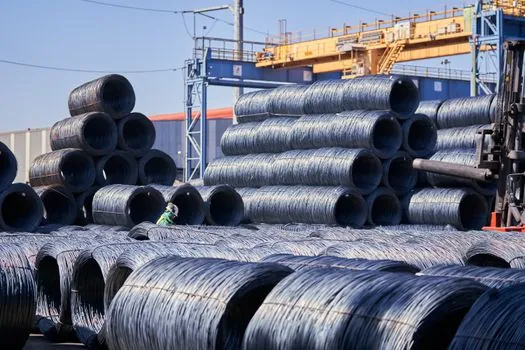
ASTM A615/A615M-26 is the current edition cited in the September 4, 2026 supplier guidance, and Chinese mills are offering hot-rolled deformed rebar from 6-50 mm diameter in ASTM A615 Grade 40, 60, 80, and 100, with Grade 75 also available on request and JIS and GB grades supplied on the same product lines [S2].
For 2026 procurement, the actionable signals are: (1) confirm the ASTM edition referenced on the mill test certificate, because A615/A615M-26 is the version the September 4, 2026 sourcing guidance points to, and (2) verify lug pattern acceptance by requesting the go/no-go ring gauge result rather than relying on a generic "deformed" label, since the relative-rib-area check is what actually separates a compliant bar from a non-compliant one [S2][S3].
This topic is covered further in Curing compound cost per m² at 5 m²/L coverage, 2026.