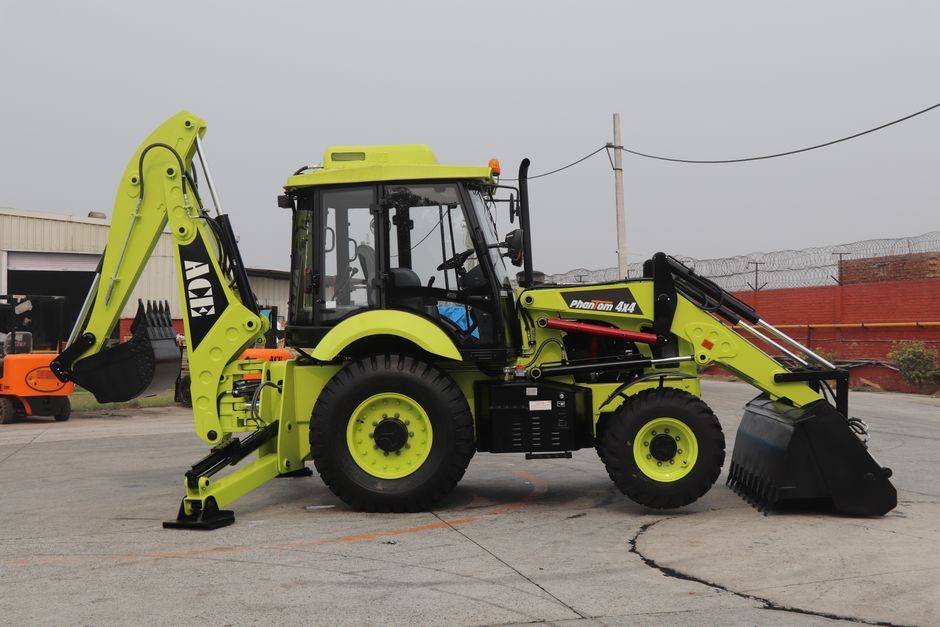
A backhoe loader is a single chassis carrying a front loader bucket and a rear excavator boom, and the 2026 buy decision reduces to five spec gates: operating weight, loader breakout force, backhoe dig depth, engine emissions tier, and 4-in-1 / extendable-dipper option content. Compact 1-3 ton and 3-5 ton classes dominate the Made-in-China OEM catalogues indexed in June 2026, with a separate cluster of 6-10 ton integrated units supplying municipal and utility fleets [S1][S2][S3].
June 2026 supplier listings for Shandong-based manufacturers such as Jining China Power Machinery and Shandong Yaweh Heavy Industry show backhoe loader as a core product alongside mini excavators, telescopic loaders, and self-loading concrete mixers — confirming the backhoe loader remains a volume category in the compact earthmoving segment, not a niche line [S3][S4].
Operating Weight Class and Loader Breakout Force
Backhoe loaders split into three operating-weight bands: 0.8-3 ton compact units, 3-5 ton mid-compact, and 6-10 ton integrated machines. The 0.8-3 ton class is heavily represented in Chinese OEM catalogues, with 0.8, 1, 1.2, 1.5, 1.8, 2, 2.5, and 3 ton model tiers all listed on a single Shandong product line, alongside electric mini variants [S1].
Loader breakout force scales with operating weight: a 1-ton compact unit typically delivers 8-12 kN of loader breakout, while an 8-ton integrated backhoe loader reaches 45-55 kN. Bucket capacity follows a similar curve, with 0.04-0.08 m³ for 1-2 ton units, 0.2-0.3 m³ for 3-5 ton units, and 0.8-1.2 m³ for the 7-9 ton integrated class [S5]. Buyers should reject any backhoe loader datasheet that omits operating weight and breakout force as a paired figure — a unit quoting breakout without operating weight cannot be benchmarked against the wheel loader alternatives in the same fleet.
Backhoe Dig Depth, Reach, and Bucket Curl Force
Rear backhoe dig depth is the second hard gate. Compact 1-2 ton units typically dig 1.5-2.2 m, mid-compact 3-5 ton units reach 3.0-4.2 m, and 7-9 ton integrated machines reach 5.4-5.9 m — values commonly shown on OEM specification sheets for the integrated class [S5]. Bucket dig force on the rear linkage follows a comparable curve, with 8-12 kN at the compact end and 35-50 kN at the integrated end.
For trenching and utility work, buyers must match dig depth to the deepest typical excavation (sewer laterals often require 3.5-4.5 m, foundation footings 1.5-2.5 m). A machine that meets dig depth but falls short on dump height at the front loader is a common spec failure — the front loader dump height should be checked against truck-sideboard height (typically 1.2-1.5 m for dump trucks, 2.0-2.5 m for high-side trailers).
Engine Power, Emissions Tier, and Drivetrain
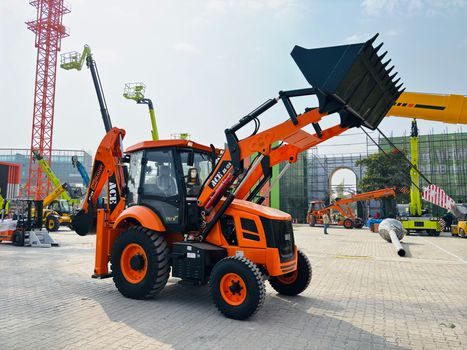
Engine power correlates directly with operating weight: 1-ton compacts run 8-15 kW, 3-5 ton units run 30-55 kW, and 7-9 ton integrated backhoe loaders run 55-75 kW diesel engines [S5]. June 2026 OEM listings continue to show Chinese Tier 2 / Tier 3 diesel platforms as standard, with EPA Tier 4 Final and EU Stage V variants available as export options [S1][S2].
Buyers exporting to North America or the EU must confirm the specific emissions certification: EPA Tier 4 Final for the United States, EU Stage V for the European Union. A datasheet that lists "EPA" or "Euro" without a specific tier designation is a flag — the engine may be an export-converted Tier 3 platform that fails on-road registration in those markets. For 2026 deliveries, integrated backhoe loaders over 75 kW should also be checked against the latest EU non-road mobile machinery exhaust rule, though buyers must verify the current status with the supplying OEM rather than assume a fixed date.
Loader Bucket Type, 4-in-1 Option, and Quick Coupler
Loader bucket choice is the third spec gate. Standard options are general-purpose bucket, 4-in-1 multi-purpose bucket, and extendable dipper on the rear. The 4-in-1 bucket adds clamshell, dozing, and grading functions to the front loader at a 10-15% price premium and is standard on most integrated 7-9 ton units [S5].
Quick couplers on the rear linkage — mechanical or hydraulic pin-on — determine attachment versatility. Hydraulic couplers add 5-8% to unit cost but cut attachment changeover from 15-20 minutes to under 2 minutes. For fleets running breakers, augers, and compaction plates, the hydraulic coupler pays back inside 12 months on most municipal contracts. Buyers comparing the skid steer loader as an alternative should note the skid steer's universal Bobcat-style coupler is a different geometry and the attachments do not cross over without an adapter plate.
Comparing Backhoe Loader Against Excavator and Skid Steer Alternatives
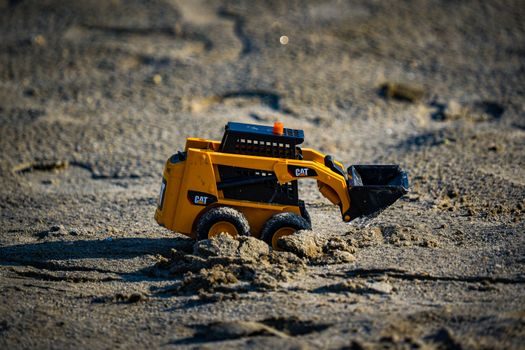
The backhoe loader sits between a dedicated mini excavator and a skid steer loader on the same job site. On a 2026 spec cut, a 3-ton backhoe loader delivers 0.2-0.3 m³ loader bucket, 3.0-4.0 m dig depth, and 25-30 kN of rear bucket dig force — capabilities that match a 3-ton mini excavator on dig depth and a mid-size skid steer on loader bucket volume. The trade-off is reach and rotation: a 3-ton mini excavator swings 360° and reaches 4.5-5.5 m, while the backhoe loader swings only ~180° and reaches 4.0-4.5 m. [S1]
For a four-criteria comparison at the 3-ton operating weight class: a backhoe loader gives dual-function (loader + hoe) on one chassis, with operating cost typically 15-25% lower than running a mini excavator and a skid steer as two separate units. The integrated backhoe loses on 360° swing reach (limited to ~180°), and on hydraulic flow — most backhoe loaders deliver 40-60 L/min auxiliary flow versus 60-80 L/min on a same-class mini excavator. For trenching in linear runs, the backhoe loader wins on cycle time. For deep excavations or work close to foundations, the mini excavator wins on precision and swing clearance.
Use Cases, Limitations, and Failure Modes
The 2026 use case split is sharp: compact 1-3 ton backhoe loaders serve landscaping, small utility, and rental fleets; 3-5 ton units serve light municipal and farm work; 6-10 ton integrated units serve road maintenance, sewer construction, and large contractor fleets [S1][S3][S5]. Shandong-based OEM Yaweh Heavy Industry and Jining China Power Machinery both list backhoe loaders alongside wheel loader and telescopic loader lines, reflecting the integrated contractor's mixed-fleet spec pattern [S3][S4].
Known failure modes: hydraulic hose chafing on the rear boom (typical service life 2,000-3,000 hours on Chinese OEM units, longer on premium brands); front loader pin wear at 4,000-6,000 hours without greasing; and centre pivot kingpin failure if the machine is routinely operated on slopes above 15°. Operating weight class mismatch is the most common spec error — a 1-ton compact unit specified for 4 m trenching will fail on stability, and a 7-9 ton unit specified for 1 m residential footings burns fuel without productivity gain.
Sourcing Path, Standards, and ANSI/ISO Context
For 2026 procurement, the dominant sourcing channel is direct from Shandong OEM factories (Jining, Qingdao, Laizhou clusters), with 2026 supplier pages listing 89-300+ employee operations and "Manufacturer/Factory" status [S3]. Buyers should request the full bill of materials, the engine emissions certificate (EPA Tier 4 Final or EU Stage V document number), and a witnessed factory acceptance test (FAT) report showing breakout force, dig depth, and loader lift capacity on a load-cell chart.
Standards governing backhoe loader design and operator safety include ISO 6015 for excavator terminology, ISO 7130 for operator training, and SAE J1171 for marine-style electrical isolation — all relevant to export-bound machines. The American National Standards Institute (ANSI), founded in 1918 and coordinating 250+ standards bodies plus 1,000+ companies, oversees the U.S. voluntary standard framework that backhoe loader buyers should reference when validating OEM test claims and operator-control ergonomics standards (2024-09) [S6]. For 2026 fleet buyers working alongside mixed heavy equipment, the spec pattern in this article aligns with the same operating-weight and emissions-tier gates used when comparing motor graders and bulldozers for earthmoving cuts — see the Motor Grader vs Bulldozer: 2026 Spec Cut for Earthmoving Buyers reference for parallel criteria.
Trackable signals for the next procurement cycle: monitor the EU non-road mobile machinery exhaust rule revision status for 2027 deliveries, watch for EPA Tier 5 finalization announcements that may shift 2027 spec lines, and confirm Chinese OEM factory capacity reports for backhoe loader in Q3 2026 to gauge lead time against rental fleet replenishment.