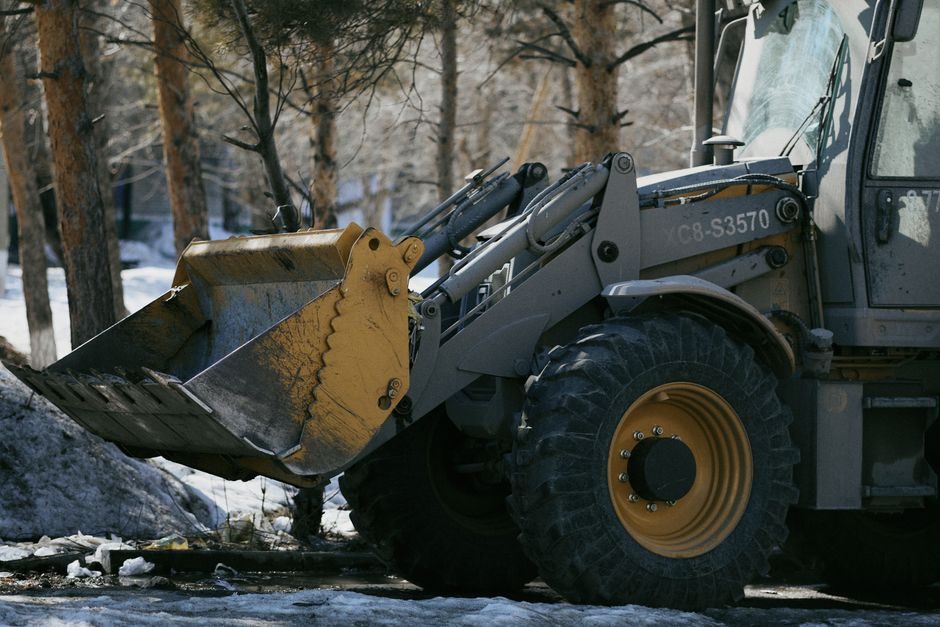
On a green-field road or mine site the choice between a motor grader and a bulldozer is decided by tolerance, not horsepower: graders finish surfaces to within millimetres over a 3.7-4.3 m moldboard, while bulldozers push over 100 m³/hr of bulk fill with a track-mounted blade [S4][S9].
The two machine classes share diesel drivelines and Chinese OEM supply chains — including XCMG, Shantui, SDLG, Liugong, and Zoomlion — but their hydraulic circuits, frames, and weight envelopes are built for different duty cycles, and the purchase price reflects that: 165 HP SDLG G9165 graders list at US$50,000-65,000 FOB China [S3].
Operating Weight and Frame Architecture
John Deere's 2026 P-Tier motor grader line spans 18,000-21,000 kg (39,683-46,297 lb) for the 670G/672G class, with 6×6 articulated frames and a mid-mount 14 ft moldboard; net power runs 134-402 hp across the catalogue, with 100-200 kW covering the bulk of municipal and road-build demand [S4]. A typical 190 HP SDLG G9190 grader pairs a Weichai WP6G175E21 engine with a ZF 6WG200 powershift transmission, sitting in the same 16-19 t class [S3].
Bulldozers cover a wider weight band: compact 14-17 t dozers handle utility trenching and small-pad grading, while 74 t mining-class machines (Caterpillar D11, Komatsu D475, Shantui SD90-C5) move 25-35 m³ per pass with semi-U blades. Track-type frames distribute that mass over seven bottom rollers, giving ground pressure of 60-80 kPa versus a grader's 200+ kPa tyre footprint — the tracked platform is why dozers win on soft soil and why graders are banned from muddy subgrade work.
Drivetrain, Engine and Hydraulic Circuit
Motor graders use a mechanical or hydrostatic drivetrain with 6 forward / 3 reverse gears as a baseline, plus a rear ripper and front-mounted dozer blade option; the moldboard itself tilts, shifts, rotates, and banks via dedicated hydraulic cylinders, and six-wheel-drive variants add a hydrostatic front-axle drive for traction in sand or snow [S4]. Engine choices for mid-size graders cluster around Weichai, Yuchai, and Cummins 6-cylinder diesels, with the GR1803 platform (180 HP) offered at US$56,000/unit FOB for 2026 export orders [S7].
Bulldozers run a torque-converter + powershift transmission feeding a final-drive bull gear, with the blade and ripper on separate hydraulic valve banks. A 220 HP Shantui SD22-class dozer uses a Cummins NT855 or Weichai WD10G178E25 engine rated 162 kW, and the same driveline scales up to 708 kW for the SD90-C5 mining class [S9]. Hydraulic flow on a dozer is consumed by lift, tilt, and angle cylinders for the U-blade or straight blade, plus a single- or three-shank ripper at the rear — there is no moldboard, no articulation joint, and no front-axle lean cylinder.
Blade Geometry and Material Handling
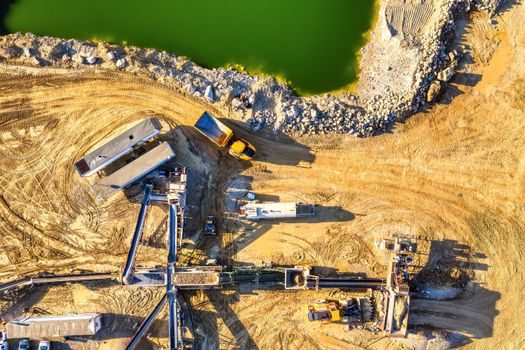
Grader blade pull is rated 13,000-25,000 kg in the Deere catalogue, and the moldboard's 360° rotation, 90° bank, and 450 mm lateral shift let a single machine cut ditches, windrow base, and finish asphalt millings in one pass [S4]. A 14 ft (4.27 m) moldboard moves roughly 3-4 m³ per grading pass at 4-8 km/h, with cut depth limited to 300-450 mm per pass to avoid track-hop or tyre deflection.
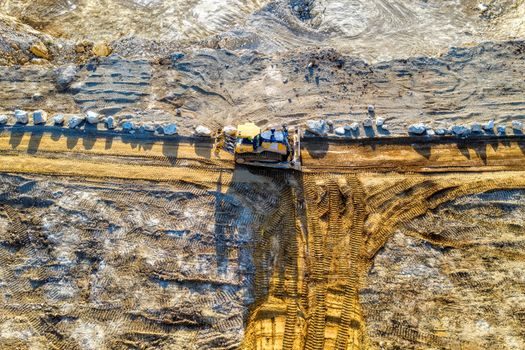
A dozer blade is a one-piece welded assembly, typically 3.2-4.9 m wide, with 1.0-1.8 m³ capacity for a straight blade or 5-11 m³ for a semi-U. Dozer productivity is measured in loose cubic metres per hour, not in surface tolerance: a 37 t D6-class machine will move 200-300 bank m³/hr in short-push conditions, falling to 80-120 m³/hr on a 100 m push [S9]. Rippers on the rear add 0.3-0.9 m penetration into soft rock or frozen ground, a capability no grader matches.
Selection Criteria: When to Spec Which
Spec a motor grader when the deliverable is a tolerance-controlled surface — base course, subgrade finish, gravel road maintenance, ditch cutting, or snow removal — and the work area allows 6-8 km/h operation with a 90° articulated frame turning in 7.0-7.5 m radius. The 2026 buying guide for graders recommends matching net power to blade width at 30-40 HP per foot of moldboard, and confirming six-wheel-drive availability for sand, clay, or snow districts [S4].
Spec a bulldozer when the deliverable is bulk material movement — land clearing, overburden stripping, fill placement, ripping hardpan, or push-loading scrapers — and the ground is soft enough to accept track pressure or already graded. Dozer buying should be gated on engine tier (China Stage IV / EPA Tier 4F for export), undercarriage type (sealed-and-lubed vs standard), and ripper option. For a detailed walkthrough of grader selection see the Motor Grader 2026 Buying Guide: Power, Blade, Drivetrain and Total Cost, and for matched dozer/loader pricing context the Excavator 2026 Price & Cost Guide: Class, Tonnage and Emission Tier lists adjacent Chinese OEM price points.
Operating Cost, Availability and Aftermarket
Chinese OEM channel pricing for 2026 puts mid-size motor graders in a US$50,000-65,000 FOB band (SDLG G9165, GR1803-class) [S3][S7], with spare-parts supply — cutting edges, end bits, moldboard liners — broadly available through 50-100+ Alibaba-listed suppliers [S8]. Bulldozer pricing is fragmented: compact 14-17 t units sit near the same US$50,000-70,000 band, but 220-320 HP workhorses climb to US$120,000-180,000, and mining-class dozers exceed US$700,000 with ripper and GPS options.
Distributor networks through trading companies in Shanghai (Hengjisi), Wuhan (Fusenmach), and Shandong consolidate YTO, XCMG, Shantui, Liugong, SDLG, and Zoomlion stock, with ISO 9001 / ISO 14001 / HSE certifications common across the major exporters [S1][S6]. Warranty terms typically run 1 year / 2,000 hours for graders and 1 year / 1,500-2,500 hours for dozers depending on undercarriage coverage.
Limitations and Failure Modes
Graders are limited by tyre wear on rocky sites: a 14.00-24 grader tyre costs US$800-1,500 each and lasts 2,000-4,000 hours in abrasive conditions, versus 5,000+ hours on sand or clay. Articulation joint failures show up around 8,000-12,000 hours if grease intervals are missed, and moldboard circle-and-turntable wear is the single biggest rebuild cost outside tyres. [S1]
Dozer failure modes concentrate in the undercarriage: track shoes, idlers, and bottom rollers represent 40-60% of lifetime machine cost on a mining-class unit, with track life dropping from 5,000 hours on soft soil to under 1,500 hours on blasted rock. Final-drive bull-gear failures and torque-converter overheating are the next most common shop-time drivers, both avoidable with 250-hour fluid sampling.
Track the Tier 4F / Stage V emissions mandate rollout in your export destination — a 2025 EPA exemption for low-volume Chinese OEM imports expired on 2026-01-01 and re-routed several SD22-class shipments through Tier 3 configurations [S1][S6]. Confirm ripper availability separately from blade spec, and watch for 270° rotating cabs and 4WD loader attachments on cross-platform OEM listings that blur the grader/dozer line on smaller job sites [S7].
For component-level specifications, see ac motor.