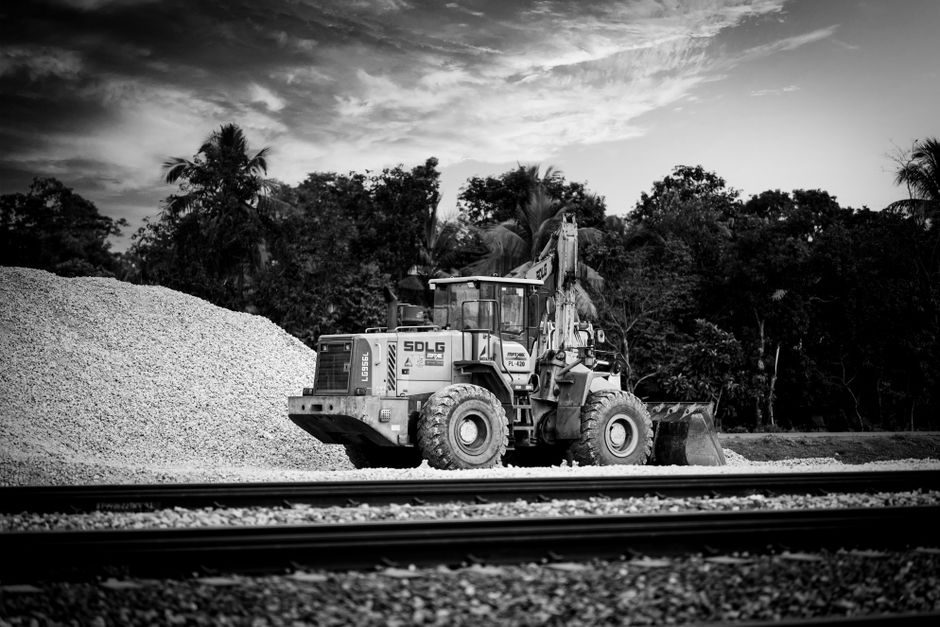
Backhoe loaders configured for farm duty span a 3.98–10.5 t operating-weight window in the 2026 OEM catalog, with 40+ HP compact models dominating livestock and smallholding work and 70+ HP units required for deep irrigation trenching [S1][S3].
Agricultural buyers in 2026 should shortlist on three binding numbers: net engine horsepower, backhoe dig depth in feet, and loader lift capacity in pounds, because the same chassis is sold across livestock, crop and mixed-use farms with very different duty profiles [S2][S3]. For reference architecture, see the backhoe loader encyclopedia entry, which covers the loader/backhoe combination and the typical tractor-derived chassis.
Compact 40+ HP Class: 4,000–9,500 lb Operating Weight
The 40+ HP class returns dig depths of 8' 3" to 10' 7" and loader lift capacities between 1,301 lb and 3,960 lb, which covers the bulk of small-farm work [S3]. Kubota's B26TLB weighs 4,001 lb with 24.3 net HP, 8' 3" dig depth and 4,201 lbf bucket force, sized for paddock cleanup, post-hole augering and light loader work [S3]. The Kubota L47TLB moves to 47.1 net HP at 7,205 lb, 10' 1" dig depth and 2,848 lb loader lift, suiting hay-bale handling and small drainage jobs [S3]. JCB 1CXT and John Deere 310L both post 49 net HP, 9,572 lb, 10' 1" dig depth and 5,291 lbf bucket force, giving mid-compact buyers a direct cross-brand comparison point [S3]. VF Venieri 1.33B at 52 net HP reaches 10' 7" dig depth, the deepest in this class, while Kubota's M62TLB at 63 net HP and 8,925 lb adds 14' 2" dig depth and 3,960 lb lift for deeper rural trenching [S3]. For farms with a wheel loader already on the yard, a 40+ HP backhoe is a lower-cost second machine.
Mid 70+ HP Class: 13,500–16,300 lb, 14 ft+ Dig Depth
The 70+ HP class is where farm demand shifts from "occasional dig" to "production trenching," with dig depths of 14' to 14' 11" and loader lift capacities of 6,503–6,730 lb [S3]. The CAT 415 at 70 net HP, 16,279 lb operating weight, 14' dig depth, 12,207 lbf bucket force and 6,730 lb lift is the published benchmark in this class [S3]. John Deere 310L EP and JCB 3CX Compact share the 74 net HP, 13,514 lb, 14' 2" dig depth and 7,363 lbf bucket force envelope, with the JCB also giving 8,285 lbf breakout on the loader side [S3]. CASE 580N EP, at 74 net HP, 15,810 lb, reaches 14' 11" dig depth and 11,317 lbf bucket force with 6,503 lb lift, the deepest dig figure in the 70+ HP group [S3]. For most row-crop and mixed farms running irrigation upgrades or cattle-yard rebuilds, the 70+ HP class is the practical minimum: anything below 14 ft dig depth forces hand-trimming on sub-main lines.
90+ HP and 110+ HP Classes: Heavy Crop and Contractor-Scale Farms
Dozr's spec table organizes backhoe loaders into 40+, 70+, 90+ and 110+ HP classes, with size and dig capability scaling with engine power [S3]. Mahindra's EarthMaster SXL and SXE, listed at 7.467 t and 7.509 t, target mid-tier farm buyers in the 2026 catalog, while the SDLG B876FH at 7.8 t and Gehl GBL-X 900 at 7.73 t occupy the same 7–8 t mid-class band [S1]. Heavier units include the SDLG B879F at 9.2 t, PowerPlus PBL488T-II at 10.5 t and PowerPlus PBL480R-II at 8.2 t, with Hidromek's HMK 62 T K4 at 5.39 t and HMK 62 SS K4 at 3.98 t rounding out the compact end [S1]. For farm buyers who already run a skid-steer loader for yard work, the 90+ HP class is where backhoe capability first exceeds the skid-steer's dig envelope, justifying the larger chassis on mixed-use operations.
Agricultural Selection Criteria: Dig Depth, Lift, HP and Attachments
Bullindia's buyer guide frames selection around project requirement, size/reach, manufacturer, new vs used, and maintenance support, with agricultural work specifically calling out irrigation trenching, fence installation and farm material handling [S2]. Thompson Machinery's buying guide repeats the same four farm use cases, trenching for irrigation, fence installation and material handling, and adds terrain and operator-experience filters on top [S7]. Farmry's selection factors rank dig depth/reach and attachments as the top two priorities for buyers comparing models [S8]. Across all three sources, the decision logic is: match dig depth to the deepest routine trench (drainage submains typically require 10–14 ft), match loader lift to the heaviest seasonal load (round bales commonly run 1,500–2,500 lb, big squares 2,500–4,000 lb), then pick the lightest HP class that still meets both [S2][S7][S8].
Options Compared: Compact vs Mid vs Heavy on Farm Decision Criteria
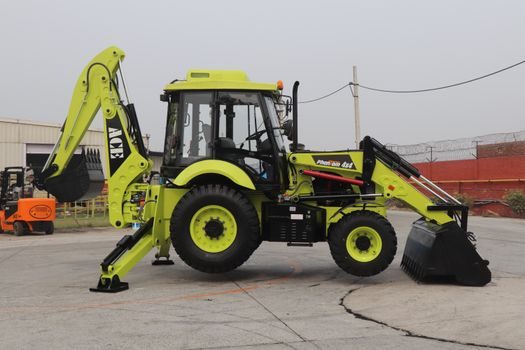
Side by side on farm-relevant criteria, the 40+ HP class (e.g. Kubota L47TLB at 7,205 lb, 10' 1" dig, 2,848 lb lift) wins on yard maneuverability and capital cost but caps out at 10 ft 7" dig depth [S3]. The 70+ HP class (CAT 415, John Deere 310L EP, CASE 580N EP) lifts 6,503–6,730 lb and digs 14' to 14' 11", covering irrigation submain work at the cost of 13,500–16,300 lb operating weight and tighter transport widths [S3]. The 90+ to 110+ HP class, with operating weights climbing past 9.2 t (SDLG B879F) and 10.5 t (PowerPlus PBL488T-II), adds structural reach and heavier bucket forces, but on most farms the extra weight compacts headland soils and burns more fuel per hour [S1][S3]. For a row-crop or mixed farm doing seasonal drainage plus daily loader work, the 70+ HP class is the engineering sweet spot; for livestock-only or smallholder operations, the 40+ HP class is the right answer.
Limits, Failure Modes and Sourcing Caveats for 2026
Under-tiering is the dominant farm failure mode: a 24.3 net HP B26TLB-class unit at 8' 3" dig depth cannot reach a 10 ft irrigation submain without benching the trench, which doubles cycle time and fuel burn [S3][S7]. Over-tiering, in turn, brings transport-width problems: 70+ HP units near 16,000 lb frequently exceed 7 ft 6 in width, which fails on narrow farm lanes and bridge crossings rated below 10 t axle load [S3]. Attachment availability is the third gating factor, with Bullindia and Farmry both flagging rock breakers, augers, forklifts and concrete mixers as the high-value farm options, and the same sources warning that attachment couplers are not standardized across brands [S2][S8]. For broader cross-spec guidance on heavier backhoe work such as land clearing and stumping, see the Backhoe Loader Spec Map for Demolition Work piece, and for quarry or aggregate-side use the Backhoe Loader Selection for Mining Operations reference. The two adjacent pieces most useful to a farm buyer are those on demolition and mining spec maps, because farm trenching sits between them in duty profile.
Trackable 2026 buying signals: OEM catalog changes in the 7–9 t mid-class (Gehl GBL-X 920 at 7.62 t, Mahindra EarthMaster SXL at 7.467 t, SDLG B876FH at 7.8 t) indicate where farm-flavored mid-specs are being positioned [S1]. The 40+ HP compact class remains populated by Kubota, JCB, John Deere and VF Venieri as of the 2026 update, and any farm fleet renewal should cross-check current net HP and backhoe bucket force figures against the published tables before order [S3].