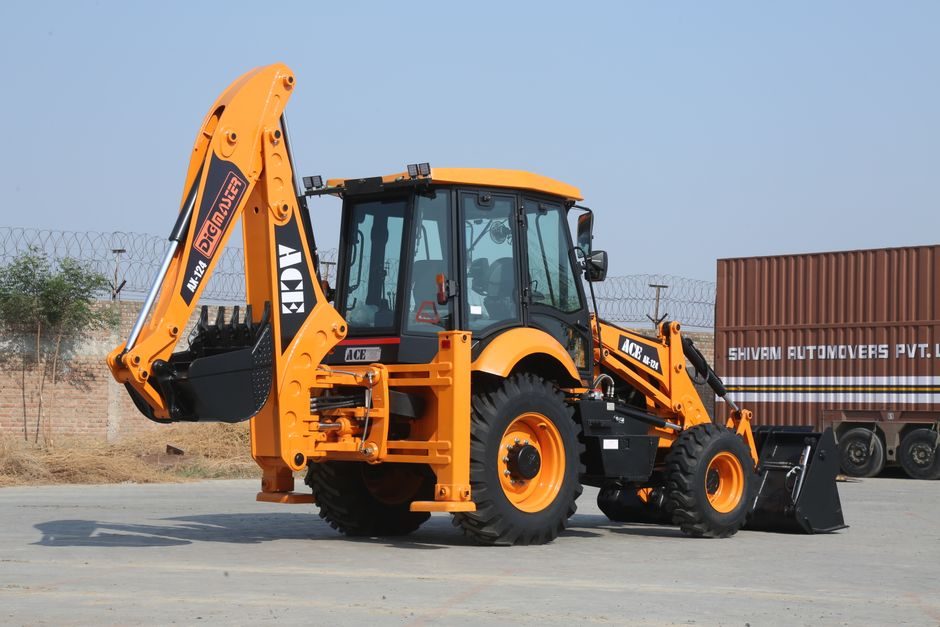
Tunneling crews that try to use a 70 HP class backhoe inside a 3 m finished bore usually lose the argument on breakout force first, then on tail-swing clearance. Three OEM spec sheets put the working numbers on the table: the procurement spec for a state-fleet Backhoe (Attachment H) sets a minimum 11,100 lbf breakout force for the Super Duty bucket class and 10,200 lbf for the standard class, with a 96 in. bucket-width ceiling [S1].
Cross-checked against the DOZR backhoe spec matrix, only 90+ HP and 110+ HP models consistently clear those breakout and lift thresholds; the CAT 415 at 70 HP posts 12,207 lbf bucket force but only 6,730 lb loader lift, while the JCB 3CX Compact at 74 HP drops to 7,363 lbf [S2]. For tunnel headings, that gap is the reason a spec-driven pre-select matters more than brand loyalty.
Tunnel Geometry vs. Machine Envelope: Why the 96 in. Bucket Rule Exists
Standard backhoe buckets are specified at 96 in. maximum width so the bucket clears the outside edges of the front tires on transport [S1]. Inside a tunnel, that 96 in. envelope is also the binding constraint against a 2.4-2.6 m rail gauge or shotcrete sidewall clearance. The SANY SLB95 ships at 7 ft. 6 in. (2,280 mm) transport width with a 12 ft. 3 in. (3,732 mm) transport height and 11 ft. 5 in. (3,491 mm) stabilizer overall width [S3] — the stabilizers, not the bucket, are usually the first item to clip the tunnel wall when the heading narrows below 3.5 m.
For shotcrete-lined rail tunnels, the loader-end hinge pin height drives muck-car loading reach. The Caterpillar 434F brochure lists a 3,909 mm loading height in standard stick and 4,487 mm in extensible-stick configuration, with a maximum 2,641 mm loading reach on the longest stick [S5]. A standard 14 ft. dig-depth backhoe is therefore the right answer for a 4 m high heading with side-dump cars; extensible stick (18 ft.+) is mandatory only when the invert sits more than 4.5 m below the loader hinge pin.
Backhoe Class Comparison for Tunnel Duty
Four criteria line up the realistic candidates: net horsepower, backhoe dig depth, bucket dig force, and loader lift capacity. The table below distills the published numbers [S2][S3][S5][S7]:
40+ HP class (Kubota L47TLB at 47.1 HP / 7,205 lb / 10 ft. 1 in. dig depth / 5,825 lbf bucket force) is ruled out for any heading work — the dig depth is short of the 14 ft. floor set in tunnel procurement specs and the 5,825 lbf breakout is roughly half the Super Duty threshold [S1][S2].
70+ HP class (CAT 415, JCB 3CX Compact, CASE 580N EP) is the borderline band: dig depths land between 14 ft. and 14 ft. 11 in., but loader lift drops to 6,503–6,730 lb [S2]. Inside a tunnel, that lift is acceptable for muck cars but marginal for segment handling, where 7,400 lb is the typical lift gate [S1].
90+ HP class (SANY SLB95 at 95 HP / 16,623 lb operating weight / 14 ft. 3 in. dig depth / 1.3 yd³ loader bucket / Deutz TCD3.6-L4 Tier 4 Final) is the practical floor for tunnel mucking where production rate matters [S3].
Side-shift 110+ HP class (Caterpillar 434F side-shift variant) extends dig force to 63,433 N (≈14,250 lbf) and stick dig force to 47,173 N with the longest stick, while keeping stabilizer width at 2,352 mm [S7] — a useful package when the tunnel profile forces offset digging against a curved wall.
Diesel Particulate Risk in Confined Headings
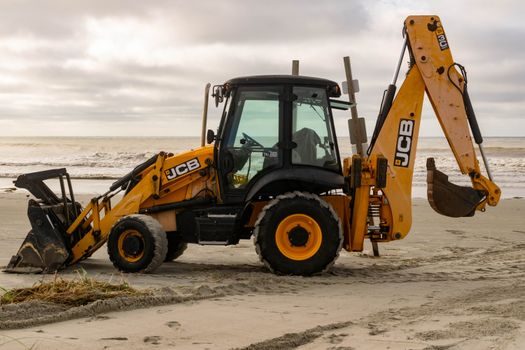
Underground diesel particulate is regulated in most jurisdictions; the SLB95 ships Tier 4 Final on a 3.6 L Deutz TCD3.6-L4 with a 220 in³ displacement, plus a 120-amp alternator and 165 Ah / 850 CCA battery, ROPS/FOPS cab, 3 in. retractable seat belt, ground-level electrical disconnect, and positive terminal battery covers as standard [S3]. Tier 4 Final is the current U.S. underground baseline; non-Tier 4 machines are typically rejected at the safety-plan stage regardless of hydraulic performance.
Ventilation math, not the engine spec, is what finally constrains a backhoe inside a dead-end heading. With a 99 hp gross / 95 hp net output at 2,200 rpm and 302.4 lb-ft torque at 1,600 rpm [S3], the SLB95 demands roughly 5,000–6,000 cfm of fresh air at the face for dilution ventilation. If the heading cannot deliver that, the spec drops to a smaller machine — which then fails the breakout-force gate, and the cycle starts over.
Hydraulic Head and Attachment Match-Up
The SLB95's load-sensing hydraulics with Kawasaki axial-piston pump deliver 41.2 gal/min (156 L/min) at 3,625 psi (24.9 MPa) system pressure, with a one-way aux line at 21 gal/min and 2,103 psi [S3]. That envelope runs a hydraulic breaker cleanly, but it also sets a hard ceiling on what a side-shift backhoe can push through a 180° swing arc — the 434F side-shift data sheet quotes a 180° swing arc across all stick variants, with 205° bucket rotation and 2,352 mm stabilizer width held constant regardless of stick length [S7].
For a tunnel that demands 18 ft. dig depth (extensible stick) plus breaker plumbed to the end of the stick, the loader's parallel-lift linkage and return-to-dig become non-optional features; the SLB95 lists both, plus a dedicated breaker circuit, as standard [S3]. A unit without breaker plumbing and return-to-dig is a poor tunneling buy, because muck-face scaling and trimming cycles dominate the shift.
Selection Gate for Tunnel Pre-Qualification
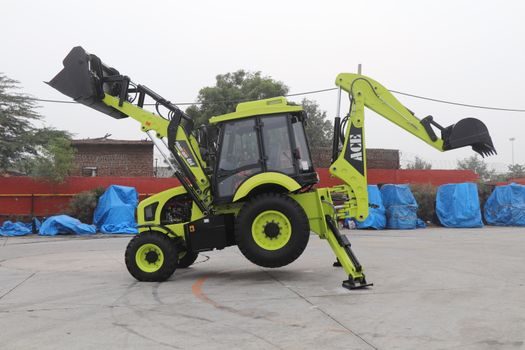
A spec-driven pre-qualification on five gates catches most tunnel bids before mobilization: dig depth ≥14 ft. for general heading work, ≥18 ft. only for shaft or deep invert work; bucket dig force ≥11,100 lbf per the procurement Super Duty class [S1]; loader lift capacity ≥7,400 lb to full height per the same spec [S1]; transport width ≤96 in. bucket and ≤2,400 mm chassis for 2.4-2.6 m gauge tunnels; Tier 4 Final diesel with ROPS/FOPS and 3 in. retractable seat belt as standard equipment [S3]. The 70+ HP class is ruled out at gate 2 or 3; the 40+ HP class is ruled out at gate 1. The 90+ HP class is the practical floor; 110+ HP side-shift units are the answer when a curved profile or 18 ft. dig depth is mandatory.
Field Failure Modes Specific to Tunnel Work
Three failure modes show up repeatedly in tunnel-spec audits. First, sidewall clipping by the stabilizer when the 3,491 mm stabilizer span [S3] is not measured against the 2,800-3,200 mm finished tunnel gauge — the workaround is retracted digging with a narrower stabilizer footprint, but that halves machine productivity. Second, muck-car loading geometry failure: a 3,909 mm standard loading height [S5] leaves the operator hand-loading the last 0.5 m into a side-dump car; extensible stick at 4,487 mm loading height [S5] closes that gap. Third, hydraulic-oil overheating on continuous loader-lift cycles: 31.7 gal (120 L) hydraulic reservoir [S3] is sized for intermittent agricultural duty, not the 45-second muck-cycle of a tunnel round — operators typically need an auxiliary cooler to keep the loop below 80 °C on long rounds.
For an overall project frame, the backhoe loader spec reference covers the general selection matrix, while for adjacent high-head pump sizing the multistage centrifugal pump selection spec map lines up with the dewatering side of a tunnel job, and for steel liner or rebar handling on the segment side, the carbon steel selection spec map carries the material-spec rules that frequently gate the segment ring supply chain. Two signals to track over the next quarter: any OEM bulletin revising Tier 4 Final ventilation guidance for heading lengths above 500 m, and any state DOT or transit-authority tunnel procurement that tightens bucket-width or stabilizer-span language below the current 96 in. / 2,352 mm baselines [S1][S7].
The underlying component specifications are covered under wheel loader, and skid steer loader.