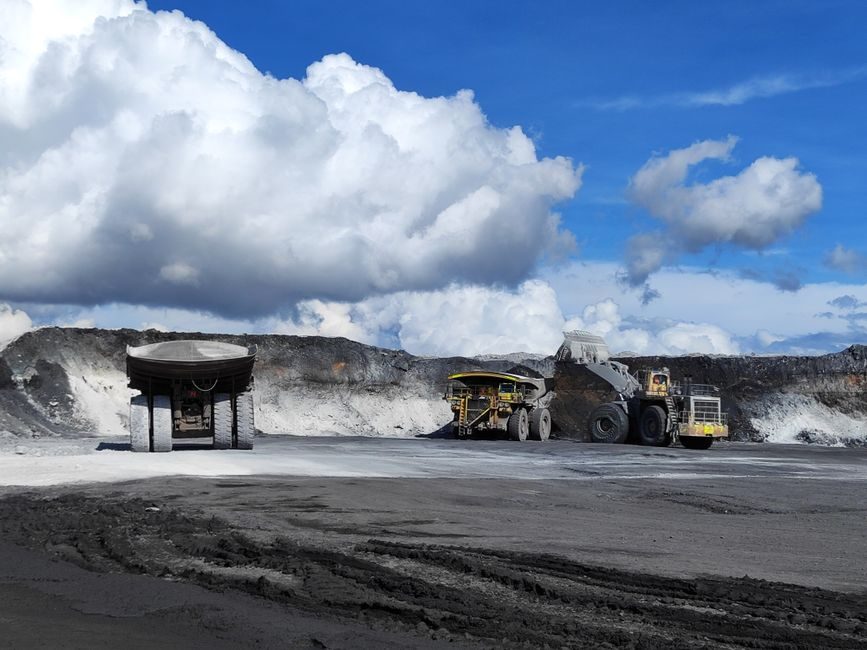
Backhoe loaders specified for hard-rock quarrying sit in the 90-110+ HP class because shot rock, fractured limestone, and granite benches punish smaller machines with bucket-bending breakout forces and accelerated undercarriage wear [S3].
The selection logic diverges sharply from general construction: quarry duty rewards mass, hydraulic flow, and reinforced loader arms over the agility and transportability that make 40-70 HP units popular on urban sites [S1][S3].
HP Class Brackets and Why 90+ Is the Quarry Floor
The DOZR spec catalog tiers backhoe loaders into 40+ HP, 70+ HP, 90+ HP, and 110+ HP size classes, with operating weights scaling roughly from 4,000 lb at the compact end to over 20,000 lb at the top of the range [S3]. The 40+ HP bracket — typified by the Kubota B26TLB at 24.3 net HP, 4,001 lb operating weight, and 8 ft 3 in dig depth — is positioned for landscaping, farming, and hay-bale handling rather than aggregate production [S3].
For quarrying, the practical floor sits at the 90+ HP class where backhoe dig depth climbs to roughly 14-17 ft and bucket breakout force is high enough to fracture weathered cap rock or pry fragmented shot material from the muckpile [S3]. 70+ HP units remain useful for soft-material sites, light utility trenching, and stockpile cleanup, but their lighter frames and lower hydraulic flow translate to shorter component life under abrasive loading [S3].
Matching Frame, Hydraulics, and Powertrain to Rock
Operating weight drives loader-lift capacity and rear-stabilizer reaction force — both of which must exceed the worst-case breakout load the bucket can deliver, or the machine will lift off its rear wheels during a hard pry [S3]. Across the spec tables, loader lift capacity scales from roughly 1,300 lb on a 40+ HP Kubota B26TLB to over 8,000 lb on 110+ HP machines in the same comparison set [S3].
Engine selection also matters: quarry work favors diesel powertrains with high torque rise and heavy-duty cooling packages, typically meeting EPA Tier 4 Final / EU Stage V emissions standards for non-road mobile machinery (NRMM), and paired with power-shift or hydrostatic transmissions sized for continuous loaded tramming [S7]. Hydraulic systems are typically load-sensing, with auxiliary flow published in the 25-40 gpm range at rated pressure to drive hammers, compactors, and tilt buckets used in face clean-up [S7].
Selection Criteria: A Side-by-Side of the Four HP Classes
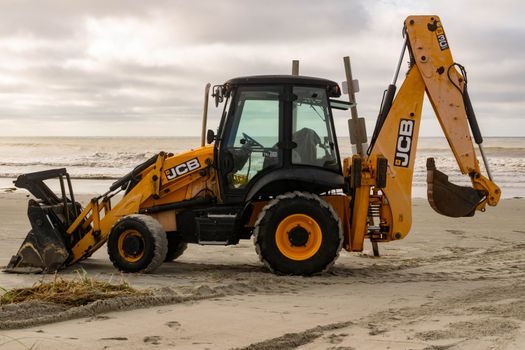
Comparing the four brackets on five decision criteria gives a clean spec map for quarry planners. At the 40+ HP class, operating weight centers on 4,000-9,000 lb, backhoe dig depth runs 8-14 ft, loader hinge pin height sits around 7-10 ft, and recommended applications are landscaping, farming, and light utility work — not quarry face loading [S3].
At 70+ HP the operating weight climbs to 12,000-15,000 lb, dig depth reaches 14-15 ft, hinge pin height approaches 11-12 ft, and the machines are positioned for mid-size construction, roadwork, and light aggregate handling [S3]. At 90+ HP the operating weight sits in the 15,000-19,000 lb band, dig depth ranges 15-17 ft, hinge pin height clears 12 ft, and the units are well matched to quarry face loading, blast-hole clean-out, and aggregate stockpile rehandling [S3]. The 110+ HP class pushes weight to 20,000 lb and beyond, dig depth beyond 17 ft, and is the bracket of choice for high-tonnage quarry production and primary loading duties where a small wheel loader would otherwise be deployed [S3].
Where Backhoe Loaders Fit — and Where They Do Not
A backhoe loader is the right tool for quarry support duties: cleaning shot rock from bench toes, backfilling blast holes with stemming material, loading tracked or wheeled haul trucks under 20-ton payload, and maintaining drainage in pit-floor sumps [S1][S3]. The combination of a front loader and a rear excavator in one chassis lets a single operator switch between loading and digging without repositioning — a meaningful productivity gain on small-to-medium aggregate pits [S3].
It is the wrong tool for primary hard-rock excavation or sustained high-tonnage truck loading. In those roles, dedicated crawler excavators paired with wheel loaders move 3-5x more material per shift, and rigid-frame mining trucks handle longer haul distances more efficiently than backhoe-loader-based fleets [S1]. For confined urban demolition or interior finishing, the skid steer loader and compact backhoe loader remain more appropriate, as covered in our demolition spec map.
Real-World Spec: A Quarry-Duty Reference Point
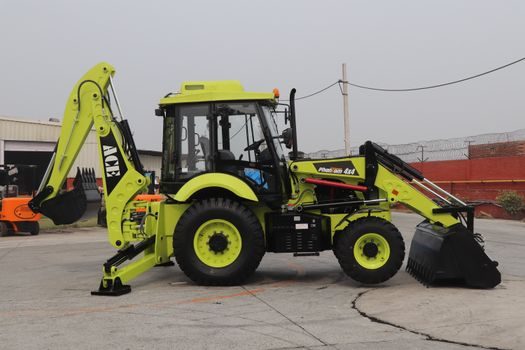
A representative 90+ HP backhoe loader for quarrying typically pairs a 90-100 HP diesel engine, 17,000-19,000 lb operating weight, 15-17 ft maximum digging depth, 12-13 ft loader hinge pin height, and a 1.0-1.3 cu yd standard loader bucket [S3][S7]. Reference benchmark: the Cat 434 series lists hydraulic tank capacity of 42.0 L in the OEM datasheet, with overall machine dimensions of 15 ft 6 in length and 13 ft 4 in transport height in the published spec sheet [S7].
Export-market alternatives from Chinese OEMs such as the ZTW30-25 list operating weight of 7,840 kg (~17,275 lb), a Cummins 4BT3.9-C100 engine rated 75 kW, 1.0 cu m rated loader bucket, 0.3 cu m backhoe bucket, 5,150 mm maximum digging radius, and 2,626 mm maximum dump height — with FOB pricing reported in the $23,400-26,500 range on Made-in-China marketplace listings [S2]. Buyers should note that the ZTW30-25 is a 6-9 t rated load class on the marketplace listing and falls below the 90+ HP quarry floor on engine power [S2].
Standards, Sourcing, and Buyer Checkpoints
Specifying a quarry backhoe loader should be anchored against ISO 6015 for backhoe loader performance definitions and the relevant NRMM emissions tier for the operating region (EPA Tier 4 Final in North America, EU Stage V in Europe) [S7]. Operator station certification, ROPS/FOPS to ISO 12117, and hydraulic-line burst ratings per ISO 6162 are baseline expectations that buyers should verify against the OEM datasheet rather than marketing copy [S7].
For a parallel spec deep-dive on the 70+ HP class for road construction, our road construction backhoe loader spec map covers the bracket below the quarry floor. Where a project requires demolition-grade backhoe duty rather than aggregate production, the demolition backhoe loader spec map is the closer reference. For broader fleet planning across excavators, dozers, and haul trucks in quarry and open-pit operations, the POWERPLUS fleet selection guide walks through a structured project-requirements methodology [S1].
Trackable next signal: watch for 2026 OEM updates to Tier 4 Final / Stage V aftertreatment packaging on 90-110 HP backhoe loaders, which tends to increase hood length and reduce forward visibility — a known spec-change that should be cross-checked against updated OEM dimensional drawings before placing fleet orders.