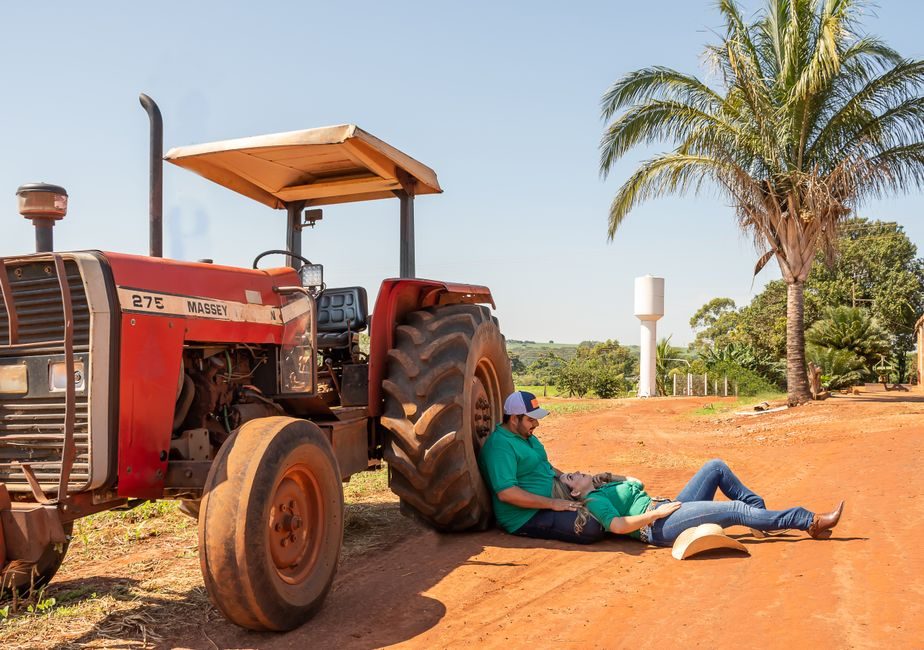
For agricultural land leveling and seedbed preparation, single-drum ride-on rollers in the 1-3 metric ton class with 32-54 inch drum widths and selectable vibratory frequency (typically 30-50 Hz range) are the most commonly specified platform, with Ammann tracing its corporate origin to agricultural equipment in 1869 before pivoting to compaction [S1][S3].
Farm applications diverge from highway work in three ways: target material is unsaturated topsoil or sandy loam rather than hot-mix asphalt, target compaction is 90-95% Proctor (lower than road subgrade), and pass-count tolerance is high because field productivity per hour matters more than smoothness [S3][S7].
Operating Weight and Drum Width Bands for Farm Use
Ride-on tandem rollers used in road work span drum widths of 32-84 inches and operating weights of 1.4-13.6 metric tons (3,000-30,000 lb) across the Ammann catalog [S1]. For agricultural seedbed work the effective window is the lower end of that band, where a 1-3 t machine with a single 36-48 inch drum delivers enough ground pressure to firm a seedbed without pulverizing soil structure or compacting below the tillage layer [S3][S6].
Pull-along rollers, with drum widths of 14-32 inches and weights well under 1 t, are sized for orchards, vineyards, and small-plot hobby farms where maneuverability outweighs productivity [S1]. For row-crop operations over 20 ha, the 32-54 inch ride-on segment is the practical minimum, and anything above the 84 inch / 13.6 t ceiling cited for tandem road rollers [S1] becomes a tracked soil compactor that over-consolidates farm soils.
Vibration Frequency and Amplitude vs Soil Type
Compactive force on a vibratory roller is governed by two parameters: frequency (vibrations per minute) and amplitude (drum displacement per cycle), and pairing the wrong combination to soil gradation is the most common cause of either under-compaction or over-compaction in field prep [S6]. Cohesive soils — clay, silt, loam — call for padfoot (sheepsfoot) drums operating at lower frequency and higher amplitude to knead the layer; smooth-drum rollers at high frequency work better on granular sand and gravel [S7].
Two-drum tandem rollers carry both drums on a single chassis and are engineered for asphalt density, so their vibration circuits are tuned to bituminous mat behavior rather than the 90-95% Proctor targets typical of agricultural seedbed firming [S3]. On-farm, a single-drum vibratory ride-on with the rear axle on pneumatic tires gives the operator the option to switch vibration off for the final pass, which prevents the surface sealing that drives rainfall runoff and erosion [S3][S7].
Type Selection: Smooth, Padfoot, and Pneumatic
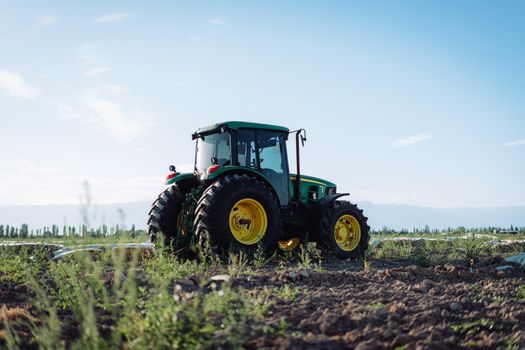
Three roller families cover almost every farm scenario, and the choice is driven by soil plasticity and crop residue rather than by horsepower or drum diameter [S7].
For comparison, pneumatic-tire rollers use cushioned rubber contact specifically because they reduce the chance of cracking or deformation in the finished surface — a quality that maps directly to seedbed integrity [S1]. Tandem two-drum steel rollers, the highway workhorse, are over-specified for farms because their dual-drum compaction forces too many passes at a frequency range designed for hot asphalt, not for the unsaturated soils described in standard agricultural seedbed prep [S3].
Field Use Cases and Pass-Count Guidance
Typical on-farm tasks include leveling land, breaking clods after primary tillage, firming the seedbed ahead of a precision drill, pressing cover-crop residue into the soil surface, and re-consolidating headlands and tramlines after harvest traffic [S3][S8]. For each of these, the pass count that a properly sized 1-3 t single-drum roller can deliver per hour (typically 0.4-0.8 ha/hr at 32-48 inch width and 4-6 km/h working speed) is the binding economic constraint, not the compactive force [S1][S3].
The roller is described in engineering references as a machine whose purpose is to "deliver a solid, stable, and smooth foundation" and to prevent shifting and sinking of the surface material [S8]. For farms that foundation is the seedbed, and the relevant stability metric is uniform seed-to-soil contact at a target bulk density of 1.2-1.5 g/cm³ for most row crops, rather than the 96-98% modified Proctor figures used in pavement subgrade design [S3][S8]. Related on-farm equipment such as the roller chain driveline that powers many of these machines, and the tapered-roller-bearing hubs on the drum, become failure-mode hot spots when vibratory settings are mismatched to soil.
Limitations, Failure Modes, and What to Skip
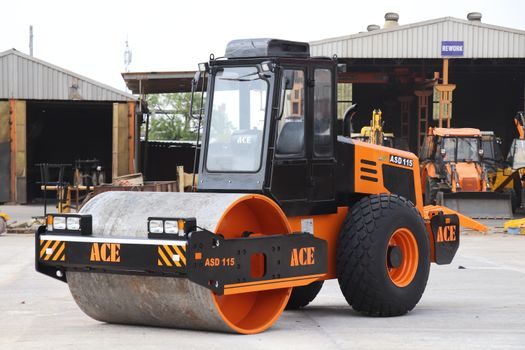
The first failure mode is over-compaction of the root zone: a tandem roller above 4 t operating at full amplitude on a moist clay loam will densify the top 15-20 cm past the point where crop roots can penetrate, and the resulting plow pan shows up as yield loss in the next two seasons [S3][S7]. The second is surface sealing: running a smooth-drum roller with vibration on at the final pass drives fines into the top 5-10 mm and forms a crust that sheds rainfall [S3].
Single-drum soil compactors and compactors designed for aggregate base are explicitly not interchangeable with farm seedbed rollers because their vibration circuits and weight distributions are tuned for 100% Proctor targets on engineered fill, not for biological soils [S1]. Pneumatic-tire rollers, while widely used in highway finish rolling, are heavier and designed for wider projects than most farm plots require, and their mass typically exceeds what is needed to firm a seedbed without sealing it [S1][S3]. For applications where the same fleet also services farm roads, lane construction, or livestock pens, the road roller encyclopedia page lays out the wider operating-weight bands and the type taxonomy that an on-farm buyer should map back to soil conditions rather than to highway spec sheets.
Sourcing, Brand Pool, and Standards
Major road roller brands active in the North American and European farm-equipment channel include Ammann, BOMAG, Caterpillar, Dynapac, HAMM, Sakai, Volvo, Wacker Neuson, and XCMG, with Chinese OEMs HengWang and Sany publishing 2026 selection guides aimed at this same buyer [S1][S2][S3]. Ammann's catalog of more than 20 tandem models spans 32-84 inch drum widths and 3,000-30,000+ lb operating weights, and the company itself traces its origin to agricultural equipment before pivoting to compaction in 1869 [S1].
For farm-spec buyers, the practical sourcing rule is to specify operating weight, drum width, frequency, amplitude, and drum type up front, then filter vendor catalogs to that envelope — a method published in the 2026 selection guides from both Sany and HengWang, which list the same decision parameters and the same OEM brand pool [S2][S3][S5]. Where the same fleet also handles infrastructure work, a side-by-side read of this agricultural spec map against the tunnel road roller selection guide and the port and terminal compaction spec map clarifies which operating-weight and drum-width bands are farm-specific and which are shared with civil infrastructure. The other reusable hardware inside the chassis — the crossed roller guide in articulated steering joints and the roller conveyor bearings on the vibrating drum shaft — should be specified to the same vendor service interval regardless of application, because vibration duty on a farm is no lighter than on a road job.
Trackable next signal: the 2026 Sany and HengWang selection guides both name the same six decision parameters (operating weight, drum width, frequency, amplitude, drum type, surface type) and the same brand pool, indicating that procurement templates for agricultural rollers have converged across Chinese and Western OEM channels as of 2026-04 [S2][S3]. Track also whether the 1-3 t single-drum smooth/padfoot segment picks up selectable-frequency hydraulics in 2027 model-year OEM releases, since that feature is the most reliable way to keep one machine usable across sandy and clay soils without changing drum shell.