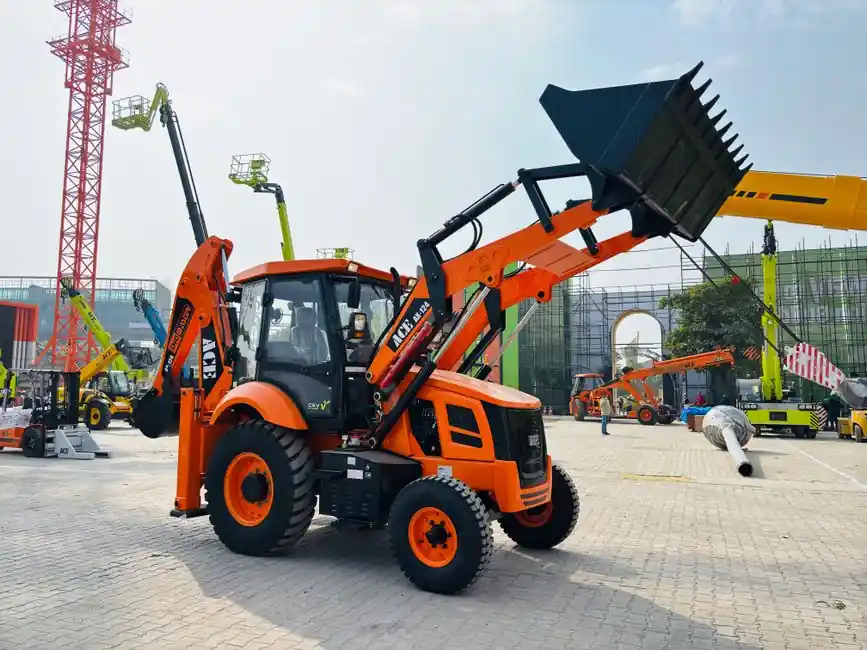
On dense urban sites, the 70-74 HP class backhoe loader (operating weight 13,514-16,279 lbs, dig depth 14 ft to 14 ft 11 in, loader lift 6,503-6,730 lbs) is the default fleet spec, with sidemount and compact variants slotted in for alley, utility, and last-meter trench work where center-mount geometry does not fit [S6][S2].
For procurement in 2026, three gates matter: machine footprint and turning radius on congested streets, dig depth matched to utility-trench class (telecom shallow vs. sewer deep), and a front-loader hinge height that can still load standard dump bodies inside a single-lane closure, all areas where the standard backhoe loader form factor must be validated against the actual street geometry [S1][S3].
Urban operating envelope: why the 70-74 HP class dominates
Published side-by-side data shows the CAT 415 at 70 HP / 16,279 lbs with 14 ft dig depth and 12,207 lbf bucket breakout, while the John Deere 310L EP and JCB 3CX Compact both sit at 74 HP / 13,514 lbs with 14 ft 2 in dig depth and 7,363 lbf bucket force, giving fleet buyers a clean weight-versus-power trade inside one spec window [S6].
Urban infrastructure work rarely needs the 90+ HP quarry-class machines; instead, the 70-74 HP band is the sweet spot because curb weight stays under 16,300 lbs (so the unit can cross older bridges and work on yard slabs without permits) while still delivering 14 ft-class dig depth for water, gas, and telecom laterals, a balance that compact excavators cannot match when a front loader is also required [S6][S3].
Center-mount vs. sidemount vs. compact: geometry for the street
Center-mount backhoes give the best balance and control for general construction with the backhoe locked to the chassis centerline, making them the default pick on open urban lots where the machine can square up to the trench [S2].
Sidemount backhoes slide the digging attachment to the side of the chassis, trading a little in-line stability for noticeably better visibility and the ability to dig parallel to a curb, wall, or existing utility without the rear of the machine swinging into traffic, which is exactly the geometry most urban-infrastructure contracts now write into the method statement [S2].
For alleys under roughly 8 ft wide, or for last-meter utility work where a full-size machine simply cannot enter, compact-class backhoes and skid-steer loaders are the realistic alternative, with the trade-off being smaller bucket breakout (often below 8,000 lbf) and reduced reach, so any project that pairs an alley-access spec with a 14 ft trench must spec the backhoe to the harder of the two constraints, not the easier one [S2][S6].
Hydraulics, GPS, and the precision-control layer
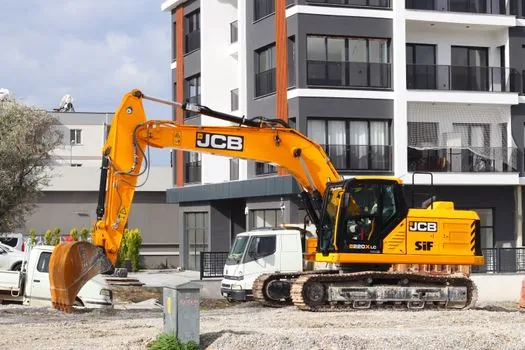
Modern backhoe loaders are now delivered with GPS-guided grading and refined electro-hydraulic valve control, which directly addresses urban tolerance bands on sewer laterals, fiber-trench depth, and finished grade, where re-work costs dominate the budget once a street is reopened [S3].
On the powertrain side, common platform practice is to drive the rear backhoe and the front loader off a single variable-displacement hydraulic pump with pilot or electronic joystick control, so the operator can feathering-grade with the backhoe while still cycling the loader, the exact combination of controls urban crews ask for when switching between trench, backfill, and load-haul in a single bay [S2].
This is also where the machine overlaps with a wheel loader on the front-end duty cycle: any spec that treats the loader side as a separate procurement often ends up with a mismatched hydraulic priority curve, so a single-machine, integrated spec is the safer urban-infrastructure choice.
Selection gates for urban procurement: a four-criterion compare
Lining the three main urban-fit options against the gates that actually matter in 2026 gives a clean decision: center-mount 70-74 HP for general urban lots (best balance, 14 ft-class dig, full loader duty); sidemount 70-74 HP for curb-side or wall-side trenching (best visibility, parallel dig); and compact backhoe / skid-steer loader combo for sub-8 ft alleys (best access, reduced dig depth and breakout) [S2][S6].
On the four standard decision criteria, center-mount scores high on stability and dig depth but loses on side-dig visibility; sidemount wins on visibility and side-dig geometry but gives up some in-line stability; compact units win on access and street footprint but lose on bucket breakout and reach, which is precisely why urban fleets now spec at least one of each class instead of trying to run a single machine across every work order [S2][S6].
Matching machine class to project type
For water and sewer laterals at 10-14 ft depth in mid-density streets, the 70-74 HP center-mount band (CAT 415, John Deere 310L EP, JCB 3CX Compact, CASE 580N EP at 15,810 lbs and 14 ft 11 in dig depth) is the correct spec, with the heavier 16,000+ lb units reserved where pavement and bridge ratings permit [S6].
For telecom and shallow power at 4-6 ft, a sidemount 70 HP class delivers faster cycle times because the operator can see the duct directly and the machine does not have to square up to the trench, and a compact or skid-steer loader handling backfill works well in parallel [S2][S6].
For last-meter work in dense historic cores, a compact backhoe sized for alley width is the only practical pick, and the procurement note must explicitly carry the trade-off: bucket breakout in the 7,000-8,000 lbf band, dig depth closer to 10-12 ft, and the front loader sized for rehandling rather than truck loading, a comparison that lines up with the broader pipeline-tractor spec logic in our backhoe loader spec map for pipeline construction and the agricultural duty-cycle logic in the 2026 agriculture spec map [S6].
Spec, sourcing, and known limits
Spec sources for any urban-infrastructure backhoe selection should start with the OEM datasheet (net HP, operating weight, dig depth, bucket breakout, loader lift, hinge-pin height) and cross-check against a third-party specs database such as LECTURA, which indexes roughly 170,000 equipment models and tracks fair-market values and hours-based residual curves across brands [S1].
The known hard limits of the 70-74 HP urban band are bucket breakout at 7,363-12,207 lbf, which is not enough for fractured rock or frost-bit ground, and a 14 ft-class dig depth that cannot reach deep trunk sewers; buyers who need either capability should step up to the 90+ HP class instead of overloading a center-mount urban machine, exactly the cut-over our 90+ HP quarry spec map describes in detail [S6].
Trackable signals for the next procurement cycle: OEM updates to electro-hydraulic joystick standardization across the 70-74 HP line, broader availability of factory-fit GPS/grade packages on entry-level urban trims, and any movement on telematics data fields for street-by-street utilization, all of which will tighten the spec on the next urban-infrastructure tender [S3][S1].