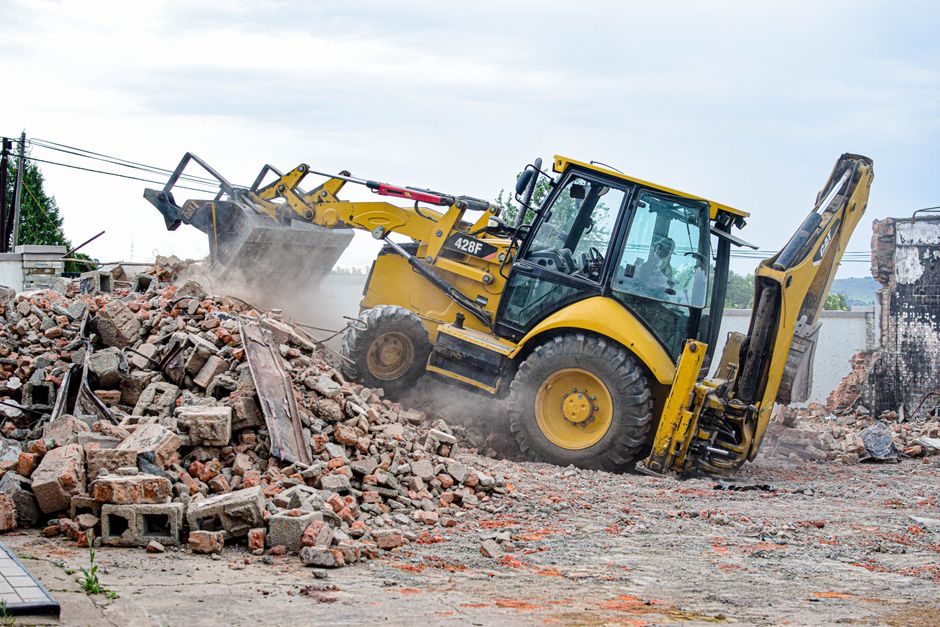
Forestry duty pushes a backhoe loader past the spec envelope it was designed for, so selection has to start from the woodlot task list, not from the brochure. Typical forestry use cases, including clearing, fire-line construction, road building, skid-trail repair, and landing work, span trenching, lifting, light dozing, and brush cutting, which is why a 70+ hp 4WD platform with a 14-21 ft (4.3-6.4 m) backhoe and a skid-steer-friendly quick coupler is the realistic floor [S1][S5].
The state procurement specification for integral medium-, heavy-, and super-duty backhoe loaders treats the machine as one pneumatic-tired unit carrying a diesel engine, a front-end loader bucket, and a rear-mounted integral backhoe, sized to "safely dig, break out, lift, carry and dump" the loads the bid lists [S1]. For forestry, the same definition holds, except the "loads" are stumps, log chunks, and slash, not bagged aggregate, which is why a backhoe loader frame rated for heavy- or super-duty service is the safer baseline.
Forestry duty profile and what it changes on the spec sheet
Forestry sites stress the cooling pack, the undercarriage, the front axle, and the front tires well beyond general construction duty, because brush, slash, and airborne debris continuously clog radiators and puncture rubber. Procurement-grade forestry specs typically require engine and hydraulic guarding, reinforced axle seals, heavy-duty front tires, and a reversible fan or auto-reverse fan option, even when the rest of the machine mirrors a standard contractor unit [S1][S2].
Engine power for the forestry envelope starts at about 74 hp (55 kW) for lighter work and rises toward 109 hp (81 kW) for the larger machines in the JCB 3CX/4CX family, with operating weights of roughly 16,820-20,940 lb (7,630-9,498 kg) [S3]. Bobcat's B760 backhoe loader sits in the same general contractor class and is explicitly marketed across forestry, landscaping, roadwork, and demolition, which signals that mid-frame machines are sized to absorb multi-sector work, not dedicated logging duty [S2].
Drive, hydraulics, and lift geometry that actually matter in the woods
Four-wheel drive with a limited-slip rear axle is the floor, and JCB pairs its 74 hp and 109 hp EcoMAX T4F blocks with an LSD rear axle and engine block heater as the baseline forestry-credible package [S3]. A hand-held tool circuit with hose reel is listed as a JCB factory option, which matters when the backhoe end is feeding a chainsaw mill, a wood splitter, or a small log-handling grapple off the machine's own hydraulic pump [S3].
Lift geometry, not just peak horsepower, is what limits forestry productivity, and the JCB 3CX/4CX spec sheet shows loader dump heights of 8 ft 10 in to 9 ft 0 in (2.69-2.74 m) and loader hinge-pin heights of 11 ft 4 in (3.45-3.46 m), values that set the real-world ceiling for stacking into a forwarder bunk or onto a landing pile [S3]. On the backhoe end, maximum dig depth for the 3CX/4CX family reaches 21 ft 4 in (6.50 m) with the extending dipper, which is the figure to use when sizing a machine for stumping, root-ball extraction, or deep fire-line trenching [S3]. Operators reading the digging-depth number should remember that Gregory Poole's engineering guidance treats max dig depth as the bucket teeth's lowest vertical reach below grade with the boom fully extended, not the depth at which the machine still has usable breakout force [S6].
Tyres, ground clearance, and frame dimensions on soft, rutted ground
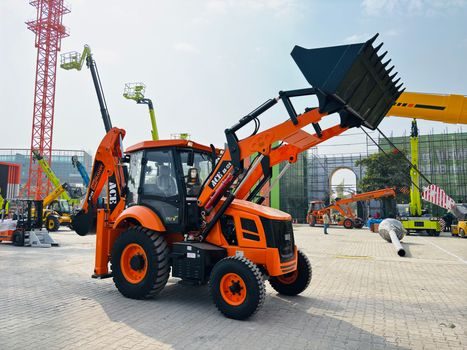
Forestry sites punish narrow rims and light sidewalls, so the JCB spec list offers a choice of front and rear traction or industrial tires in cross-ply or radial construction, including Sitemaster and Michelin brand patterns, as a factory option [S4]. Ground clearance numbers on the 3CX/4CX run about 1 ft 1 in (0.33-0.34 m) at the mainframe and 0 ft 11 in to 1 ft 6 in (0.28-0.45 m) at the front axle depending on the model, with the 4CX all-wheel-steer variants sitting higher at the front axle [S3].
Overall width with the bucket on a 3CX/4CX is 7 ft 9 in (2.35 m) across every variant, which is the constraint that decides whether the machine can straddle a single-lane skid trail or has to back down a narrow right-of-way, a real limiting factor on selective-cut timber sales [S3]. Transport length runs 23 ft 7 in to 25 ft 2 in (7.19-7.67 m), so planning a lowboy route and a landing turnaround is part of the spec conversation, not an afterthought [S3].
Attachment package for mulching, grappling, and brush cutting
A backhoe loader only earns its keep in the woods if the front coupler accepts a mulcher, a rotary cutter, a brush grapple, or a snow/dozer blade without adapters piling up. Bobcat lists mulchers, mowers and cutters, grapples, rippers and scarifiers, blades and grading implements, and brooms in its backhoe-loader attachment catalog, in addition to breakers, augers, and clamps, which is the full envelope a forestry contractor would expect to be able to swap onto a single host machine [S2].
On the rear, JCB's standard excavator bucket range runs 300 mm to 900 mm (about 12-36 in), with a deep-profile bucket offered as an option, so stump-hole cleanup and narrow trenching for water bars or irrigation on a landing can both be handled from the same dipper [S3][S4]. For heavier forestry attachments like a hydraulic thumb on the backhoe, a clutch-style quick coupler, or a high-flow auxiliary, the procurement spec instructs buyers to confirm flow, pressure, and return-line provisions on the host machine, because forestry tooling is more sensitive to under-specified hydraulics than light dirt-work buckets are [S1][S3].
Comparison: 40+ hp, 70+ hp, 90+ hp, and 110+ hp backhoe classes on forestry criteria
DOZR's spec guide groups backhoe loaders into 40+ hp, 70+ hp, 90+ hp, and 110+ hp size classes, and the split maps onto forestry work roughly as follows. A 40+ hp unit is borderline on forestry, useful for trail-light brush cutting and small stump work but short on hydraulic flow for serious mulching. A 70+ hp class, which covers machines like the JCB 3CX at 74 hp (55 kW), is the realistic entry point for sustained mulching and grapple work [S3][S5].
The 90+ hp class adds headroom for larger mulcher heads and heavier grapple cycles, and the 110+ hp class, which spans machines like the JCB 4CX at 109 hp (81 kW), is the right pick for production-scale right-of-way clearing where the operator is feeding a chipper or a forwarder for most of the shift [S3][S5]. Across all four classes, operating weight rises roughly with horsepower, the JCB range going from about 16,820 lb at 74 hp to 20,940 lb at 109 hp, which is the trade-off contractors have to price against soil compaction and trailer sizing [S3].
Who a forestry-spec backhoe loader is, and is not, for
For contractors, municipal public-works departments, utility right-of-way crews, and small-timber operators who need one machine that can trench, lift, doze, and power a range of hydraulics on a woodlot, a forestry-spec backhoe loader is the rational choice. It is not the right tool for full-time industrial logging, where a purpose-built forestry excavator or a dedicated skidder is safer and more productive, and it is not a substitute for a compact track loader when the dominant task is running a mulcher head in tight, steep terrain [S1][S2][S5].
Machines like the Caterpillar 416 center-pivot backhoe loader and the wider Cat backhoe line are aimed at the same general contractor, road-building, and utility market, so forestry use is feasible on them with guarding and tire upgrades, but it is a configuration choice, not the OEM's headline duty cycle [S7]. For buyers cross-shopping against the JCB and Bobcat lines covered in the spec sheet data, the practical filter is whether the dealer can deliver forestry guarding, an auto-reverse fan, and the right coupler hydraulics, not which badge is on the hood [S2][S3][S7].
Service fluids, cold-start, and uptime in remote blocks
Remote woodlots are unforgiving on service intervals, so the JCB 3CX/4CX service-fill numbers are part of the spec conversation: cooling system 18.5 L, fuel tank 160 L, engine oil with filter 15 L, gearbox with filter 16 L, rear axle 16 L, front drive axle 16 L, and hydraulic system including tank 117 L [S4]. An engine block heater, which JCB lists in its 74 hp and 109 hp configurations, is the cheapest cold-start insurance a forestry buyer can specify, because morning frost on a landing costs more than the option's price [S3].
Buyers should also confirm that the radiator, hydraulic cooler, and air intake are arranged for easy cleaning, that the machine carries forestry tire patterns from the factory, and that the dealer supports field-service routes into the operating area, since downtime in a timber sale is paid back in standing timber value, not in hourly rental rates [S1][S2][S4].
Selection criteria and a 1-2-3 sourcing checklist
Three engineering criteria dominate forestry backhoe-loader selection. First, choose the size class by the heaviest attachment you will run, not by the average bucket load, so that hydraulic flow and front-axle capacity are not the limiting factor on day one. Second, validate the rear backhoe's max dig depth and lift curve against the deepest stump or trench on the site, using the 21 ft 4 in (6.50 m) figure on the JCB extending dipper as an upper-bound reference [S3][S6].
Third, lock down the guarding, tire, and coupler options in writing before purchase, because aftermarket forestry guarding on a base contractor chassis costs more and fits worse than factory options ordered at bid time [S1][S2][S4]. For a deeper dive into 90+ hp heavy-duty machines on abrasive aggregate sites, a related spec map on quarry backhoe loader selection and the broader backhoe loader selection for mining operations walk through comparable sizing logic. A buyer weighing forestry against heavy dirt work can also compare against the demolition-focused backhoe loader spec map for demolition work to see how guarding, hydraulics, and lift ratings change by duty cycle.
Track these signals over the next buying cycle: OEM-published forestry guarding kits as a factory option rather than a dealer-installed add-on, expanding backhoe-loader attachment catalogs that include high-flow mulcher circuits, and dealer-published operating-cost data that separates forestry from general contractor duty cycles. Each of these is a real spec-sheet or catalog change, not a marketing reissue, and each will tighten what a forestry-spec backhoe loader can, and cannot, deliver on a woodlot.
The underlying component specifications are covered under wheel loader, and skid steer loader.