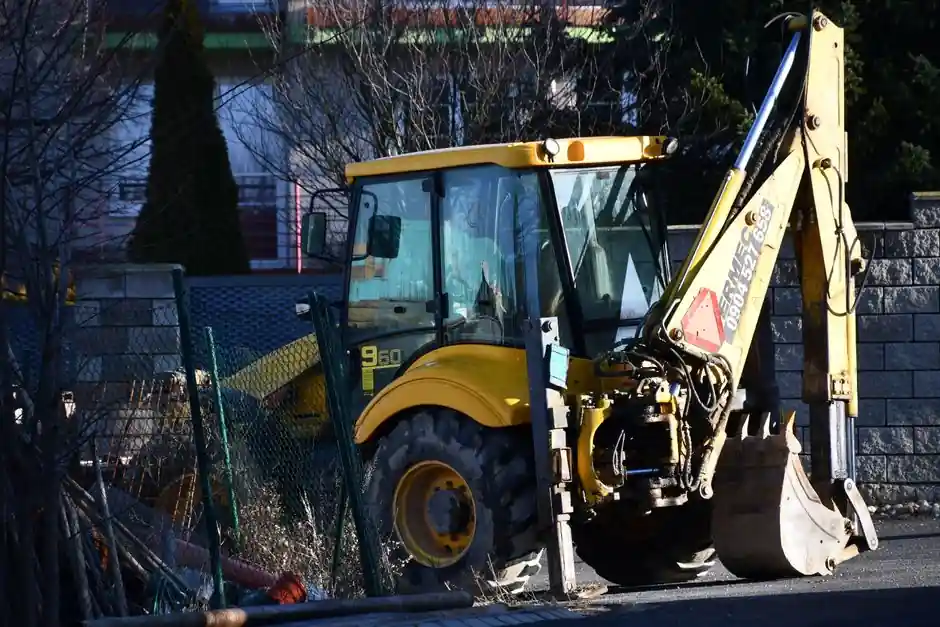
Pipeline trench work is governed by three numbers: pipe diameter, burial depth, and soil class, and the backhoe loader class should be selected to clear all three with margin, not merely to match the bucket width of the machine already on the yard [S2].
For utility and municipal water mains in the 4-24 in diameter range at 4-8 ft cover, the 70-100 HP class dominates: dig depths of 14-15 ft, backhoe bucket breakout of 7,363-12,207 lbf, and loader lift of 6,503-6,730 lb handle both excavation and backfill in one pass [S3]. Sub-50 HP compact units, with dig depths near 10 ft and bucket force under 6,000 lbf, are restricted to service-lateral tie-ins and shallow irrigation laterals, not trunk-line work [S3].
Class Boundaries and Where Each Fits on a Pipeline ROW
The 40+ HP class caps at roughly 14 ft 2 in dig depth and 6,572 lbf bucket force on the Kubota M62TLB, which is adequate for 2-4 in service lines at 3-4 ft cover but marginal for sewer laterals requiring 5-6 ft [S3]. Operating weights in this band sit between 4,001 lb (Kubota B26TLB) and 9,572 lb (JCB 1CXT, John Deere 310L), so trailer moves between spreads are cheap, but ground pressure is too low for clean trench walls in wet clay [S3].
The 70+ HP class, where the CAT 415 posts 14 ft dig depth with 12,207 lbf bucket force, the John Deere 310L EP and JCB 3CX Compact both deliver 14 ft 2 in at 7,363 lbf, and the CASE 580N EP reaches 14 ft 11 in at 11,317 lbf, is the default for water and sewer trunk work up to 24 in diameter at standard 4-6 ft cover plus pipe bedding [S3]. For deeper stormwater or force-main installations at 8-10 ft cover, the 90-110 HP class with 15-17 ft dig depth is the safer pick.
For a deeper cross-cut on machine-class mapping under tougher digging conditions, see the mining-oriented selection map, which uses the same HP bands but loads the comparison toward breakout force and ground clearance rather than trench geometry.
Spec Numbers That Actually Decide the Buy
Backhoe dig depth is the single most-misread number on a pipeline spec sheet: rated depth is measured from ground line with the machine on a flat, level pad, so a 14 ft machine only delivers about 12.5 ft of usable trench depth once a spoil pile, side slope, or shoring box is in the way [S3]. Plan the spread with a 1.5-2 ft margin between rated trench depth and the deepest pipe invert in the run, or the operator will be ramping the machine off cribbing to finish the last joint.
Loader-side numbers matter for backfill, not excavation. The CAT 415 lifts 6,730 lb to full hinge-pin height with 12,207 lbf breakout, and the CASE 580N EP lifts 6,503 lb with 11,317 lbf breakout, both enough to place a 1.25 cu yd heaped bucket of native or import backfill in one cycle [S3][S1]. Where the right-of-way is tight and the loader has to back-blade rather than side-cast, lift-to-hinge-pin height of 10 ft 6 in to 11 ft 5 in is the spec to compare, not the bare lift figure [S3].
Engine power sets the steady-state digging rate more than peak breakout. Tier 2/Tier 3 equivalent ratings of 68.5-74.5 kW (93-101 hp gross per ISO 14396) on the Caterpillar 434 powertrain are typical for the 70-100 HP class, with 64-70 kW net per SAE J1349, so a 14 ft trench in medium clay advances at roughly 30-50 ft per productive hour with a single operator [S5].
Public Tender Specs: What the Buyer Actually Writes
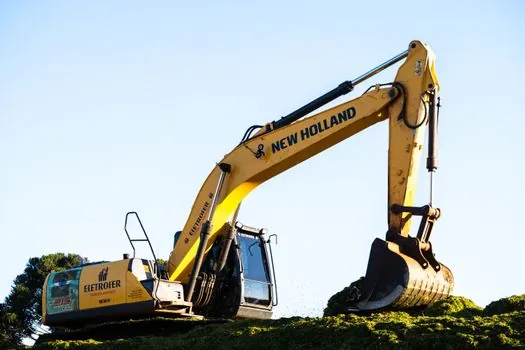
Municipal and state pipeline tenders do not specify a backhoe by brand. They specify a class of work and let the contractor match, so the spec language worth memorising is the envelope, not the model. The South Carolina procurement attachment H specifies a 1.25 cu yd heaped minimum bucket per SAE J742 (latest edition), 7,400 lb minimum lift to maximum height, 11,100 lbf minimum breakout force, dumping clearance under bucket of 8 ft 4 in minimum, and bucket width capped at 96 in and not extending past the front tire outside edges [S1].
Bucket width is the hidden constraint: a 96 in wide bucket on a backhoe with 88 in outside tire width lets the operator trim the trench floor flat in one pass, but anything wider forces a second cleanup pass and is typically disallowed by spec [S1]. For pipe-laying work, a 24-36 in trenching bucket on the same machine cuts a cleaner wall, and the 96 in bucket is reserved for the loader-end backfill pass.
WSSC Water and the Suamico standard specifications for pipeline construction (01411) carry the same logic at the segment-test level: air-test and mandrel-test segments are documented per pipe diameter and segment length, and the backhoe spread is implicitly sized to dig the full segment plus a working face at the bell hole, not just the nominal trench depth [S6][S7].
Selection Matrix: Matching Class to Pipe and Trench
Four decision gates cover most pipeline backhoe selections: [S2]
1. Pipe diameter 2-4 in at 3-4 ft cover in soft soil: 40+ HP compact, 8-10 ft dig depth, sub-6,000 lbf bucket force. Example: Kubota L47TLB at 47.1 HP, 10 ft 1 in dig depth, 5,825 lbf [S3].
2. Pipe diameter 6-12 in at 4-6 ft cover in mixed soil: 70+ HP, 14-15 ft dig depth, 7,000-12,200 lbf bucket force. Example: CAT 415 at 70 HP, 14 ft dig depth, 12,207 lbf [S3].
3. Pipe diameter 12-24 in at 6-8 ft cover with imported bedding: 70+ HP extended or 90+ HP, 14 ft 11 in to 16 ft dig depth, 11,000+ lbf bucket force. Example: CASE 580N EP at 74 HP, 14 ft 11 in, 11,317 lbf [S3].
4. Pipe diameter 24-48 in at 8-10 ft cover, deep stormwater or force main: 90-110 HP class, 15-17 ft dig depth, and 1.25 cu yd heaped bucket per SAE J742 to meet the 7,400 lb lift and 11,100 lbf breakout floor common in public specs [S1].
Soil class moves each row up or down one band: rocky or stiff clay conditions should bump the selection one HP class higher, and clean sand or previously trenched urban right-of-way will let a unit run one class lower than the nominal pipe-diameter pick.
What a Backhoe Loader Will Not Do on a Pipeline Job
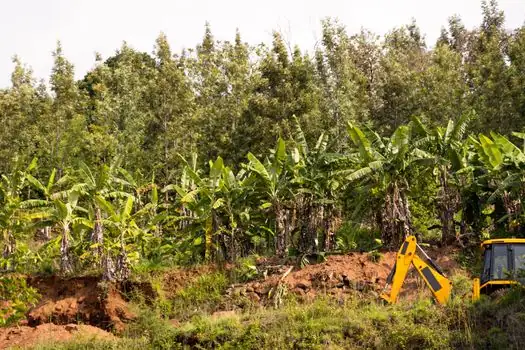
Backhoe loaders are not excavators. On long trunk-line work above 24 in diameter or 10 ft cover, a dedicated crawler excavator with a longer stick and higher bucket pin will out-produce a 90+ HP backhoe by a wide margin on steady-state trenching, even though the backhoe wins on mobility and the ability to backfill without a second machine. The deciding factors are trench length per day, not peak daily volume. [S2]
For trench shoring and shored bell-hole work, backhoe loaders are typically paired with a hydraulic shoring shield or trench box that the loader-end lifts into place, so loader lift to hinge-pin height of 10 ft 6 in or more is the gate, not raw breakout force [S3]. On confined urban right-of-way where the machine has to work one side of the trench only, a compact or side-shift backhoe is the safer pick, regardless of HP class.
Trackable Signals Going Forward
Two near-term signals to watch: SAE J742 heaped-bucket test methodology revisions, which directly reset the 1.25 cu yd floor used in public specs, and the next round of Tier 4 Final engine ratings for the 70-100 HP class, which is where most fleet replacements between 2026 and 2028 will land. For complementary spread planning on bucket elevators feeding aggregate to the trench bedding, see the cold chain bucket elevator selection map. [S3]
Spec-level background on the components involved: backhoe loader, pipeline pump, and wheel loader.