
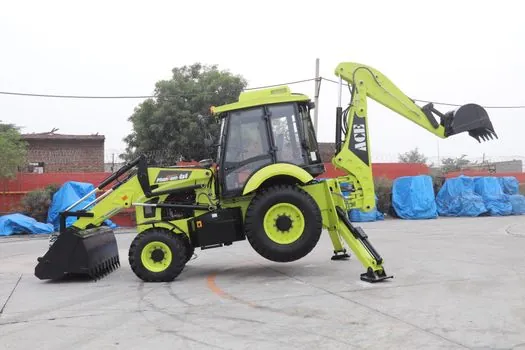
A 70+ HP backhoe loader in the 13,500-16,300 lb operating weight band, such as the CAT 415 at 16,279 lbs or the CASE 580N EP at 15,810 lbs, is the workhorse carrier most snow-removal fleets pair with 84-108 in hydraulic-angle blades and 1.14-2.07 yd³ snow buckets [S3][S2].
The selection logic for snow duty is inverted from a normal dirt spec: the loader end, not the backhoe, drives the decision, and the limiting parameter is the loader's lift capacity and hydraulic flow at the coupler, not engine horsepower. Two 70+ HP units, the JCB 3CX Compact and the John Deere 310L EP, share a 13,514 lb operating weight and a 7,363 lbf backhoe bucket force, but their loader hinge points differ by 11 in (10' 6" vs 11' 5"), which is the figure that sets dump clearance over a 7 ft snow windrow [S3].
Carrier class: why 70+ HP is the snow-removal sweet spot
Backhoe loaders below 50 HP, including the Kubota L47TLB at 7,205 lbs, are commonly used for farm and small-property snow work, but their loader lift capacity tops out at 2,848 lbs, which restricts them to 48-72 in blades per OEM match charts [S3][S2].
The 70+ HP class is where a backhoe loader gains the hydraulic flow and front-axle weight needed to push a 96 in or wider blade through packed snow without unweighting the rear, and where a 1.83-2.07 yd³ heaped snow bucket can be filled in two passes on a 6 in cut [S2].
For airports and large industrial sites, the FAA AC 150/5220-20A selection example sized the fleet by snow removal rate, not by carrier type, picking two Class III high-speed rotary plows to clear 5,000 tons per hour combined, which is the throughput logic that pushes fleets toward larger wheel loader platforms rather than backhoes for airside work [S1].
Blade and pusher sizing: matching the carrier's weight band
Paladin's 5700 series, rated for carriers up to 9,000 lbs lift and 11,000 lbs operating weight, runs in widths from 84 in (LAF5784, 875 lbs, 73 in cut at 30° angle) to 144 in (LAF5744, 1,185 lbs, 125 in cut), with all models built on 10-gauge reinforced steel and reversible wear edges [S2].
For heavier 70+ HP backhoes, the Paladin 115 series steps up to lift capacities under 10,000 lbs and operating weight under 20,000 lbs, with the 11596 at 96 in and 1,180 lbs, angling 35° hydraulically, and the 11508 at 108 in, 1,235 lbs, giving 88 in of cut at full angle [S2].
When the carrier crosses into the 14,500-30,000 lb range, manufacturers move to box pusher designs like the Kage Snowstorm KBSS 12 ft (2,662 lbs, 10 ga Grade 50 moldboard, 5/8 in x 8 in x 6 ft high-carbon cutting edge, 3 in bore x 1.5 in rod cylinders, 8 compression trip springs), which is a heavier construction suited to commercial lot work where straight-push volume matters more than angled windrowing [S4].
Bucket vs blade: when to load, when to push
For 70+ HP backhoes, the Paladin 11184-11108 snow bucket family gives heaped capacities from 1.47 yd³ (84 in, 733 lbs) to 2.67 yd³ (108 in, 1,078 lbs), with the 11108 sized to lift capacities under 9,500 lbs and operating weight under 11,000 lbs, so it matches the larger 70+ HP units only when the load is loose powder rather than wet pack [S2].
A skid-steer loader bucket follows the same leading-edge vs heaped logic but at smaller scale: 84 in or 96 in V-blades handle small-to-mid skid steers, while a large-framed skid steer takes a 108-120 in blade, per attachment-maker guidance that the blade width at full scoop must exceed the carrier's tire or track width [S8].
Western Plows draws a similar carrier line for pushers, segmenting its wheel-loader pusher line from 60+ HP up to 140+ HP, with the heavier class getting box-style pushers that move snow as a single slab rather than rolling it [S5].
Selection criteria: the 4-number check before you buy
Four numbers govern whether a 70+ HP backhoe will run a given snow attachment without straining: loader lift capacity (6,503-6,730 lbs for the CAT 415 and CASE 580N EP), loader breakout force (8,285-12,207 lbf), loader hinge pin height (10' 6" to 11' 5"), and operating weight against the attachment's rated carrier class [S3].
Push the comparison against the OEM match tables: a 96 in Paladin 5700 blade at 930 lbs asks for lift under 9,000 lbs, so the CAT 415 at 6,730 lbs of lift and 16,279 lbs of operating weight clears the chart with margin, while the John Deere 310L EP at 13,514 lbs operating weight also fits, but the bucket force of 7,363 lbf is the lower of the four, so angle-cylinder stalling is more likely in dense pack [S3][S2].
For a municipal lot where drifts reach 24 in, the right spec is a 70+ HP backhoe, a 96-108 in hydraulic-angle blade, a 1.83-2.07 yd³ bucket for loading, and a box pusher on a second machine for long pushes, which is a fleet composition that mirrors what Bobcat and CASE both publish as their snow-removal attachment matrix for this carrier class [S6][S7].
Hydraulics, visibility, and cold-weather derates

Hydraulic-angle cylinders on a 96 in blade typically run 2 in bore x 1 in rod, and the bigger 12 ft Kage pusher scales to 3 in bore x 1.5 in rod, which sets the GPM demand the carrier's auxiliary circuit must meet before the blade can hold angle under load [S4].
Cold-weather derates on backhoe loader hydraulics are not published as a single percentage, so the practical move is to step down one blade size from the room-temperature match chart, for example running a 96 in blade on a carrier the chart rates for 108 in, once ambient drops below 0°F, because oil viscosity raises the working pressure and slows cycle time [S2].
For machines that cross between dirt work and snow, the loader hinge pin height is the figure that determines whether the bucket clears a 7 ft windrow; at 11' 5", the CAT 415 stacks higher than the JCB 3CX Compact at 10' 6", which matters when loading into a 9 ft dump body on the same pass [S3].
When a backhoe is the wrong tool
A backhoe loader is the wrong carrier for airport airside operations under FAA AC 150/5220-20A, where Priority 1 paved areas are sized by tons-per-hour removal rate, not by carrier versatility, and the AC's worked example selected two Class III high-speed rotary plows for 5,000 tph combined rather than a backhoe-based solution [S1].
Backhoes are also the wrong choice for sustained, long-push commercial work above 30,000 lbs of operating weight, where manufacturers recommend a dedicated wheel loader with a box pusher, because the backhoe's rear stabilizers are not designed to absorb continuous impact loading from a heavy moldboard [S5].
Within mixed municipal fleets, the backhoe loader earns its place by switching between a 96 in blade in winter and a 1.83 yd³ general-purpose bucket in summer, which is the dual-use economics that keep it in the spec for county and small-city public works rather than dedicated airport or heavy-industrial snow operations [S3][S6].
For deeper spec work on machine class selection, see this forestry backhoe loader spec map and this backhoe loader spec map for pipeline construction; the next trackable signal is the 2026 attachment OEM fall releases, which historically refresh the carrier-class match charts in September and reset the lift-capacity thresholds that gate 96 in vs 108 in blade choices on 70+ HP backhoes.