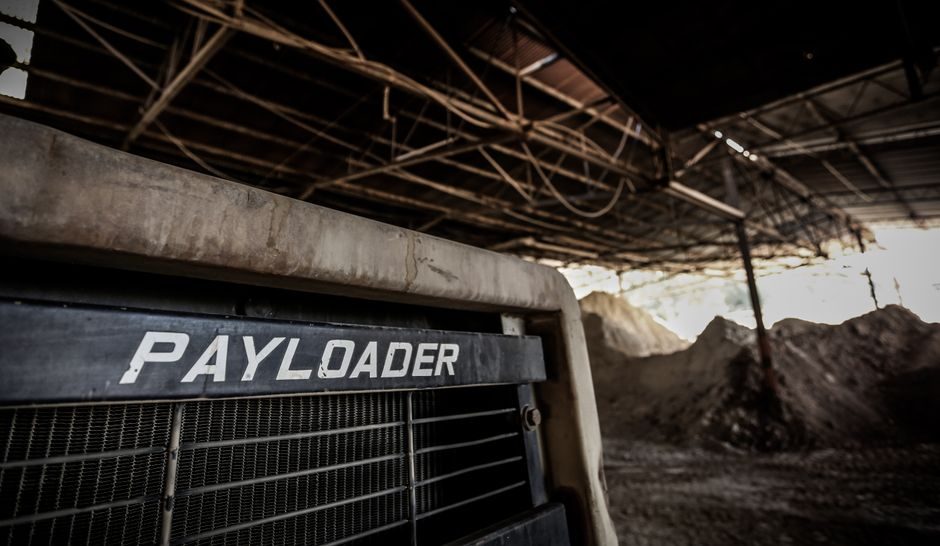
A backhoe loader is a tractor-style chassis carrying a loader bucket on the front and a rear-mounted excavator-style digging arm — XCMG's WZ30-25 ships with a 0.3–1.0 m³ bucket and 7,600 kg machine weight at 4×4 drive [S9]. A wheel loader, by contrast, is a single-purpose front-end loader: Qingdao Zongjin's Wolf line ranges from the 750 kg Mini series up to 5-ton-plus class machines with articulated frames [S2].
On Made-in-China.com, compact backhoe loaders with 18.2 kW diesel engines list at roughly US$8,950–9,989 per unit, while dedicated wheel loaders and mini loaders cluster in similar export bands depending on engine tier and bucket capacity [S3]. The two machines overlap in size and price but diverge sharply in duty cycle, which is what the spec comparison below resolves.
Operating Weight, Engine Power, and Bucket Class
The XCMG WZ30-25 backhoe loader ships at 7,600 kg operating weight, a 2,180 mm wheelbase, 3,230 mm dumping clearance, and 0.3–1.0 m³ bucket capacity, with rated load 3–6 t and travel speed ≥40 km/h [S9]. Qingdao Zongjin's Wolf WL80–WL280 wheel loader range scales from 1 t class up through 5-ton-plus configurations, paired with bucket options that match the host machine's tipping load envelope [S2]. Compact backhoe loaders on Made-in-China.com run as small as 18.2 kW diesel units under 3 t — small enough to tow on a tag trailer between urban utility sites [S3].
Rule of thumb: anything under ~3 t operating weight with a rear arm is almost certainly a compact utility backhoe loader, not a real wheel loader. Real wheel loaders under 1 t exist as the Wolf Mini 750 class, but they have no rear excavator boom [S2]. Operating weight tracks with engine displacement and loader-arm lift geometry, so buyers should match the data plate to the planned bucket density (e.g. 1.6 t/m³ for crushed stone vs 1.0 t/m³ for screened topsoil) before chasing kW figures.
Work Envelope: Digging Depth vs Bucket Breakout
Backhoe loaders earn their name from the rear boom, which typically reaches 3.5–5.5 m dig depth depending on stick and boom configuration, plus a swing arc for trenching along a pipeline right-of-way [S4]. The WZ30-25 backs that up with a 4×4 wheeled chassis, hydraulic transmission, and front-discharge bucket so the same machine can backfill a trench and then load trucks in a single shift [S9]. Wheel loaders have no rear digging function at all — they trade dig depth for larger, higher-capacity front buckets and articulated steering for tight stockpile maneuvering [S1].
For trenching, utility cuts, foundation digging, and small-diameter pipe-laying work, only the backhoe loader design can do the job in a single pass. For bulk aggregate rehandling, hopper loading at a batch plant, or stockpile management at a quarry, a wheel loader cycles faster and carries more per pass. The two roles meet in a few hybrid cases — the XCMG WZ30-25 is explicitly marketed as a "multipurpose excavator loader" precisely because it blurs the line at the 7.6 t / 1 m³ scale [S9].
Drive, Transmission, and Site Mobility
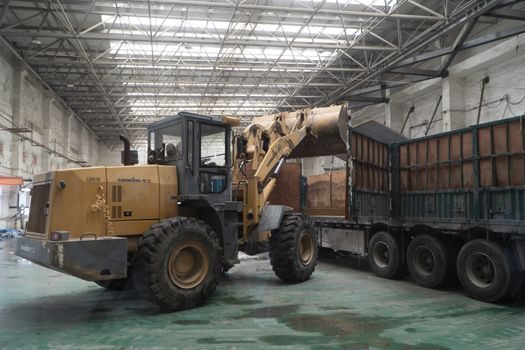
Backhoe loaders commonly run 4×4 with equal-size wheels to support both roading and trenching stability — the XCMG WZ30-25 is offered in both 4-drive and 2-drive configurations and posts a 40 km/h+ travel speed [S9]. Wheel loaders, including Qingdao Zongjin's Wolf WL80 to WL280, use an articulated chassis and hydraulic powershift transmissions sized to the loader linkage; average lead time on Wolf Wheel Loader orders sits at 15 workdays peak or off season [S2].
Articulation lets a wheel loader pivot inside its own length, which matters in stockyards and tunnel portals. Backhoe loaders use a rigid frame for stability under the rear boom, which limits tight turning but improves trenching accuracy. Across the export catalog, both platforms offer EPA Tier 4 / Euro Stage V diesel options — Chinese OEM listings on Made-in-China.com flag "EPA Engine" as a key search attribute for both backhoe loaders and compact wheel loaders bound for North America [S3].
Use-Case Match: Who Needs Which
Municipal utility crews, small civil contractors, and rental fleets buy backhoe loaders because one machine covers loader, excavator, and light grading duty on a daily basis — JCB-brand units and equivalents are listed on ECVV with 16-piece-per-month supply from Shanghai Duomi Heavy Machinery [S7]. The 1960s Case 530 utility wheel loader backhoe, original-equipment sheet on file, shows the same combined-role DNA has been marketed for six decades under the same body style [S6].
Quarries, ready-mix plants, ports, and large earthworks specify dedicated wheel loaders because cycle time, fuel-per-tonne, and operator visibility around the bucket outweigh the value of a rear boom. A buyer who only loads trucks and never digs should not pay for a rear hydraulic system. A buyer who digs most days and loads occasionally will underperform on the loading side with a backhoe but get a far more versatile single asset — the XCMG WZ30-25 at US$32,000 / US$29,500 / US$25,900 by tier (1–2 / 3–4 / 5+ pieces) is positioned exactly at that crossover price point [S9]. The matching encyclopedia reference for a backhoe loader and a wheel loader lays out the same operating-weight tiers on the spec side. For a tighter footprint where trenching is absent, a skid steer loader sits below both as a 1–4 t alternative.
Pricing, Lead Time, and Export Channels
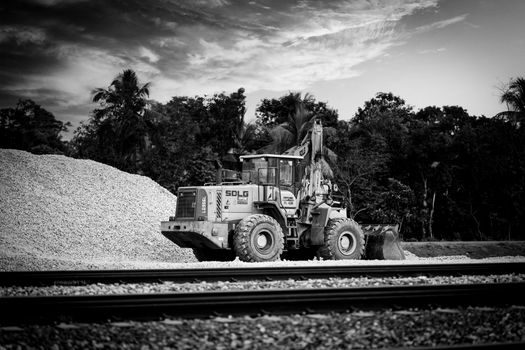
Compact backhoe loaders in the 18.2 kW / sub-3 t class export at roughly US$8,800–9,989 per unit on Made-in-China.com, with shipping terms typically FOB, CFR, CIF, DDP, FCA, or EXW [S3][S8]. Mid-size backhoe loaders such as the XCMG WZ30-25 tier at US$25,900–32,000 depending on order quantity [S9]. Wolf wheel loaders from Qingdao Zongjin carry 15-workday lead times and accept LC, T/T, or PayPal payment, with main export markets in South America, Eastern Europe, Africa, Oceania, and Western Europe [S2].
For OEM buyers, Qingdao Zongjin offers OEM/ODM service, sample availability, and multilingual sales coverage in French, Russian, Portuguese, Spanish, German, and Italian — useful for Latin American and African distributor accounts [S2]. Used-equipment channels add another price band: Shanghai Duomi Heavy Machinery lists JCB used backhoes alongside used forklifts, loaders, bulldozers, graders, cranes, rollers, and excavators for buyers willing to accept a depreciated machine at lower capex [S7]. A spec-driven comparison against a skid steer loader vs wheel loader framework helps buyers decide whether the third platform — articulated, small, no rear boom — fits before adding it to the shortlist.
Limitations, Failure Modes, and Standards
Backhoe loaders compromise on both ends: the front loader arm is shorter and the rear boom lighter than a dedicated excavator of the same operating weight, so deep utility trench work beyond ~4 m usually requires a midi excavator instead [S4]. Wheel loaders with no rear digging arm force contractors to bring a second machine or hand-dig the trench — that hidden cost is the single biggest reason fleet buyers choose a backhoe over a pure wheel loader despite the loading penalty.
On the supply side, both platforms carry CE certification under the EU Machinery Directive for export to Europe, and EPA engine options for North America; Qingdao Zongjin's "ZJ" series wheel loaders hold international quality system certification plus CE [S1]. XCMG's WZ30-25 lists customization availability and after-sales service edition support, which matters when ordering in small batches for rental fleets [S9]. Buyers should verify the engine emission tier (EPA Tier 4 Final / EU Stage V) on the actual data plate, not the marketing listing, before accepting any machine in port.
Track these signals over the next quarter: any CE/EPA sticker revision on the XCMG WZ30-25 family, fresh Mini 750 / WL80 pricing from Qingdao Zongjin, and any new compact backhoe loader listings under 3 t on Made-in-China.com below the US$9,000 / unit mark — those are the realistic inflection points for fleet renewals in the second half of 2026.