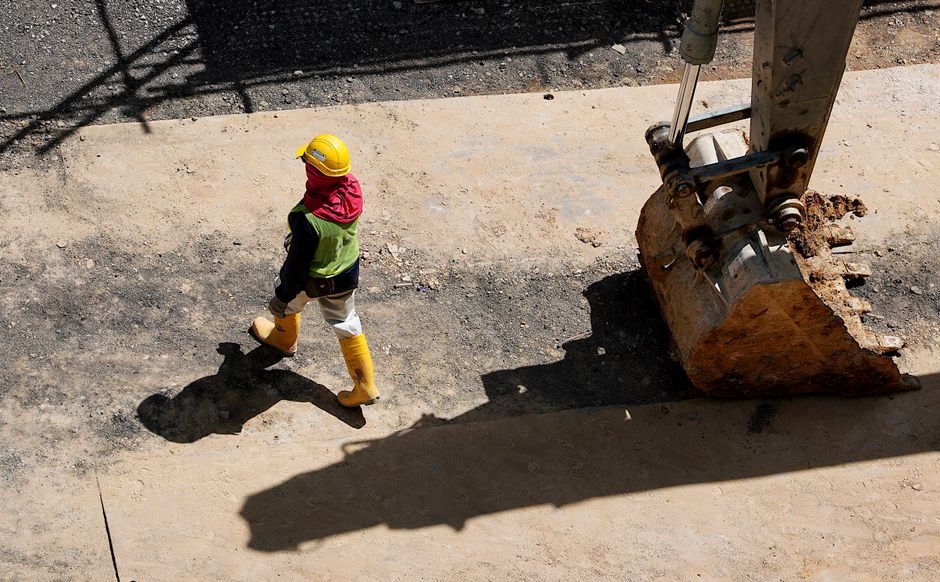
A backhoe loader is a single-frame, pneumatic-tired machine that pairs a front loader bucket with a rear excavator-style backhoe, typically 70-100+ HP, 13,500-25,000 lb operating weight, with dig depths of 4.7-15 ft across compact, center-pivot and side-shift formats [S1][S5][S10].
Backhoe loaders (BHLs) sit in the productivity gap between a skid-steer loader and a full-size hydraulic excavator, and are specified by municipal fleets, utility contractors, rental yards, and small-to-mid civil site operators [S1][S3]. The South Carolina state procurement specification, for example, splits the class into three size categories - Medium Duty (min 13,800 lb, 71 HP), Heavy Duty (min 14,800 lb, 95 HP) and Super Duty (min 15,500 lb, 100 HP) - all with a 100-inch maximum transport width, 13'6" maximum transport height, and 29-foot maximum transport length [S1].
Compact, Center-Pivot, and Side-Shift Frame Architectures
Three frame layouts dominate the global BHL market, and the choice is set by the working envelope, not by brand [S4][S9].
The compact class (e.g., the 70-74 HP JCB 3CX Compact / John Deere 310L EP tier) runs 13,500-14,200 lb operating weight, 14' 2" dig depth, and 7,300-8,300 lbf backhoe bucket force - tight enough for residential and landscaping work [S5]. The JCB 3DX/3DX Plus datasheet records a 5.96 m total travel length, 2.24 m wheelbase, 2.87 m cab roof height, and 4.77 m maximum dig depth for that 74 HP class [S10].
Center-pivot machines rotate the entire cab and boom assembly around a central kingpost, ideal when the operator can square up to the trench [S4][S9]. Side-shift (offset) backhoes slide the boom laterally across the rear frame, letting the operator dig a trench parallel to a wall, curb, or existing utility without repositioning the whole machine - a layout almost universal on European-style units and now standard on most 14-15 ft dig-depth models [S4][S9].
Duty-Class Spec Tiers and What Actually Changes
Public procurement specs from the South Carolina procurement office group BHLs by minimum operating weight, minimum net horsepower, and minimum wheelbase rather than by nameplate, giving a clean three-tier reference [S1].
Medium Duty: 13,800 lb minimum, 71 HP minimum, 80-inch minimum wheelbase, 4-cylinder Tier IV diesel, 12 V electrical system, ROPS enclosed cab [S1]. Heavy Duty raises the bar to 14,800 lb, 95 HP, 83-inch wheelbase. Super Duty hits 15,500 lb, 100 HP, 84.5-inch wheelbase [S1]. For comparison, the 70+ HP production class in the Dozr spec guide puts the CAT 415 at 70 HP / 16,279 lb / 14 ft dig depth / 12,207 lbf bucket force / 6,730 lb loader lift / 12,207 lbf breakout, while the JCB 3CX Compact and John Deere 310L EP both sit at 74 HP / 13,514 lb / 14' 2" dig depth / 7,363 lbf bucket force [S5]. A 100+ HP Super Duty crawler-class BHL listed on the Chinese export market (Nicosail) carries 2,000-3,000 kg payload with a 3-6 t load capacity, exported in the US$5,780-7,680/set price band [S2].
Hydraulics, Drivetrain, and Pump Capacity
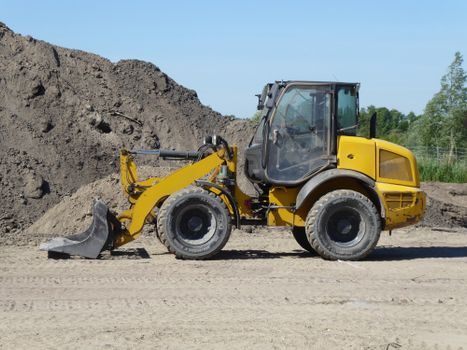
Backhoe loaders run closed-center, load-sensing hydraulics with axial-piston pumps, and the 250 bar (≈3,625 psi) system pressure benchmark is common across the duty tiers [S1][S6].
The Teknox LRC specification sheet records a variable-flow axial-piston pump at 160 L/min @ 2,200 rpm, 250 bar backhoe and loader pressure, hydrostatic AWD with a single double-acting 85 mm bore / 117 mm stroke steering cylinder, ±8° axle oscillation, and a 9.8 m outside turning circle (or 12.6 m over the widest loader bucket) [S6]. The South Carolina spec reinforces the same envelope with Tier IV heavy-duty liquid-cooled 4-cylinder diesels, 12 V electrics, two-stage dry air cleaners (Donaldson Type or equivalent), electronic governors, and a safety interlock that prevents cranking while the transmission is in gear [S1].
Typical Field Applications by Size Class
Application drives class selection: trenching volume, travel distance, and attachment count decide compact vs heavy vs super duty [S3][S4][S7].
Compact 70-74 HP BHLs are the rental-yard workhorse - landscaping, breaking asphalt, small-diameter utility trench, light paving prep, and material handling with the front bucket [S3][S4][S7]. Goldman Equipment's buyer guide and Boom & Bucket's comprehensive guide both list the same core jobs: excavation, trenching for water/sewer/electrical, light demolition, backfilling, loading trucks, and grading [S4][S7]. Center-pivot 14-15 ft dig-depth machines extend into municipal water/sewer work, road repair, and small subdivision site prep [S4][S9]. Super-duty 100 HP+ units take on deeper utility trench, larger-diameter pipe laying, quarry/aggregate face work, and heavier demolition with hydraulic breaker attachments - the same envelope where a wheel loader might be the only alternative [S1][S7]. For comparison, the procurement-spec Med/Heavy/Super tiers also pair cleanly to the backhoe loader encyclopedia page on machine anatomy, application mapping, and the trade-off against dedicated excavators or loaders.
Attachments, Quick Couplers, and Use-Case Flexibility
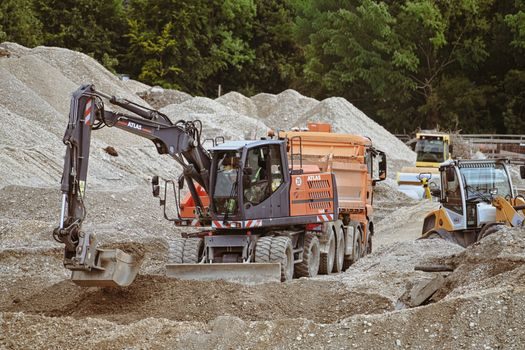
Most modern BHLs accept powered rear attachments - hydraulic breaker, grapple, auger, stump grinder - via quick-coupler mounting and an auxiliary hydraulic circuit, which is what makes a single BHL substitute for several specialty machines on a small site [S9].
Wikipedia's backhoe-loader entry confirms that quick-attach mounting systems and auxiliary hydraulic circuits are now standard equipment on most production BHLs, and that intermediate attachments such as a tiltrotator further extend the working envelope [S9]. Front-loader attachments are equally modular: a 6-in-1 multi-purpose bucket (2.23 m wide on the JCB 3DX) or a general-purpose bucket (2.35 m) lets one machine doze, load, grade, and clamp [S10]. Goldman Equipment's buyer guide and Boom & Bucket's types/uses guide both flag the front bucket + rear hoe as the productivity multiplier that defines the class [S4][S7]. For sites debating a BHL vs a compact track loader, the spec trade-off overlaps with the broader skid-steer loader decision map covered in the Skid Steer vs Wheel Loader selection guide.
Limitations, Sourcing Realities, and Common Failure Modes
BHLs trade raw digging force and reach for mobility, and that trade-off is the main constraint buyers need to plan around [S4][S9].
Compared with a dedicated hydraulic excavator of the same operating weight, a BHL gives up stick reach, bucket breakout force, and below-grade dig depth - which is why municipal water-main work above 15 ft of dig typically steps up to a midi-excavator rather than a bigger BHL [S4][S9]. Goldman Equipment and Boom & Bucket both note that BHLs are not designed for continuous heavy excavation; the machine is built to be moved often, not to sit in one trench for a shift [S4][S7]. Transport geometry also bites: 100-inch maximum width, 13'6" maximum height, and 29-foot length are hard public-procurement limits, and most BHLs sit right at them with the backhoe in the transport cradle [S1]. Sourcing reality: the Made-in-China export listing shows multiple Chinese OEMs offering sub-3 t mini BHLs at US$5,780-7,680/set FOB, while name-brand units (CAT, JCB, John Deere, CASE) sit in a materially higher band tied to dealer networks and warranty support [S2]. When the procurement spec is read strictly, the operator-weight minimums (13,800 / 14,800 / 15,500 lb) and the Tier IV engine requirement are non-negotiable - a 2 t Chinese mini BHL cannot bid on that lot, regardless of price [S1][S2].
Trackable signals for the next 6-9 months: watch for the next revision of the South Carolina-style state-procurement BHL spec, especially around Tier V engine transition and any tightening of the 100-inch transport width; watch used-fleet price moves on 70-74 HP center-pivot BHLs as 2026 rental-season utilization data comes in; and watch whether the Chinese export-band US$5,780-7,680 sub-3 t BHL segment expands or compresses against rising Tier IV final-stage emission compliance costs in export markets [S1][S2][S5].
Background reading: Amphibious Excavator Selection: Weight Class, Pontoon Design, and Spec Gates.