China-based baler manufacturers cluster around six machine types — vertical, horizontal single-ram, two-ram, bagging, round agricultural, and scrap-metal presses — with FOB price bands spanning roughly US$1,000-100,000 per set across full-automatic hydraulic waste-paper balers from Qingdao Sipingdafa Hello Baler [S1], and US$2,000-55,000 for CE-certified vertical bagging balers from Jiangyin Dinghua [S5].
The supply side splits into three tiers: Diamond/Audited manufacturers on B2B portals such as Made-in-China.com (e.g., Nantong Jiabao Machinery, established 2006-10-18) [S4]; specialist full-automatic lines from XTpack covering horizontal, two-ram, semi-automatic, and PET-bottle balers [S6]; and Indian agricultural-baler builders like Lakshmi Envirotech (Lens India), founded 1992 in Coimbatore, with 100+ employees and 50,000 sq.ft covered area [S3].
Main Baler Types and Their Operating Bands
Horizontal full-automatic waste-paper balers from Sipingdafa list at US$1,000-100,000 FOB per set, with hydraulic HFA20-25H models carrying CE marking [S1]. Two-ram balers and full-automatic presses from XTpack are positioned for cardboard, PET bottles, textiles, and cross-cylinder compression duty [S6]. Vertical bagging balers from Jiangyin Dinghua (CE certificate, US$2,000-55,000 per set MOQ 1) target wood-press and bagging-packaging lines [S5].
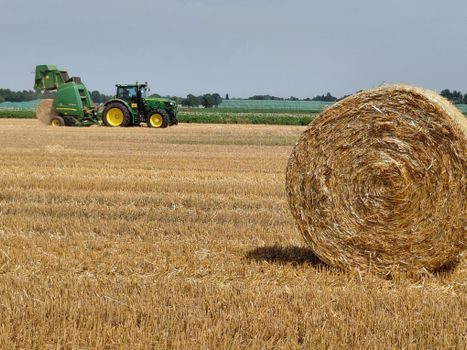
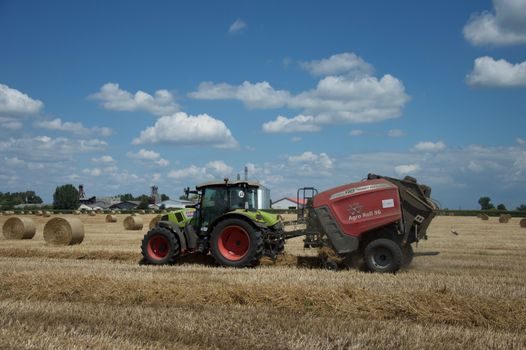
Round agricultural balers — silage, hay, straw wrappers — cluster tightly in the US$2,100-14,000 custom-build band, with model codes such as MRB0850 and 1070 mini round baler wrappers from Chinese exporters [S10]. Scrap-metal car balers in the heavier 400-ton class list at US$90,000-110,000 per set on Made-in-China.com (2023-07-18 listing retained in 2026 search results) [S7]. Press-baling lines from Anhui IAPACK reach US$250,000 per set at 1-set MOQ, while Henan Yongshuo sits in the US$3,200-6,600 mid-range as Diamond Member Audited Supplier [S9].
Supplier Tiers and Certification Markers
Made-in-China.com tags high-volume exporters as Diamond Members with Audited Supplier status, including Nantong Jiabao Machinery (Manufacturer/Factory & Trading Company, established 2006-10-18) [S4] and Anhui IAPACK [S9]. CE marking is the dominant European compliance reference, repeated across Sipingdafa, Jiangyin Dinghua, and Henan Yongshuo listings [S1][S5][S9]. ISO 9001 quality-system certification appears on Sipingdafa's waste-paper baler SKUs alongside CE [S1].
Outside China, Lakshmi Envirotech Systems (Lens India) positions as an Indian agricultural-baler specialist founded 1992, with product lines Jawan 1220, Jawan 220, Jawan Turbo, and Ridge Plaster, plus in-house sheet-metal components and spares, and a stated 500+ customer base in Tamil Nadu [S3]. XTpack publishes a horizontal-baler, full-automatic-baler, two-ram-baler, semi-automatic-baler, vertical-baler, and PET-bottle-baler product family under a single OEM brand [S6].
Selection Criteria: Drive, Chamber, and Material
Hydraulic drive dominates the baler category in 2026 listings — every Sipingdafa, XTpack, Jiangyin Dinghua, and Dezhou Shengxin SKU cited above is a hydraulic baling press [S1][S5][S6]. Chamber orientation (vertical vs horizontal) and ram count (single vs two-ram) are the second-tier selection axes: two-ram designs from XTpack handle denser scrap-metal and rigid-plastic streams, while horizontal single-ram suits OCC, mixed paper, and PET [S6].
For agricultural duty, round balers use pickup-and-belt wrapping rather than hydraulic ram compression, with model size (1070 mini vs MRB0850) and PTO vs electric-motor drive defining the build [S10]. Buyers specifying a baler should weigh bale weight, throughput (tons/hour), bale density, infeed geometry, and binding method (wire-tie vs auto-twine vs net-wrap) against the supplier's published spec sheet. For deeper chamber and drive-type guidance, see the selection map on chamber and drive.
Price Bands and Lead-Time Signals
The 2026 Made-in-China.com index for used baler machine prices [S2] sits alongside active OEM price ranges — vertical bagging balers US$2,000-55,000 [S5], round agricultural balers US$2,100-14,000 [S10], full-automatic horizontal waste-paper balers US$1,000-100,000 [S1], 400-ton scrap-metal car balers US$90,000-110,000 [S7], and press-baling machines up to US$250,000 [S9]. Standard MOQ across these listings is 1 set or 1 piece.
OEM-direct storefronts such as hellobaler.com list trending hydraulic baler SKUs and a cart flow as of 2026-07-29 [S8]. Where a procurement team needs to cross-check motor power, cylinder bore, platen size, and PLC control brand, the OEM spec sheet (not the B2B portal card) is the binding document. For a broader view of how Chinese OEM supplier maps cluster, the aluminum-extrusion sourcing map shows the same Diamond/Audited tier structure that baler buyers navigate.
Who Baler OEMs Are For — And Who They Are Not
Chinese OEM balers fit buyers needing mid-volume throughput (1-30 tons/day), standard CE/ISO documentation, and 1-set MOQ pricing — typically MRFs, OCC recyclers, textile reclaimers, and agricultural contractors sourcing directly from factory-floor listings [S1][S4][S5][S6]. They are not a fit for plants needing ATEX/IECEx zone-rated controls, ASME-stamped pressure-vessel certification on the hydraulic accumulator, or audited U.S. UL/CSA electrical panels — those builds route through Western systems integrators.
Buyers chasing custom engineering (PLC HMI integration with cutting machine upstream lines, in-line labeling machine bale tagging, downstream filling machine bagging) need an OEM with a documented controls-engineering team — XTpack's bagging-machine line and Sipingdafa's HFA20-25H both publish full-automatic integration options [S1][S6]. Plants planning baler integration into a shakeout machine foundry line or a core machine cell should confirm bus protocols (Modbus TCP, EtherNet/IP, PROFINET) at the RFQ stage, not after PO.
Failure Modes and Engineering Constraints Buyers Hit
The most common in-service failures on hydraulic balers are seal blowout in the main cylinder (typically 100-200 hour MTBF under contaminated hydraulic fluid), PLC sensor noise on photoelectric bale-height eyes, and shear-pin or wire-tie head wear — none of which is a design defect, all of which are predictable from duty cycle. For a useful baseline on electromechanical spec discipline that also applies to baling-press control panels, the metal-stamping part spec map shows how to demand process-tolerance data on sub-supplied parts. [S2]
Buyers in tropical or coastal climates should specify IP65 control cabinets and stainless hydraulic-tank breathers — these are not standard on the US$2,000-14,000 round-baler tier [S10]. For agricultural balers, pickup tine wear, belt splice failure, and net-wrap cutter fatigue are the documented failure points; spare-kits and field-service reach should be on the RFQ scorecard, not an afterthought.
Standards, Audits, and Verification
CE marking (per the EU Machinery Directive 2006/42/EC) and ISO 9001 quality-system certification are the two compliance references appearing most frequently in 2026 baler listings from Sipingdafa [S1], while the Made-in-China.com Audited Supplier tag adds a third-party-validated business-license check on top of the OEM self-declaration [S4][S9]. For buyers shipping balers into the EU, CE documentation must include a Declaration of Conformity, technical file, and risk assessment under the Machinery Directive — not just a CE sticker on the nameplate.
Indian agricultural-baler buyers should note that BIS/ISI certification is process-specific and not interchangeable with CE; Lens India markets CE-style compliance via its quality-system claims but does not list BIS mark numbers in the public page [S3]. For U.S. and Canadian buyers, UL 508A on the control panel and NFPA 79 electrical standard are the relevant references — neither appears in the Chinese OEM listings reviewed.
Trackable signals to watch: OEM price-list refreshes on hellobaler.com (last indexed 2026-07-29) [S8] and Diamond/Audited membership renewals on Made-in-China.com are the lowest-noise way to spot a supplier that has stopped shipping. Cross-reference the OEM's recent RFQ response time before issuing a PO — a supplier that took 72 hours to quote in July 2026 is unlikely to ship within 30 days of PO in August.