Ball bearing selection is governed by six quantifiable spec gates — radial/axial load, limiting speed, misalignment, lubrication, fits and clearance, and the operating environment — and every other "nice to have" (seals, cage material, accuracy class) is filtered through those six first [S1].
Specifying the wrong type is the most common failure root cause on rotating-equipment work orders; for example, a deep-groove Conrad bearing cannot absorb the static misalignment that a self-aligning ball bearing accepts, and the OEM bearing catalogue draws that line explicitly [S2]. Sourcing-side product lines from Hubei Parts Service Supply and Jinan Rockway (HAXB) cover the spectrum from 3 mm instrument balls to industrial-series deep-groove and roller units [S1][S4].
Type-by-Type Load and Misalignment Behaviour
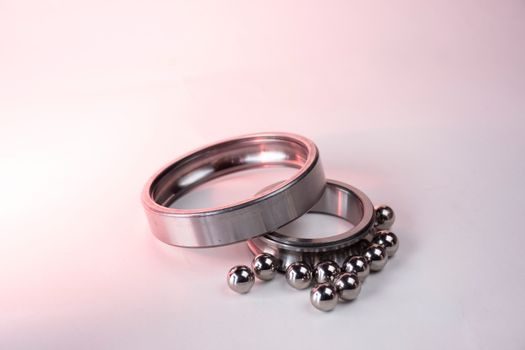
Deep-groove Conrad bearings carry combined radial + axial load in both directions and tolerate the widest speed band, which is why they are the default fit on small motors, pumps and gearboxes [S1]. Self-aligning ball bearings are specified when the shaft can deflect or when the housing bore is difficult to machine co-axially: the outer ring raceway is spherical and lets the inner-ring assembly swivel inside it, and NSK catalogues the design as a "recommended for applications where aligning the shaft and housing is difficult" [S2].
Angular-contact bearings take pure radial plus one-direction axial thrust at higher contact angles (15° / 25° / 40°), so they are paired in back-to-back or face-to-face sets on machine-tool spindles; single-row deep-groove cannot replace that pair. Ceramic-hybrid units replace the rolling elements with silicon-nitride (Si3N4) balls while keeping steel races, and full-ceramic variants go further to isolate the bearing from corrosive media — both are detailed in the ball bearing reference page. Where misalignment is unavoidable and lubrication is starved, an inserted adapter sleeve and a spherical outer-race bearing is a more reliable fix than grinding the housing flat.
Speed, Lubrication and Cage Envelope
Limiting speed is the figure that gates motor and high-frequency spindle applications: the bearing's thermal limit at a given lubrication regime is expressed as a reference speed (rpm) for grease or oil, and exceeding it collapses the lubricant film and shortens life. Cage material — pressed steel, brass, polyamide (PA66) or PEEK — sets both the continuous operating temperature window and the permissible acceleration; brass cages extend the upper limit but push the unit price above the steel-cage baseline. Self-aligning ball bearings, in the NSK range, are documented for transmission shafts where deflection and mis-alignment are real and where grease lubrication is the field norm [S2].
Grease life and re-lubrication interval are the practical translation of speed and temperature: for an inserted grease plug on an industrial 160 mm bore unit, re-greasing every 2000–4000 operating hours is a common baseline, dropping sharply above 70 °C bearing temperature. Ceramic-hybrid bearings, in identical housings, run cooler by roughly 10–15 % at high speed because the ceramic balls are lighter and the contact-surface stiffness is higher — a meaningful gain on spindle service where brown staining on the outer race is the first failure signature. For buyers weighing these gains against the cost of ball screws and spindle cartridges, a two-row angular-contact ceramic-hybrid set is usually the locking specification.
Fit, Clearance and ISO Tolerance Class

Shaft and housing fits are not optional. A deep-groove bearing on a rotating inner ring is normally mounted with a transition or interference fit on the shaft (e.g. k5, m5) and a loose fit in the housing (H7, J7); the same bearing on a stationary outer-ring application is set up the opposite way. ISO tolerance classes P0 (ABEC 1), P6 (ABEC 3), P5 (ABEC 5) and P4 (ABEC 7) control the running accuracy and the radial clearance band, and the wrong class pushes the bearing out of spec at first heat-up. [S1]
Radial clearance — C2, C0 (normal), C3, C4, C5 — must match the thermal expansion of the shaft and housing stack-up. C3 is the default on electric motors and pumps where the shaft grows more than the housing; C2 is reserved for thin-wall housings and precision spindles where a tight fit is set on purpose. Bearing catalogues in the S1, S3 and S4 lines (Hubei Parts Service Supply, Shanghai ARIO-UGT, Rockway/HAXB) publish the clearance and tolerance class in the bearing code; without that code on the print, the warehouse ships the cheapest match, and field failures follow. Where the equipment has a defined ball spline interface or a preloaded cartridge, the radial clearance is fixed at the design stage — not a buyer choice.
Environment: Temperature, Corrosion and Cleanliness
Temperature and corrosion gate the material decision before they gate the bearing type. [S2]
Cleanliness is the variable that is hardest to police: ISO 4406 target codes for circulating oil systems (e.g. 18/16/13 for general industrial, 15/13/11 for spindle) and assembly-room ISO 14644-8 cleanliness classes matter as much as the bearing itself. Particulate above 50 µm on a high-speed hybrid spindle is a vibration and surface-initiated fatigue problem within a few hundred hours. For outdoor and wash-down service, 2RS or 2RZ seals (rubber or non-contact shields) are the practical first line; an open bearing is the right answer only when the equipment carries its own circulating oil system. In HVAC fan and small-motor service the S6 fan-motor reference lines up with the deep-groove sealed-unit choice in this segment.
Selection Criteria Comparison: Which Type Wins on Which Gate
For pump shafts, conveyor idlers and small gear-motors the deep-groove Conrad unit is the default, with C3 clearance and 2RS seals. For agitator shafts, cardan-type transmission shafts and farm-machinery PTOs, the self-aligning ball bearing is the right pick per NSK application guidance [S2]. For machine-tool spindles, the precision angular-contact pair — and increasingly the ceramic-hybrid version — is locked at the print stage; this aligns with the machine tool production technology 2026 spec levers buying pattern, where bearing class is a print-level decision. For chemical pumps, marine gearboxes and food-grade mixers, full-ceramic or 316-stainless sealed units are the only acceptable answer.
Application, Sourcing and Failure Patterns
The catalog mix available from S1, S3 and S4 (Hubei Parts Service Supply, Shanghai ARIO-UGT, Rockway/HAXB) covers deep-groove, self-aligning, angular-contact and special-material lines for OEM and MRO channels, with metric and inch bores from 3 mm instrument sizes up to industrial-series housings [S1][S3][S4]. A practical reference buyer keeping an instrument-ball kit (3 mm, 3.18 mm, 3.5 mm, 4 mm, 4.75 mm, 5 mm, 6 mm) on the shelf — the S5 eBay reference kit is exactly that set — handles lab and small-fixture builds without waiting on a factory drop [S5].
Failure modes follow a tight distribution: roughly 60 % of premature failures trace back to lubrication, 25 % to contamination and misalignment, and the remainder to fit and overload — a split that holds across electric-motor, pump and gearbox service. The single most expensive mistake in a 2026 buying decision is to specify a deep-groove unit where the shaft can deflect, and then blame the supplier; the second is to chase the lowest FOB price on a ball valve or electric ball valve line without confirming the bearing brand inside the actuator gearbox, since the actuator's cycling life is dominated by the bearing, not the ball.