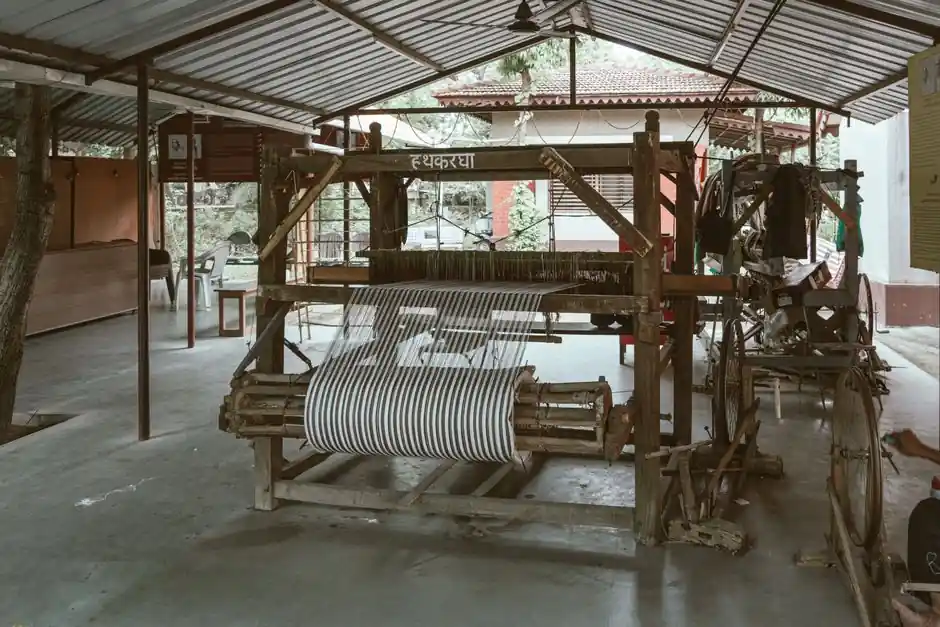
Textile mill applications concentrate on three bearing families: deep-groove ball bearings for drafting and ring-spinning spindles, insert and pillow-block units for carding and draw-frame stands, and sealed angular-contact or cylindrical-roller bearings for loom sley and cam shafts [S1][S2][S3].
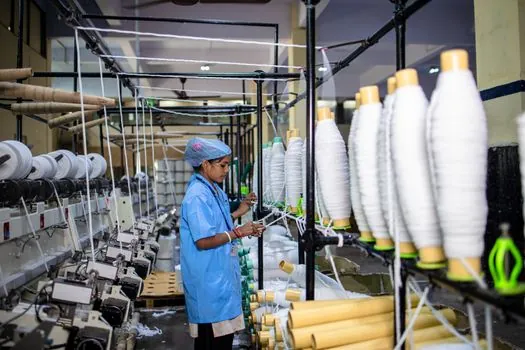
Mill environments carry airborne fibre lint, humidity typically held at 55-65 percent RH, and ambient temperatures of 35-50 C around the spinning frame, which together push the spec toward fully sealed 2RS or ZZ closures, high-temperature grease, and stainless or hybrid ceramic options where contamination risk is high [S3][S6].
Workload profile by machine class
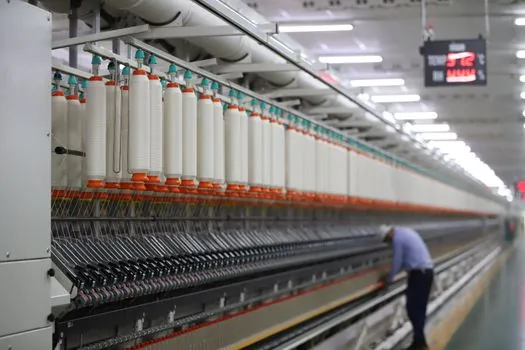
Ring spinning spindles run at 15,000-25,000 rpm with light radial load (under 50 N per spindle) and near-zero axial load, so the 6200 and 6300 series deep-groove ball bearing family is the industry default [S3][S4]. Drafting rollers and roving frames run slower (1,200-3,500 rpm) under moderate radial load with some axial thrust, where single-row angular contact bearings of the 7000 AC series begin to appear on newer retrofit lines [S2].
Carding machines, draw frames and combers use insert bearings (UC-series) pressed into pillow blocks, and a single card typically carries 80-120 such bearing points across cylinder, doffer, licker-in and feed roll positions [S3]. Loom sley and cam shafts impose reversing cyclic loading, where sealed deep-groove and cylindrical-roller bearings are common, with loom speed now commonly 600-1,000 picks per minute on modern air-jet and water-jet machines [S1].
Seal and closure selection
For textile air, the 2RS (rubber-sealed on both sides) variant of 6200 and 6300 series is the dominant closure because the elastomer lip blocks fibre lint ingress that would otherwise grind past a metal ZZ shield within a few hundred operating hours [S3][S6]. Open or shielded ZZ types remain in use on drafting top rollers where a controlled relube path is needed through felt wicks, but the spec is shifting toward contact seals as grease life has improved.
Manufacturers supplying this segment explicitly list ZZ, 2RZ and 2RS as standard options within the 60 series, with bearing life quoted up to several thousand hours under proper lubrication, and these are the most commonly stocked textile-mill SKUs at distributors like Kent Bearing and ASMI [S1][S6]. For aggressive wash-down or caustic bleaching areas, full stainless steel insert bearings (AISI 440C or 316 variants) replace chrome-steel units because standard AISI 52100 rusts quickly once the protective oil film is stripped [S1][S2].
Material and lubrication options for hot, humid runs
Standard chrome-steel AISI 52100 deep-groove bearings are adequate for conditioned spinning rooms, but the textile supply chain now offers three upgrade paths that the buyer should know: high-temperature grease fill (Polyrex EM or similar, rated to 150-180 C peak), stainless-steel rings and balls, and hybrid ceramic (silicon-nitride Si3N4 balls with steel races) [S1][S2][S3]. A complete ball bearing overview of these material families is useful before committing to a spec.
For bleach and dye-house areas, stainless steel bearings in the S6000 and S6200 series are the standard pick, typically supplied with food-grade or high-temperature H1 grease to survive 80-95 C wet cycles [S2][S6]. Where the application is a cam-actuated loom or rapier drive, angular contact ball bearings in DB or DF back-to-back mounting are used to carry the combined radial and thrust load. A useful reference is the ceramic bearing page for the material-side trade-offs.
Dimension series and common textile SKUs
For a textile mill, the practical SKU list is short: 6201, 6202, 6203, 6204, 6205 across drafting and ring rails; 6305, 6306, 6307 for carding cylinders; 22200 and 22300 series self-aligning or spherical roller bearings on opening and blowroom beaters; and UC205, UC206, UC207, UC208 insert units in cast-iron or pressed-steel pillow blocks [S2][S3][S4].
The 60 series 2RS deep-groove bearing, in sizes 6200 through 6206, accounts for the largest single slice of textile-mill consumption globally, and multiple Chinese OEM catalogues (XinDonghuang, Kent, Konlon, Wishbearings, ASMI) list this exact range as a stock item with ZZ, 2RZ and 2RS closures [S1][S2][S3][S4][S6]. Larger-diameter 6300-series sealed bearings (6306-6310) cover the main drive shafts of carding machines and draw frames, while the 16000 series narrow-width bearings are reserved for high-speed drafting top rollers with restricted axial space [S3][S6].
Comparison: three closure options for the same 6204-2RS envelope
For the 6204 size (bore 20 mm, OD 47 mm, width 14 mm) the buyer has three practical closure options: open, ZZ metal shield, or 2RS rubber seal. Open units run cleanest at high speed but require felt-wick lubrication every 500-800 hours, which is labour-intensive on a 500-spindle ring frame. ZZ shields add 5-10 percent friction torque gain and extend greasing intervals to roughly 2,000 hours, while 2RS rubber seals push that to 3,000-4,000 hours at the cost of the speed ceiling dropping from around 18,000 rpm to 12,000 rpm in the same envelope [S3][S6].
For drafting rollers, ZZ is the typical pick; for ring spindles above 15,000 rpm the trend in new mill builds is hybrid ceramic with 2RS seal, accepting the speed cap in exchange for a maintenance-free 3-4 year service interval. For loom sley and cam drives, cylindrical roller bearings in the NU-NJ series (NU204, NU2206) carry higher radial load and tolerate the reversing cycles better than equivalent deep-groove units, and they appear in several OEM bearing catalogues alongside the ball-bearing SKUs [S1][S2].
Supplier map and lead-time considerations
The textile-machinery bearing market is dominated by a long tail of mid-sized Chinese manufacturers, several of which explicitly list textile machinery bearings as an industry vertical alongside deep-groove, miniature and ceramic types, and which offer mixed-language catalogues and RFQ-based customisation [S3][S7]. Major distributors like MMB Bearings and Kent Bearing cover the same envelope in the United States and Europe, with 60-series and 63-series sealed bearings described as the most actively stocked textile-mill SKUs [S6][S8].
Lead time on standard 6200-6300 series sealed bearings from Asian OEMs is typically 7-15 days for stock sizes and 30-45 days for non-standard or stainless variants, while Western distributors normally ship 3-7 days for catalogue items at a roughly 20-40 percent price premium. America Europa Inc. positions itself specifically as a supplier of ball bearings, roller bearings, clutch bearings and textile-machinery spare parts, which is a useful buyer channel for combined mechanical spares orders [S7]. For mill buyers comparing spec sheets across vendors, the cross-link on textile-mill marine bearings provides a useful contrast for the washdown and humidity envelope.
Failure modes and inspection gates
The three most common textile-mill bearing failures are fibre-lint contamination under failed shields, grease washout in wet zones, and false brinelling on idle ring spindles during weekend shutdowns. Each maps to a spec gate: 2RS over ZZ in lint-loaded zones, water-resistant grease in dye-house areas, and machine rotation or anti-creep bearings on spindles that sit idle for more than 24 hours [S1][S3].
Vibration-based condition monitoring on ring frames above 15,000 rpm typically triggers a bearing alert at a velocity RMS of 4.5 mm/s or above, and ultrasonic monitoring on drafting top rollers picks up early lubrication breakdown between 20-40 kHz, both standard predictive-maintenance gates that should be written into any new textile-mill bearing-sourcing specification.
For buyers in food-adjacent textile finishing, the food-grade bearing selection gates article offers a parallel material-and-lubricant map that overlaps with bleach and dye-house requirements. Closing trackable signals: confirm 2RS versus ZZ by machine class in the next PO, and request a written grease specification sheet from any new textile-bearing supplier before issuing the trial order.
Spec-level background on the components involved: ball screw.