
A SCARA Z-theta axis typically uses a rotary ball spline: a grooved shaft that handles vertical (Z) travel while an angular-contact bearing, crossed-roller element, or gear on the nut delivers the end-of-arm (theta, R) rotation, on a single shaft instead of two [S3].
THK lists the "Precision Ball Screw/Spline" as a stock product explicitly aimed at machines combining rotary and straight motion, naming the Z-axis of SCARA robots, assembly robots, automatic loaders and machining centres as the target use cases [S1].
Why One Shaft Replaces Two on a SCARA Z-Theta Axis
Traditional linear bushings are almost exclusively used in dual-shaft configurations to prevent the bearings from rotating on the shaft; ball splines are inherently anti-rotation because the load-carrying balls ride inside grooves on the shaft OD, so one spline shaft can replace a two-shaft linear bushing arrangement and shrink footprint, mass and assembly alignment work [S3].
Firgelli's 2026 SCARA reference describes the same architecture: the Z-axis is a separate ball-screw spline, and the Z-axis ball screw spline needs preload; if the spline nut loosens, the tool wobbles in yaw and screwdriving torque readings go noisy [S5].
Most SCARA Z-theta axes additionally use a hollow spline shaft so that pneumatic lines, encoder wiring and tool vacuum can be routed up the centre of the arm, eliminating a separate cable carrier and removing a snag point above the end-effector [S3].
Decision Criteria: Ball Screw Plus Spline vs. Alternatives
Three options show up on a SCARA Z-theta spec: a combined ball-screw-and-ball-spline (BSSP) shaft, a separate ball screw plus rotary ball spline stack, and a belt/pulley linear actuator with a servo on the R axis. The BSSP shaft wins on compactness and alignment, but couples the two motions mechanically; the stacked approach decouples them at the cost of two aligned shafts; the belt solution is cheapest and lightest but loses rigidity and repeatability. [S5]
Key selection criteria with concrete benchmarks: (1) footprint, where a single BSSP shaft replaces a two-shaft linear bushing pair [S3]; (2) repeatability, with SCARA specs quoted at ±0.01 mm for a full 25 x 305 x 25 mm cycle under 0.45 s [S5]; (3) load capacity, where ball-spline contact in shaft grooves gives higher load ratings than equivalently sized ball bushings [S3]; (4) cable routing, where hollow spline shafts are the common way to bring utilities up the Z-theta axis [S3].
Standard reference: ISO 3408 covers ball-screw dimensions and accuracy; THK's BNK precision ball screw with finished shaft ends is listed as ISO 3408 compliant and is the typical screw backbone used in the BSSP architecture [S1].
How the Z-Theta Stack Is Built
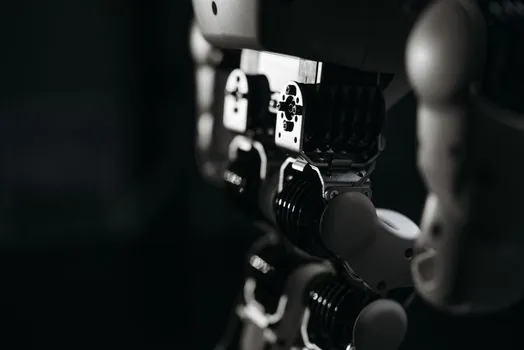
Mechanically, a SCARA Z-theta axis stacks a Z servo and brake on top, a harmonic-drive or cycloidal reducer on joint 1 (shoulder, theta 1) and joint 2 (elbow, theta 2), and the BSSP shaft running vertically through the inner link; Z lift is produced by a motor driving a ball-screw section of the same shaft, while the theta (R) rotation is produced by a servo coupled to the rotary element on the spline nut. [S5]
Concrete numbers from one published SCARA reference: shoulder and elbow joints are typically driven by 400 to 750 W AC servos through harmonic drives at 80:1 or 100:1 ratio, and backlash in those joints is quoted at ±30 arc-seconds when new, with drift of 0.05 to 0.15 mm at the tool flange if preload drops [S5].
The natural mode of a 600 mm reach outer link sits at 25 to 40 Hz; over-accelerating the controller excites that mode and the tooltip rings for 80 to 150 ms after every move, which is why Z-theta spec sheets quote a 0.45 s cycle only with a properly tuned acceleration profile, not raw maximum acceleration [S5].
Failure Modes, Preload and Lubrication
The most common field failure on a SCARA Z-theta BSSP is spline-nut preload loss: the symptom is yaw wobble at the tool and noisy screwdriving torque, and the root cause is typically a missed relube interval or a damaged seal letting contamination into the ball circuits [S5].
Second failure mode is back-drive of the Z axis when the brake is off for teach mode: a BSSP shaft with no back-drive prevention will drift down under tool weight, which is why the Z servo usually holds position with a dynamic brake plus a spring-set brake in the gearhead, not a passive holding brake alone [S5].
Third failure mode is harmonic-drive wear at joints 1 and 2, which shows up as end-effector drift of 0.05 to 0.15 mm and is the typical reason a 0402 component placement goes out of tolerance long before the BSSP shaft itself wears [S5].
For a deeper look at how rolling-element bearings and ball-spline grooves compare to plain bushings on stiffness and load rating, see the reference page on ball spline construction and the related ball screw geometry used in the same shaft.
Real Use Cases: Electronics, Dispense, and Small SCARAs
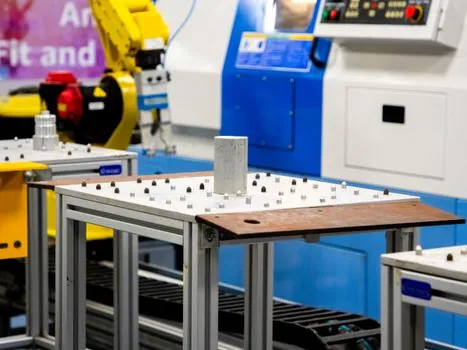
Electronics assembly is the dominant application: a 25 x 305 x 25 mm pick-place cycle in under 0.45 s with ±0.01 mm repeatability is the benchmark that pulls the BSSP architecture into the spec, and it is what justifies a single-shaft Z-theta design over stacked linear and rotary stages [S5].
Dispense and screwdriving cells use the same architecture because the theta (R) rotation needs to be coaxial with the Z lift, which is exactly what a rotary ball spline gives you, and a stacked ball-screw plus rotary stage would introduce a moment arm that bends the tool under thrust load [S3].
Small-format SCARAs such as the YK800XC class use a dedicated 200 mm Z-stroke R-axis ball spline, illustrating that the BSSP pattern is now the default Z-theta transmission for sub-1 kg payload horizontal articulated arms rather than a niche option [S6].
For a related comparison of how direct-drive servo sizing interacts with harmonic reducers on these joints, see the spec breakdown on SCARA robot selection.
Standards, Sourcing, and the 2026 Supply Picture
The screw side of the BSSP is governed by ISO 3408 for dimensions, accuracy classes and nut geometry; THK's BNK precision ball screw with finished shaft ends is the stock ISO 3408-compliant part used inside its BSSP assemblies [S1].
On the supply side, the major BSSP / rotary ball spline vendors as of 2026 include THK (DSP ball spline with integrated ball screw, plus the BNK-based BSSP), KSS (miniature 4 mm BSSP "VZ-theta actuator"), NB Corporation of America, Nippon Bearing, Misumi, Nook Industries and Yamaha Motor (hollow-shaft rotary ball splines for SCARA arms), with YRG Inc. distributing aftermarket R-axis ball splines sized to specific YK-series SCARAs such as the 200 mm Z-stroke YK800XC [S6][S7].
Trackable signals for the next 6 to 12 months: (1) whether miniature BSSP shafts below 6 mm bore move from KSS-only supply into broader distribution, given KSS currently markets a 4 mm BSSP "VZ-theta actuator" as the smallest in its line [S7]; (2) whether hollow-shaft rotary ball splines become a stock option at more vendors, since cable-routing up the Z-theta axis is now the rule rather than the exception in electronics SCARAs [S3].
Background reading: Aluminum Squeeze Casting Pressure Window for Near-Zero Porosity.