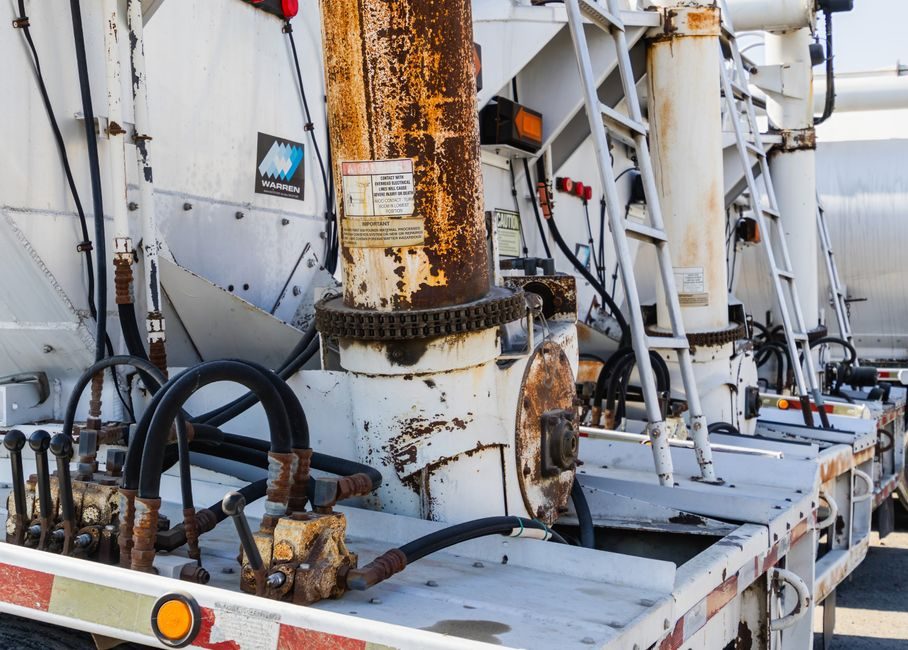
A ball valve is fit for a given service only when all four wetted parts are jointly compatible with the fluid, temperature, and pressure; body-only datasheet checks miss roughly half of the field failures, because the seat and seal polymers carry most of the chemical and thermal attack [S3][S4].
The four wetted parts are: the body (pressure envelope and corrosion boundary), the ball (the rotating shut-off element), the seat (the static soft or metal sealing ring on each side of the ball), and the stem seal (dynamic, around the stem). Choosing one material for the body and another for the ball, and a third for the seat, is the rule, not the exception — for example, the Mader 217696 ships as nickel-plated brass body, hard-chromium-plated brass ball, PTFE seat, and PTFE stem seal [S2].
The Four Material Layers That Decide Service Fit
Body materials for ball valves fall into five common families: PVC, CPVC, bronze/brass, cast iron, carbon steel, and stainless steel — each tied to a fluid-and-pressure band rather than a single application [S3].
For a Honeywell 075SMA11-style shut-off, the OEM offers cast iron, carbon steel, low-temperature carbon steel, and stainless steel body assemblies, with internal trim options to handle general-purpose or corrosive gases plus an oxygen-compatible configuration, all rated up to 125 PSIG (8.6 bar) over a −29 °C to +60 °C window [S1]. For a low-cost manual line valve, the Mader 217696 is built around nickel-plated brass with DN 10–25 mm ports, 2/2-way, rated −20 °C to +150 °C [S2]. The Honeywell upper temperature (+60 °C) and the Mader upper temperature (+150 °C) span the full cold-to-hot envelope that a process engineer is likely to encounter on utility and light-process service.
Body Material vs Working Fluid: A Selection Map
Material selection is driven by three independent axes: chemical compatibility of the wetted alloy, allowable pressure-temperature envelope, and any service-side regulatory constraint (oxygen, sour, or hygienic) [S4].
PVC and CPVC are thermoplastics: PVC is used for cold-water and low-pressure service, while CPVC is rated for higher-temperature hot-water service [S3]. Bronze and brass suit low- to medium-pressure systems and are characterised by water resistance and general corrosion resistance, with brass commonly nickel-plated for added surface stability, as on the Mader 217696 [S2][S3]. Cast iron tolerates higher pressure and temperature than PVC, which makes it a popular general-purpose body material [S3]. Stainless steel is the default for chemical and general factory service where corrosion resistance and durability are required, and is one of the most important ball-valve body materials cited by manufacturers [S3]. On top of these, titanium alloys appear in highly corrosive service — their use in chemical electrodes, refinery heaters, and seawater desalination is documented for Chinese industrial production since the mid-1960s — and are sometimes specified for niche ball-valve trim.
Seat and Seal: The Soft-Parts That Get Ignored
The seat is the polymer or metal ring pressed against the ball on each port face, and the stem seal slides against the stem on every cycle; together they carry the chemical attack and the thermal load far more than the metal body [S3].
PTFE (polytetrafluoroethylene) is the workhorse seat/stem-seal polymer for general service and is the material used on the Mader 217696 for both the ball seal and the spindle seal [S2]. PTFE's chemical resistance is broad, but its upper continuous temperature is bounded — beyond that, the seat begins to creep and leak, which is why a +150 °C-rated brass manual valve with PTFE seats and a +60 °C-rated steel actuated shut-off with metal-to-metal seating target very different process envelopes [S1][S2]. For temperatures above PTFE's range, metal-to-metal seating is used: the Honeywell 075SMA11 ships with metal-to-metal seating for fast (<1 s) shut-off and is qualified to FCI 70-2 Class VI seat leakage, a control-valve leakage class [S1]. The pairing rule is therefore simple: the seat and stem seal dictate the temperature and chemical envelope, the body dictates the pressure envelope, and you must check both before any cross-reference.
Standards and Certifications That Constrain the Material Choice
Material compatibility is gated by the standards the body and trim are qualified against, not by the alloy name alone [S4].
Two of the most cited body-material references in current selection guides are API Standard A216/A216M (carbon-steel castings) and the EN ISO 5211 / EN ISO 5210 actuator-attachment family, both of which are listed as reference documents in the current material-selection FAQ [S4]. On top of the body standards, the Honeywell 075SMA11 carries FM, CSA, UL, and CE approvals, is approved for Class I, Division 2 hazardous locations, and has a full assessment to IEC 61508 as SIL 3 capable — meaning the material and actuation combination is qualified for safety-instrumented shut-off, not just general service [S1]. For oxygen service specifically, the OEM calls out a dedicated "oxygen compatibility" body/trim option rather than reusing the general-purpose gas configuration [S1]. Specifying a non-cleaned brass valve into oxygen, or a carbon-steel body into sour service without NACE MR0175 compliance, is the most common way a body-only datasheet check fails in the field.
Comparison Table: Body / Seat / Pressure-Temperature Envelope

The common body-seat pairings sort cleanly into four service tiers when lined up against temperature, pressure, and a representative fluid [S1][S2][S3].
PVC body / elastomer or PTFE seat — cold water, low pressure, T typically ≤ ~60 °C, used in utility and irrigation [S3]. CPVC body / PTFE seat — hot water, T up to roughly the CPVC limit, used in building services and light chemical [S3]. Brass or bronze body / PTFE seat — manual line service, DN 10–25 typical, T −20 °C to +150 °C on the Mader 217696 [S2]. Carbon-steel or stainless body / metal-to-metal seat — fast actuated shut-off, 125 PSIG (8.6 bar), T −29 °C to +60 °C, with FM/CSA/UL/CE and IEC 61508 SIL 3 capability on the Honeywell 075SMA11 [S1]. A spec that mixes a stainless body with a low-temperature elastomer seat, or a brass body with a metal seat on dirty water, will pass a body-only datasheet review and still fail at the seat interface — this is the integration pitfall the four-layer check is designed to catch.
When a Ball Valve Is and Is Not the Right Choice
A ball valve is the right pick for on/off service, for clean or slightly dirty media, and for moderate-to-high pressure where a tight shut-off and fast actuation are needed; it is the wrong pick for sustained throttling, for slurries that erode the seat, and for very high-temperature superheated steam that exceeds the seat polymer or the metal-seat envelope [S3][S4].
A V-port ball, with a contoured ball, is one way to extend a ball valve into modulating duty, and CFD studies have been used to characterise the regulation of V-ball valve opening under different flow conditions [S5]. The qualification caveat is unchanged: even a V-port ball must still be checked at all four material layers, and a V-ball with a soft seat at high pressure drop is still subject to seat erosion. If the requirement is sustained modulation, a control valve sized per IEC 60534 is the safer baseline; if the requirement is tight isolation, a ball valve on a metal seat is the right baseline; if the requirement is automated shut-off in a safety loop, an electric ball valve qualified to IEC 61508 SIL 3 is the right baseline. For pneumatic or electric actuation, the actuator-attachment interface must conform to EN ISO 5211 (part-turn) or EN ISO 5210 (multi-turn), which the current selection guides flag as the dominant interface standard [S4].
Spec-Writing Checklist for the Four Material Layers

Four checks decide whether a ball-valve candidate is fit for the intended service; running through them in order catches most field failures before the purchase order is released [S3][S4].
First, body alloy vs fluid: PVC, CPVC, brass, bronze, cast iron, carbon steel, stainless steel, and titanium each map to a different fluid/pressure window, and titanium-class alloys (with documented use in chemical, refinery, and seawater service) sit at the top of the corrosion-resistance band [S3]. Second, ball and stem alloy vs fluid: the Mader 217696 uses hard-chromium-plated brass for the ball to reduce galling and wear against the PTFE seat [S2]. Third, seat and stem-seal polymer vs temperature and chemical: PTFE is the default for general service, but is bounded on temperature, which is why the Honeywell 075SMA11 uses metal-to-metal seating for fast, high-temperature shut-off [S1][S2]. Fourth, qualification: API 6D, API 607, API 600, ASME B16.34, NACE MR0175 for sour service, and IEC 61508 for SIL-rated shut-off, plus the EN ISO 5211/5210 actuator-attachment family for actuation [S4]. When all four pass, the ball valve is fit for service; when any one fails, the line item is rejected, not negotiated. Two process-side signals worth tracking over the next quarter are the rate of new IEC 61508 SIL 3 listings on actuated shut-off valves and the tightening of clean-for-oxygen specifications on brass-body valves, both of which will reshape material decisions before the next major turnarounds.
The underlying component specifications are covered under ball bearing.
This topic is covered further in Self-Priming Pump Certification Checklist for Boiler Feed Service.