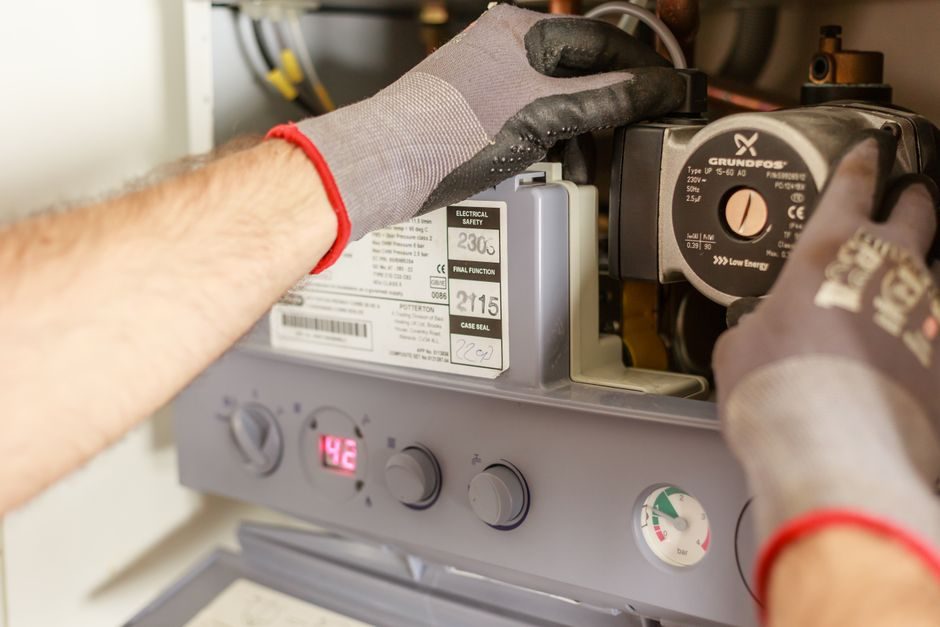
For boiler-feed service the pump's prime, vapor, and seal envelope — not just its flow and head — is what the inspector signs off on [S3]. A typical ZXL-series self-priming pump in industrial/drainage duty is qualified for media up to 80 °C as standard, with special builds rated to 200 °C, viscosity ≤ 100 cP, and solids up to 30% by volume [S3].
Working-condition limits on those units are bounded: ambient ≤ 40 °C, altitude ≤ 1000 m, relative humidity ≤ 95%, suction lift 5–6.5 m, and suction pipe length ≤ 10 m [S3]. Suction lift is the figure that almost always gets self-priming pumps removed from a fired-boiler-feed specification, because hot condensate tanks vent vapor the casing cannot re-lift on every start.
Scope: where a self-priming pump is and is not appropriate
A self-priming pump is a centrifugal pump that retains a liquid reservoir in the casing so the impeller can re-evacuate air from the suction line on each start, without an external vacuum or foot valve. ZB/ZBD-series light-duty units advertise 9 m suction from dry, with an integral pressure switch and pressure pot for automatic operation [S2]. The principle is identical across makers: axial liquid return, gas–liquid separation chamber, and one stored volume per cycle.
That architecture is what disqualifies the device for many boiler-feed duties. Hot-return condensate above ~80 °C, deaerator storage with NPSH margins under 2 m, and any service on the discharge side of a fired boiler where the NB-stamped boiler requires a positive-displacement or multistage centrifugal feed pump are the three exclusions to write into the project specification. Conversely, a centrifugal pump in self-priming trim is a fit for cold start-up, make-up water from a vented tank, boiler-blowdown receiving, and chemical-feed dilution — none of which require a board-mounted boiler-feed unit.
Certification documents the inspector will ask for
Build the submittal package around five items: (1) the manufacturer's published performance curve with NPSHr at the duty point, (2) a hydrostatic test certificate at 1.5× the design discharge pressure held for 30 minutes, (3) material certificates traceable to the casing, impeller, and shaft, (4) a mechanical-seal data sheet (faces, secondary seals, metallurgy) suitable for the feedwater chemistry, and (5) the pump's nameplate photograph showing serial, RPM, and rated head. The ZXL/CYZ-A specification already commits to cemented-carbide dynamic and static seal faces and a horizontal, direct-coupled frame that simplifies alignment [S3].
For power-piping boundary valves, the same engineering package frequently references a Ball Valve Selection Guide: Body, Material, Class, and Service Match so the suction and discharge isolation match the pump's pressure class. Cross-reference the gasket spec (spiral-wound vs. compressed sheet) and the flange rating (ASME B16.5 Class 150/300) in the same transmittal so the QA reviewer sees one consistent package.
Material and mechanical-seal selection

Default ZXL/CYZ-A construction is cast iron casing with stainless-steel shaft options for the chemical/petroleum variant [S3]. The CYZ-A fuel-transfer variant — gasoline, kerosene, diesel, jet fuel — is the construction closest to boiler-feed chemistry, and is built around corrosion-resistant mechanical seals and stainless steel wetted parts [S3]. For hot condensate (≤80 °C standard, 200 °C special) the specifier should request the high-temperature mechanical-seal option and verify the casing pressure-temperature rating curve on the nameplate.
Solids handling is the second material question: ZXL units accept up to 30% solids by volume in drainage service [S3], but a boiler-feed stream is normally clean condensate. State the cleanliness expectation (≤ 50 µm particle size, no scale chips) in the RFQ and pair the pump with a self-cleaning filter on the suction side if the upstream condensate return is open. Inline strainers for make-up water are commonly specified with a precision filter buying guide 2026: micron rating, media, and housing class reference so the micron rating is matched to the seal flush.
Operating-window limits the datasheet must show
The performance parameter table in any self-priming pump datasheet must give, at a minimum: flow (m³/h), head (m), speed (rpm), suction lift (m), NPSHr (m), and maximum fluid/ambient temperature. ZXL/CYZ-A publishes the operating envelope as: ambient ≤ 40 °C, altitude ≤ 1000 m, RH ≤ 95%, fluid temperature ≤ 80 °C (special to 200 °C), suction lift 5–6.5 m, suction pipe ≤ 10 m, and viscosity ≤ 100 cP [S3]. Those numbers are the upper bound; a hot-condensate boiler-feed duty will violate the temperature or NPSHr line on day one.
Use the table to draw a pass/fail line on the P&ID. If the duty point crosses any of: fluid T > 80 °C without the high-temp option, NPSHa < NPSHr + 1 m safety, suction lift > 5 m, or solids > 30% by volume, the answer is no. Mounting footprint is also datasheet-defined: ZXL direct-coupled design claims 30% less plan area than an ordinary self-priming pump of equivalent duty, with an IP54 outdoor motor option that removes the need for a pump house [S3].
Comparing the self-priming options against boiler-feed criteria
Line the three realistic self-priming options up against four selection criteria — temperature capability, suction lift, fuel/chemical compatibility, and footprint — before the RFQ goes out. Open-impeller ZXL: 80 °C standard / 200 °C special, 5–6.5 m lift, cast iron with stainless option, compact direct-coupled frame [S3]. ZB/ZBD light-duty: pressure-switch + pressure-pot automation package, 9 m lift, 80 °C media class, small footprint, aimed at clean water and light pressure-boosting [S2]. CYZ-A fuel transfer: −20 to +80 °C media, 5–6.5 m lift, corrosion-resistant seal + stainless wetted parts, tank-truck and airport refueler orientation [S3].
None of the three is a substitute for a positive-displacement diaphragm pump or multistage centrifugal on a fired boiler's feed line. They are fit for cold start-up, vented make-up, and chemical dilution where the self-priming pump casing's stored volume can evacuate suction air on each start without external help.
Verification at receiving inspection
On receipt, the receiving inspector should compare the pump nameplate RPM, rated head, and serial against the certified curve, then witness a cold-run to confirm re-prime time from dry. The re-prime test is the field-level proof that the unit will start without a vacuum pump — a property the centrifugal pump family does not generally have. Record fluid temperature, suction-line static head, and time-to-stable discharge; reject if re-prime exceeds the manufacturer's published value at the as-installed suction lift. [S3]
Track these signals going forward: (1) revision status of ASME B31.1 and the boiler NB-stamp data report on the certified unit, (2) a new high-temperature mechanical-seal option (200 °C) on the next ZXL/CYZ-A purchase order when condensate temperature exceeds 80 °C, and (3) a paired Push-In Fitting Selection: Tube, Thread, Media, and Duty Anchors review for the seal-flush and instrument-air connections so tubing and thread are not the failure point in a hot-condensate installation.