A digital signal's spectral content extends to infinity in theory, so engineers must define a working bandwidth; the common practice is to truncate the power spectrum at the knee frequency, the point that captures ~75% of total signal power [S1].
For clocked designs, the practical shortcut is bandwidth is roughly 5x the fundamental clock frequency, so a 1 GHz clock maps to a 5 GHz analog bandwidth requirement and a 2.5 GHz clock maps to about 12.5 GHz [S2]. This ratio is what determines whether a VFD or any high-speed driver's output stage can deliver the edge rates the channel expects.
Why a Square Wave Has Infinite Theoretical Bandwidth
The Fourier transform of a single finite-width square pulse is a sinc function, and the sinc function's side lobes never reach zero, so energy extends to positive and negative infinity [S1]. A periodic 50%-duty-cycle square pulse train at clock frequency fclk is instead a sum of shifted sincs that converges to a Fourier series of discrete harmonics at fclk, 3fclk, 5fclk, etc., with amplitudes set by the edge rate and duty cycle [S1].
Because the spectrum has no natural cutoff, any "bandwidth" assigned to a digital signal is a convention, not a physical edge; one textbook states outright that "for digital signals, the bandwidth is infinite," and that claiming digital bandwidth must be finite is "incorrect" [S3]. This is why a digital multimeter or oscilloscope front end is specified by analog bandwidth rather than by sample rate alone.
The Knee-Frequency Rule and 5x Clock Heuristic
The knee frequency (fknee) is the cutoff that retains approximately 75% of the total spectral power, and the bandwidth needed to pass fknee is the practical minimum for low-distortion propagation on a PCB [S1]. For a clock-like square wave, fknee collapses to roughly 0.5 / Tr, where Tr is the 10-90% rise time; the analogous oscilloscope/measurement rule is BW ≈ 0.35 / Tr, which gives about 3.5 MHz for a 100 ns rise time [S7].
Empirically, designers use BW ≈ 5 x fclk as the working number: 1 GHz clock needs 5 GHz bandwidth, 2.5 GHz clock needs about 12.5 GHz [S2]. That 5x factor is conservative for CMOS-style edges and matches the knee-frequency truncation to within a small multiplier for typical 50% duty-cycle signals [S1][S2]. The relationship is monotonic and one-way: faster clocks always demand proportionally wider channel bandwidth, which is why a digital panel meter sampling rate spec is meaningless without a stated analog input bandwidth.
Signal Bandwidth vs. Channel Bandwidth
Signal bandwidth is a property of the waveform in the frequency domain; channel bandwidth is a property of the medium (cable, trace, fiber, free space) and is always finite [S3]. Designing a high-speed link is therefore an exercise in making the channel bandwidth at least as wide as the truncated signal bandwidth defined by the knee frequency, so that the receiver sees an edge that still looks like an edge [S3].
When channel bandwidth falls below the signal's knee frequency, the high-order harmonics that shape the rising edge are attenuated, the edge rounds off, and intersymbol interference grows; coaxial cable and twisted-pair copper, for example, both behave as low-pass RC-style channels and progressively attenuate higher harmonics [S4]. The same physics shows up at the process-instrument level, where a pressure transmitter's HART loop and a flow meter's pulse output are both constrained by the analog bandwidth of the wiring and the input stage of the receiver.
Where the 5x Rule Breaks Down
The 5x-clock heuristic assumes a roughly symmetric 50%-duty-cycle clock with CMOS-like edge rates; it underestimates the requirement for fast-edge, low-duty-cycle signals and overestimates it for slow sinusoidal clocks [S1][S2]. For a stream of narrow pulses, the spectrum's first-null frequency is set by the pulse width, not the repetition period, so the bandwidth can exceed 5 x fclk by a wide margin.
Multilevel signaling changes the picture further: a PAM4 link transmits two bits per unit interval, so the baud (symbol) rate is half the bit rate, and the required channel bandwidth tracks the baud rate, not the bit rate [S3]. The ITU-R SM.853 formula for necessary bandwidth of digital FM emissions (Bn ≈ 2R/Log2(S) plus modulation terms) is the formal regulatory analogue of the PCB rule, defining the spectrum an emission must occupy to be received reliably [S6].
Comparison of Common Bandwidth-Definition Conventions
Engineers use at least four different bandwidth definitions, and choosing the wrong one for a specification causes system-level mismatch. The table below lines them up against the decision criteria that matter for a digital-channel budget. [S1]
Definition, decision criterion 1 (what it measures), criterion 2 (typical use), criterion 3 (limitation): -3 dB point, the frequency where a filter or amplifier transfer function drops 3 dB, used to specify receiver front-end and oscilloscope analog bandwidth, gives a single number but says nothing about phase or group delay; Knee frequency (~75% power), the truncation of a digital signal's spectrum that retains most of the edge energy, used for PCB signal-integrity budgeting, is waveform-dependent so the same fclk can give different fknee; Channel operating range, the contiguous frequency band a medium passes with low loss, used for cable, fiber, and wireless link budgets, is medium-dependent and varies with length and connector quality; Necessary bandwidth (ITU-R SM.853), the spectrum an emission must occupy for reliable demodulation, used in regulatory and radio-link planning, is computed from bit rate and modulation parameters, not from edge rate [S3][S4][S6].
For digital clock channels, the knee frequency (criterion: edge-rate-driven) and the -3 dB receiver bandwidth (criterion: instrument-spec-driven) are the two that must be matched against each other; the others govern adjacent parts of the system [S1][S3].
Applying the Rule in Test and Measurement
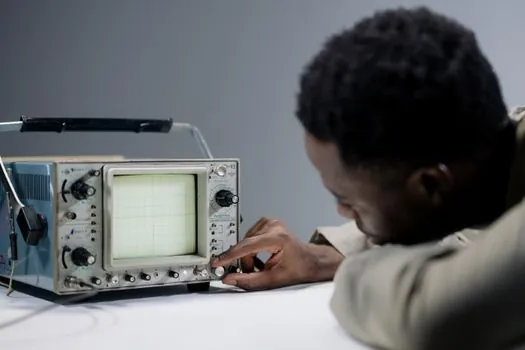
The instrument-side analogue of the 5x rule is the oscilloscope bandwidth criterion: to measure a square wave with 100 ns rise time, the scope needs about 3.5 MHz of analog bandwidth, computed as 0.35 / Tr [S7]. The factor changes with target fidelity: 0.35/Tr approximates a -3 dB sinewave response, while 0.5/Tr matches the knee-frequency criterion used in PCB work [S7][S1].
Analog bandwidth in an ADC or scope is defined as the frequency at which a swept sine input's spectral amplitude is reduced by 3 dB relative to its midband value, which is the same -3 dB convention used in filter design [S4][S3]. The Keysight reference summarizes the umbrella definition: bandwidth is fmax minus fmin over a continuous band, and it quantifies the range of frequencies a system can handle, which directly bounds data rate and signal integrity [S5]. ASTM E94/E94M-22 radiographic examination guide and the ASTM A536 ductile iron decision map live in completely different domains, so no cross-link is forced here.
Selection Checklist for Clock-to-Bandwidth Budgeting
Use the 5x rule (BW = 5 x fclk) as a first-pass channel-bandwidth target for 50%-duty CMOS clocks, then verify with the knee-frequency calculation fknee ≈ 0.5 / Tr for the actual measured edge [S2][S1]. Confirm that the receiver's -3 dB analog bandwidth exceeds the larger of these two numbers, and confirm that the channel medium's loss profile does not attenuate fknee below the receiver's sensitivity threshold [S3][S4]. For PAM4 or other multilevel links, budget against the baud rate (half the bit rate) rather than the bit rate, and recheck using the ITU-R SM.853 necessary-bandwidth formula as a regulatory sanity check [S3][S6].
Two trackable signals: NI's 0.35/Tr measurement rule (last updated 2026-09-02) is the live reference for oscilloscope bandwidth sizing, and Keysight's 2026-02-23 bandwidth-formula guide is the live reference for system-level fmax minus fmin budgeting [S7][S5]. If either of those references changes its recommended multiplier, the 5x rule-of-thumb number for clocked digital channels should be re-checked against it.