
A battery friction-weld strapping tool does in one hand-held unit what a manual tensioner-and-seal set does in two tools and a consumable buckle: it tensions the strap, friction-welds the joint, and cuts the tail in a single trigger pull, with no separate metal or plastic seal to load [S3][S5]. A manual tensioner-and-seal set instead grips the strap with a hand ratchet or friction wheel, locks tension with a separately crimped metal or plastic buckle, and requires a second tool to cut the tail [S4].
Both routes cover PP and PET strapping; the battery tool covers common strap widths including the 5/8" (≈16 mm) size that dominates PET pallet strapping, with weld settings adjusted to the strap's break strain [S5]. The manual route covers the same PET/PP range but adds a buckle consumable and a separate seal-crimping step to every cycle [S4].
Where Each Tool Fits the Daily Cycle
Battery friction-weld strapping tools are specified where volume is high and the seal point is hard to reach, because they eliminate the seal itself: the strap ends are welded together by friction, so no metal clip or plastic buckle is stocked, fed, or crimped [S5]. A manual tensioner and seal, by contrast, is the lowest-cost entry point and runs with no battery, no compressor, no air line, and no charging cycle, which makes it the default for one-carton, one-bundle, or low-to-medium volume pallet work [S4].
The battery unit's purpose is captured directly in the [S5] supplier guidance: friction weld tools are used instead of the conventional tensioner and sealer tool where volume is high and the seal is difficult, and the same job is done in less time without two tools that can be awkward in confined areas [S5]. For a warehouse that walks pallets across a yard, the battery tool also drops the trip hazard from hoses and cords that an air-powered or corded-electric tool would otherwise introduce [S2].
Operating Specs: Cycle Time, Power, Strap Range
A battery friction-weld tool completes tension, weld, and cut in seconds with one hand on a single button, and a 60-90 minute charge is enough to strap hundreds of packages per cycle on common models [S2]. That same tool family carries adjustable tension force, welding time, and strap-speed settings, with battery level and tool status shown on an LED or digital panel, and memory slots on higher-tier units to recall job-specific parameters [S2].
A manual tensioner and seal trades that automation for mechanical simplicity: strap is wrapped around the load, the short end is loaded under the gripper, the long end is fed into the tensioning wheel or ratchet, the handle is pumped until snug, a separate seal or buckle is slid over the overlap, the seal is crimped with a second tool, and the tail is cut before the tensioner is released [S3][S4]. Cycle time scales with operator skill, not tool throughput, which is why training one operator well is what keeps a manual line's tension consistent rather than the tool itself [S4].
Joint Quality: Friction Weld vs Buckle-Crimped Seal
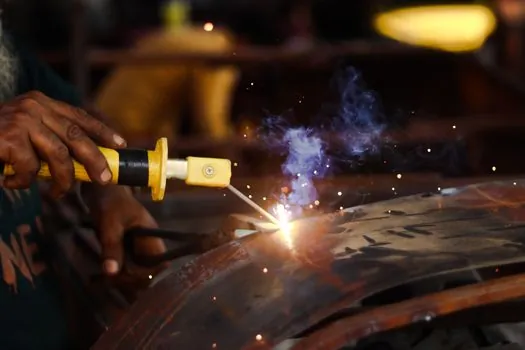
The friction-weld joint is produced by the tool itself: the two strap ends are rubbed together under load until the polymer softens and fuses, the tool then holds the joint while it cools, and a built-in cutter trims the tail, so every cycle leaves a welded seal rather than a mechanical interlock [S3][S5]. A battery tool's specification matters here because the weld time and cooling phase are programmable, which is what lets the same tool run both PP and PET once the break-strain setting is changed for the strap in use [S2][S5].
The manual tensioner-and-seal joint is a buckle, not a weld: the strap is locked in place with a plastic buckle or a metal buckle, and that buckle is either crimped or friction-locked, never heat-fused, so the strap's full tensile strength has to be carried by the buckle and the operator's crimp rather than by a welded polymer bead [S4]. For PET and PP on standard pallet and carton loads this is normally adequate, which is why a hand-tensioned, buckle-sealed joint remains the reference low-cost baseline; for high-tension or hard-to-reach seals, the welded joint is what the friction-weld tool is bought to replace [S4][S5].
Cost Structure: Capex, Consumables, Running Cost
A manual tensioner and seal set sits at the bottom of any strapping-tool price list because there is no powered drive, no battery, and no on-going power or gas cost to run it, and the only consumable is the buckle itself [S4]. A battery friction-weld tool costs more per unit than a manual set, but the supplier position is that the time saving per strap, plus the elimination of seal stock, is what makes the payback short on high-volume lines [S5].
The recurring cost lines also diverge: a manual line pays per seal/buckle and per operator-minute, while a battery line pays per battery cycle and per charger slot, which is why the published guidance is to keep at least one spare battery on charge so the line never idles on a recharge, and to budget for a high-speed charger (some models support a ≈15-minute top-up) if downtime matters [S5]. For low-volume users, the same supplier calculus flips: the spare battery, the charger, and the higher tool price have no cycle to amortise against, which is the case where a manual set remains the rational buy [S4][S5].
Decision Matrix: Four Criteria, Two Options
On daily volume, the manual set fits low-to-medium runs, intermittent one-pallet work, and sites with no charging infrastructure, while the battery friction-weld tool fits high-volume lines and any seal point that is awkward to reach with two separate hand tools [S4][S5]. On joint integrity, the manual set delivers a buckle-crimped or friction-locked interlock whose strength depends on operator crimp quality, and the battery tool delivers a friction-welded polymer bead with tool-controlled weld and cool time, which is the [S5] reason the welded joint is described as "a perfect seal every time" within the tool's adjusted settings [S5].
On operator fatigue and safety, the manual set needs physical pumping on every cycle and exposes the operator to strap-snap recoil if the line is stood in, while the battery unit runs from a single trigger pull and removes the hose/cord trip hazard that an air or corded tool would add [S2][S3]. On total cost of ownership, the manual set wins on entry price and zero power cost for low volume, and the battery tool wins on per-strap labour and on seal-consumable elimination once daily volume is high enough to recover the tool's higher purchase price [S4][S5].
Standards, Materials, and Sourcing Constraints
Both tool families are documented for PP and PET strapping, with the friction-weld tool additionally called out as compatible with the 5/8" (≈16 mm) PET size that is the most common industrial width and is widely stocked by distributors [S5]. Steel strapping remains a separate tensioner family and is not what the battery friction-weld or manual PET/PP set is built around, which matters when a buyer is matching tool to strap material rather than the other way round [S3].
On the safety side, the published operating guidance for any strapping tensioner, whether manual ratchet, pneumatic, or battery, is to wear gloves and safety glasses, stay out of the strap line because a snapping strap can recoil with force, avoid over-tensioning that can damage the load or break the strap, handle cut ends carefully because they are sharp, and keep tension wheels, cutters, and moving parts clean and lubricated [S3]. For the battery tool specifically, suppliers add weather protection for outdoor use and physical storage on the strapping cart so the tool is not dropped, run over by a forklift, or shipped out by mistake on a pallet it just strapped [S5]. For PET strap selection criteria that sit upstream of this tool choice, the material-side decision is covered separately in Stainless vs Aluminum Strapping Band: Material Selection Spec Guide and in Strapping Bands in Industrial Packaging: Types, Selection, and Use Cases.
Track, before purchase, the daily strap count per shift (the single number that flips the decision from manual to battery), the widest strap that will run through the tool (so the friction-weld unit's width range is confirmed against the 5/8" PET baseline), and whether a second battery and a high-speed charger are quoted in the same package (so the line is not stopped by a recharge on day one) [S5].