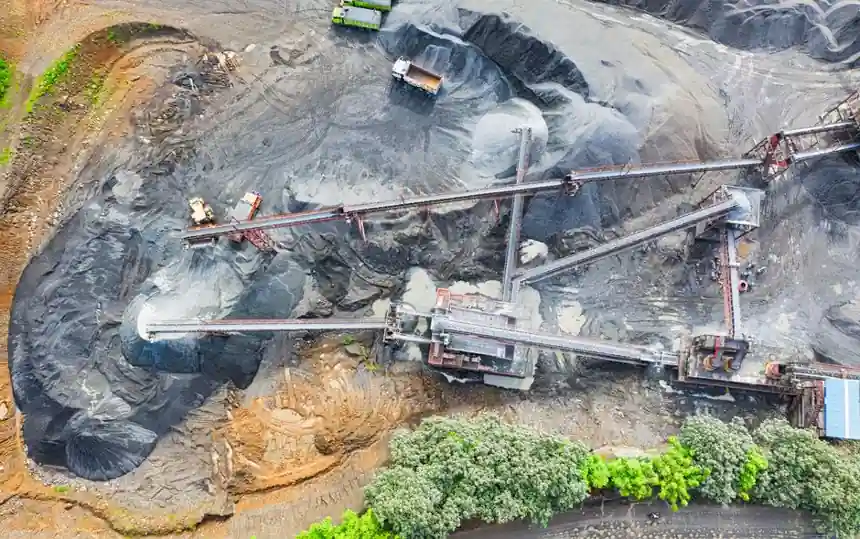
Belt conveyors are the dominant continuous-handling equipment class, covering everything from 50 mm wide food-grade cleated belts to 2400 mm wide mining troughers carrying over 10,000 t/h [S2][S7].
Selection is driven by four hard variables: load profile (bulk vs. unit), belt width and tensile class, incline angle, and environmental exposure (temperature, abrasion, static, chemical). The 2026 supplier market, including MIR Belting and US Conveyor, is concentrating on modular splicing (Ziplink-style) and tracking-friendly carcass designs for fast line changeover [S4][S5].
Bulk-material belt conveyors: troughed, cleated, and inclined variants
Troughed belt conveyors using 20°–45° idler sets dominate bulk-mineral and grain duty, with belt widths 500–2400 mm and EP 400–EP 2500 polyester-nylon carcasses common above 1.5 m/s [S2]. Cleated (chevron) belts hold product on inclines of 18°–35°; high-angle cleated designs can push to 45°–60° but require reduced throughput and slower speeds, typically 0.5–1.0 m/s [S3]. For abrasive ores, abrasion-resistant covers of 6–10 mm on the wear face with a 4 mm pulley-side cover are standard; impact zones use idler spacing reduced from 1.2 m to 0.6 m and crowned pulleys for tracking [S3]. Pusher belts and plough discharges use laterally stiff, flat-running carcasses to maintain tracking when side-loaded by reciprocating pushers, making them common in transfer lines and electric furnace feed systems [S1].
Unit-handling and package belt systems
Unit-handling belts are typically 300–1200 mm wide PVC or PU flat belts running at 0.3–2.0 m/s on slider-bed or roller-bed frames, sized for boxes, totes, and parts [S2]. Live roller and lineshaft conveyors share the belt-drive topology but shift the drive into 50–89 mm OD rollers for accumulating lines. For ESD-sensitive electronics, ESD (electrostatic-discharge) belts use conductive carbon-loaded covers, surface resistivity typically 10^5–10^9 Ω, preventing static accumulation during transfer of populated PCBs [S2]. Inclined unit-handling uses chevron or rough-top cleated belts, or modular plastic belts (PP, POM, acetal) for higher temperature or washdown duty up to 80–100 °C [S3].
Specialty belt types: magnetic, vacuum, and food-grade
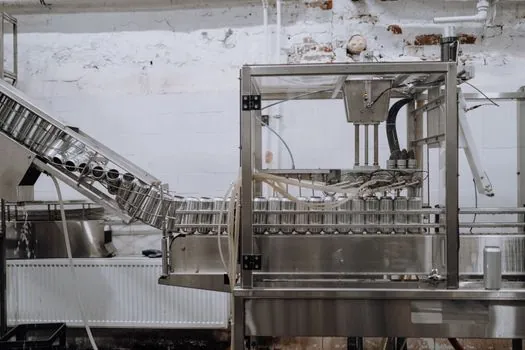
Magnetic conveyors carry ferrous parts on a moving magnetic field beneath a stainless slider bed, eliminating the need for a belt cover and enabling operation up to 150–200 °C in hot-chip or stamping environments. Vacuum belt conveyors draw the load through suction holes (5–10 mm diameter, ~20% open area) and pull small parts (PCBs, pouches, sheets) flat against the belt, common in printing and packaging lines at 0.1–1.5 m/s. Food-grade and pharma belts require FDA- and EC 1935/2004-compliant PU or PE covers, stainless-steel 304/316L frames, and CIP (clean-in-place) washdown capability; for cold-chain pneumatic and refrigerated transfer, low-temperature belt compounds remain flexible down to −30 °C, a topic covered in cold-chain pneumatic conveying sizing for adjacent material-handling specs. [S2]
Belts, fasteners, and tensioning hardware
Belts themselves divide into fabric-ply (EP, NN, cotton), steel-cord (ST 630–ST 7500 kN/m tensile), and specialty (Modular plastic, chain, flat wire) constructions, each with defined minimum pulley diameters, e.g. steel-cord ST 2500 needs at least 1000 mm drive pulleys, EP 400 typically 400–500 mm [S2][S7]. Mechanical splicing via hinged plate fasteners (Flexco-style) allows fast repair but introduces a 30–40% strength penalty versus endless vulcanised splices, so high-tension lines still favour hot or cold vulcanised splices rated at 90–100% belt strength. Proper tensioning is a separate discipline: the belt tensioner category covers gravity, screw, and pneumatic take-up units sized at 0.5–2.0% of belt length travel. For light-duty indexing and tight-radius transfer, a chain belt or modular plastic chain delivers 180° turn geometry impossible for fabric belts. Heavy-duty bulk lines often pair a ribbed belt on the drive motor to a separately spec'd conveyor belt, and short-centre indexing drives frequently use a flat belt for quiet, low-vibration operation. Splicing technology, like MIR's Ziplink, is now a 2026 differentiator for plants with mixed belt profiles and short maintenance windows [S4].
Design software and engineering parameters
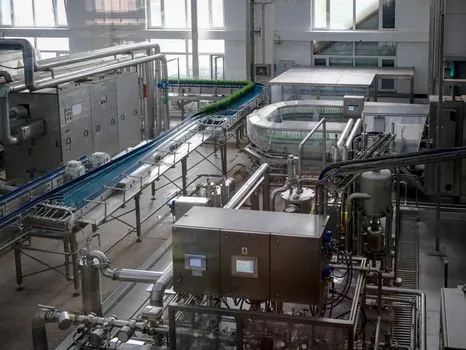
Modern belt-conveyor design software packages calculate drive power from CEMA (Conveyor Equipment Manufacturers Association) or ISO 5048 methodology, factoring belt speed, mass per metre, lift, and wrap angle on the drive pulley [S3]. Typical drive motor sizes range from 0.37 kW for short cleated lines to 1.5–3.0 kW for medium troughed units, with large mining boosters exceeding 1,000 kW per drive station. The 2026 generation of design tools also models tracking behaviour, splice ratings, and idler spacing to reduce over-design; many now include grain-industry and hazardous-gas monitoring overlays for safety compliance [S3].
Application fit and selection rules
Use a troughed bulk-material belt when continuous tonnage exceeds 50 t/h, inclination is below 18°–20°, and the product is granular or lumpy; switch to cleated above that angle. Pick a flat PVC/PU unit-handling belt for boxes and packaged goods at moderate speeds, and a modular plastic or stainless mesh belt when the line requires curves, washdown, or temperatures above 80 °C. A pusher or sortation belt fits lateral sortation and transfer-carrier lines, while an ESD belt is mandatory for any populated PCB or explosive-dust route [S1][S2]. Cost-versus-life is straightforward: a flat belt is the lowest-cost option but cannot carry abrasive material; a steel-cord belt costs more per metre but delivers 5–10× the service life on long, high-tension bulk runs. For plants with frequent product changeover, the mesh belt family is often a better fit, and the broader belt conveyor category covers all of the above in spec-first form.
Limitations and failure modes

Common belt-conveyor failures include mistracking (often traced to idler misalignment or off-centre loading), cover wear on the carry side, splice pull-out, and belt slip from inadequate tension or contaminated pulleys. Belt conveyors are a poor fit for sterile cleanroom transfer (favoured by overhead conveyors), for highly viscous pastes (positive-displacement pumps are better), and for severe vertical lifts above 45°–60° (where a steep-angle pocket belt is needed). Standard design guides flag mistracking as the single largest cause of unplanned downtime, followed by cover wear and splice failure; preventive idler maintenance intervals of 6,000–10,000 operating hours are typical in abrasive service [S3].
Trackable signals: the 2026 product pages from US Conveyor and MIR Belting now flag modular splicing kits, RFID-tagged belt covers, and arc-tracked carcass monitoring as the next set of differentiators, with 6,000–10,000 h idler service intervals and CEMA-driven drive-power selection the still-current 2026 design baseline [S3][S4][S5].