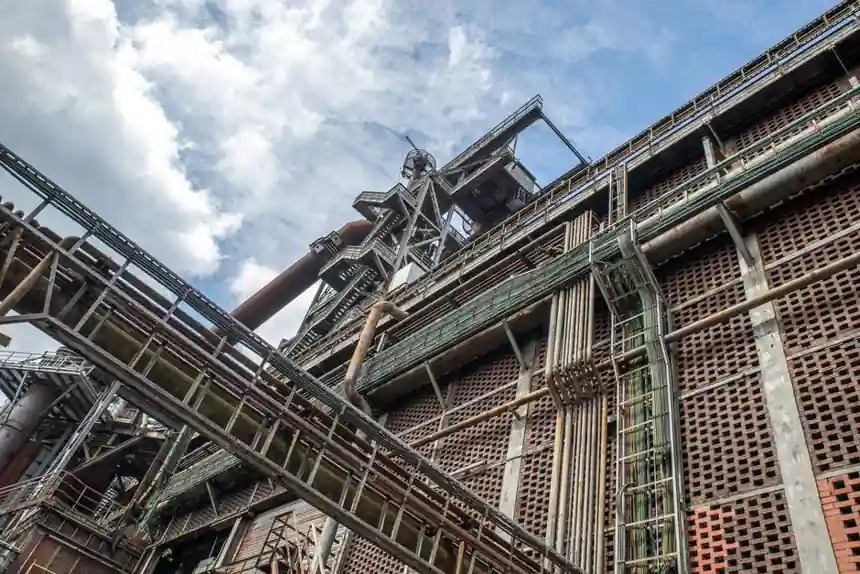
Steel-mill main-drive and conveyor belt tensioners are sized by drive power, shaft speed, torque, dynamic load, and ambient mill conditions, with constant-force or rotary actuators dominating heavy-duty applications [S1][S5].
Proper selection on a V-belt, ribbed belt, or timing belt cut unplanned downtime, premature belt wear, and bearing failures, all common failure modes in rolling, slab-handling, and coke-side conveyors [S4].
Definition and Scope: What a Belt Tensioner Does in a Steel Mill
Industrial belt and chain tensioners are available in a wide range of sizes, styles, and materials, and they handle different minimum and maximum loads to keep belt and chain drives at their designed operating tension [S1]. In a steel mill the device compensates for belt elongation under load, absorbs shock from slab impact, and maintains wrap angle on the driven sheave [S1].
For steel-mill service, the tensioner is part of a larger belt conveyor or mill-drive take-up system, and its specification depends on the drive train type: V-belt, ribbed belt, synchronous (timing) belt, or chain. B&B Manufacturing classifies these devices as idlers and tensioners whose function is to restore the drive to its original tension as belts wear, since worn belts stretch and slip, lowering transmitted horsepower [S4].
Selection Criteria: Drive Power, Speed, Torque, and Mounting Envelope
Designers must consider drive power, speed, torque, load, operating cycles, and available mounting space when selecting a tensioner, per established mechanical-design guidance [S5]. In steel-mill practice the five hard constraints are (1) nameplate kW at the driver, (2) service factor for the driven machine, (3) belt linear speed and pitch, (4) take-up travel (mm), and (5) envelope around the motor base or tail pulley.
Linear belt speed above 25 m/s and drives with reversing duty or cyclic impact loading push the spec from a fixed mechanical adjuster to an automatic actuator [S5]. For drives above 75 kW, the practical lower bound is a constant-force spring or hydraulic-pneumatic actuator with at least 50–100 mm of take-up stroke; below 7.5 kW a manual threaded screw or eccentric idler is usually adequate [S5]. A belt tensioner selection should never be made on shaft diameter alone, because torque capacity depends on the spring rate, lever arm, and actuator force.
Linear vs Rotary vs Spring vs Hydraulic Tensioners: Criteria Comparison
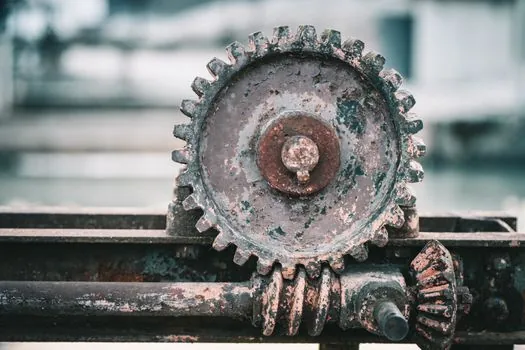
There are two basic approaches to applying tension to a belt cleaner or drive: linear and rotary, with the cleaning position and angle of approach often dictating which type is used [S3]. For steel-mill drives the four practical families and their best-fit roles compare as follows:
Manual linear (threaded screw or eccentric idler): cheapest, fits compact motor-base take-ups below 7.5 kW, no self-adjustment, requires scheduled re-tensioning [S2][S3]. Constant-force spring rotary: compact, mountable in any orientation, ideal for belt-cleaner tensioning and main V-belt drives, supplies steady force as the belt wears, the standard fit for steel-mill scraper conveyors and primary belt cleaners [S3]. Pneumatic / hydraulic rotary: required for high-impact applications above 75 kW, supports remote adjustment and load sensing, and can be tied into plant air at 4–8 bar [S3]. Elastomeric / stored-torque rotary: provides compact self-tensioning without external air, common in OEM timing belt drives where space is tight and the drive runs in a fixed direction.
Dual tensioning is recommended for belt cleaners installed on belts wider than 48 in. (about 1,200 mm), but dual tensioning does not remove the need for regular adjustment to maintain suitable cleaning pressure on the belt [S3]. For a multi-stand rolling-mill main drive, a chain belt or chain coupling frequently uses a matched chain tensioner sized to the same kW and service factor as the drive chain itself.
Steel-Mill Application Map: Where Each Type Fits
Cold-rolling mill coiler drives and temper mill drives commonly run multi-rib ribbed belt or synchronous belt drives in the 15–55 kW range, where constant-force spring tensioners are the default because they compensate for belt creep without operator intervention. Hot-strip mill runout table conveyors and slab yard conveyors use wide flat belts, often 1,200–2,400 mm, and per the dual-tensioning rule above are typically equipped with two pneumatic rotary tensioners per cleaner pole, fed from the plant 4–8 bar air system for remote monitoring and quick blade changeout [S3].
Coke-side and sinter plant conveyors see high temperature, dust, and moisture, and the tensioner selection must add a stainless or zinc-plated spring housing with sealed bearings; powder-coat or epoxy finishes are inadequate above 80 °C ambient. For a light-duty flat belt drive on a mill auxiliary such as a coolant pump, an eccentric idler or simple threaded-rod tensioner is typically sufficient and matches the simplicity of a hinged motor-mount plate arrangement that swings on a set screw [S2]. The Practical Machinist thread illustrates the geometry: a 1/2 in. (12.7 mm) hole in the motor plate, a shoulder pin, a hex barrel threaded to draw the mount back, plus a locknut to hold setting, the kind of detail that still appears in steel-mill auxiliary retrofits [S2].
Limitations, Failure Modes, and What to Avoid
Inadequate tensioning causes carryback to cling to the belt and spill along its path, piling up under the conveyor and generating excessive dust, while over-tensioning leads to friction damage to the carrying side of the belt, premature blade or belt wear, and potential splice damage [S3]. A constant-force spring that is undersized for the drive kW will run at the bottom of its stroke and lose take-up travel, while an oversized spring over-tensions the belt on cold start and shortens belt life by 30–50%.
Most belt tensioners must be monitored and adjusted manually so they can maintain optimum pressure, and estimating when blades or belts need to be changed is often a guessing game, so leaving any tensioner unattended for long periods invites bearing and splice failures [S3]. For steel mills the specifier should also reject any tensioner whose published force curve is not linear within ±10% over the advertised stroke, since non-linear springs cause belt vibration at the natural frequency of the drive. Avoid pairing a manual linear tensioner on a reversing drive: the operator cannot re-set tension fast enough, and the belt will slack on every reversal.
Sourcing, Standards, and Audit Trail
Specifiers should anchor the build to ISO 9001:2015-certified suppliers (the baseline audited quality system for steel-mill drive components) and require a documented force-vs-stroke curve, material certificates for the spring, and a duty-cycle rating matched to the driven machine [S4]. B&B Manufacturing lists ISO 9001:2015 alongside REACH, RoHS, and Proposition 65 compliance on its tensioner and idler lines, the kind of certification stack a mill procurement audit will look for [S4].
Cross-reference the proposed tensioner against the OEM drive rating using the supplier's competitor cross-reference tool, and request the B&B or equivalent full catalog to lock the part number to the driven machine's catalog code [S4]. For new steel-mill builds in 2026, a useful tracking node is the supplier's published availability of pneumatic rotary tensioners with integrated position feedback (4–20 mA or IO-Link), since that signal can be tied into the mill's existing access-control and asset-monitoring layer for predictive maintenance. Another trackable signal is the move toward dual-tensioner fields above 1,200 mm belt width on conveyor retrofits, a change driven by CEMA cleaner-position guidance that is now standard practice in mill-specific conveying packages [S3].