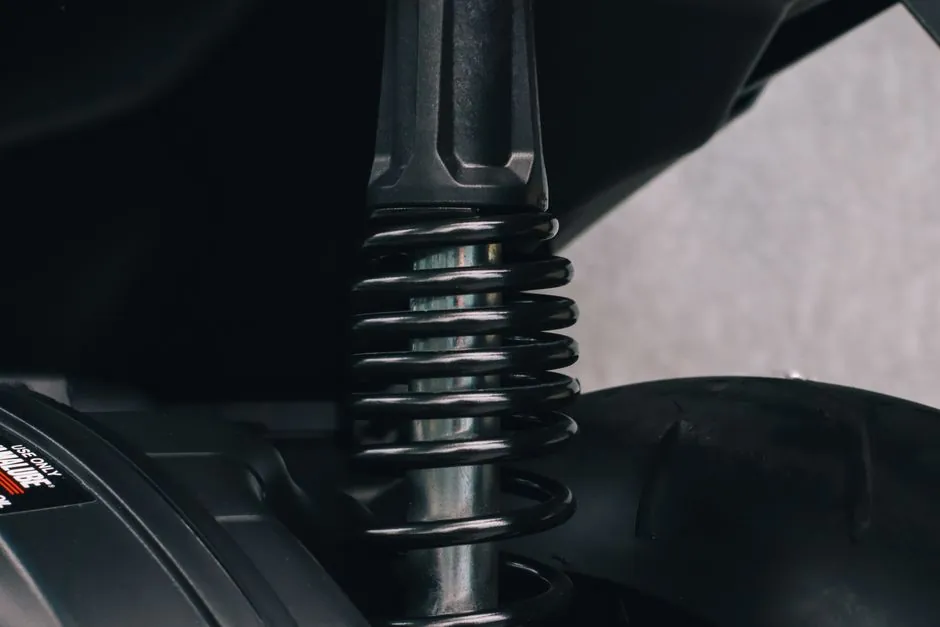
A belt tensioner spring rate is selected from the required tension force and available spring travel, commonly expressed as force per unit deflection, rather than from a generic pressure rating.
The calculation must account for belt type, span length, pulley forces, installation angle, preload, thermal exposure, and whether the drive needs a fixed, adjustable, or automatic tensioner.
Spring Rate Definition and Force Calculation
For a linear coil spring, spring rate is the force required to produce a stated deflection. A 200 lb/in spring compresses 1 in under a 200 lb load, and adding another 200 lb produces another 1 in of compression, provided the spring remains within its linear operating range [S1]. In SI units, the equivalent relationship is expressed as N/mm, with 200 lb/in approximately equal to 34.5 N/mm.
The governing calculation is F = kx, where F is spring force, k is spring rate, and x is deflection from the spring's free or installed reference position. The selected rate must produce the required tension at the actual installed length. A spring selected only for its force capacity can still apply insufficient or excessive tension because the same force may require different deflections [S1][S6].
Convert Belt Tension into Spring Force
The first step is to determine the belt force required by the drive, then resolve that force into the spring-tensioner direction. For a lever mechanism, the spring force is not automatically equal to the belt force because the moment arm changes the force ratio [S1]. A longer spring lever generally reduces the spring force required for a given belt-side force, while a shorter lever requires more spring force.
Proper V-belt tension is critical to performance and service life: excessive tension can overload bearings and damage components, while insufficient tension can cause slippage, heat buildup, and premature wear, so tension should be set by a defined method rather than by feel.
The spring should then be selected so its force at the installed length equals the calculated spring-side demand. If the spring includes preload, total spring force is preload plus rate times working deflection. Do not confuse required spring force with spring rate: the same force can be produced by a softer spring with greater preload or a stiffer spring with less preload [S1].
Angle, Geometry, and Lever Effects
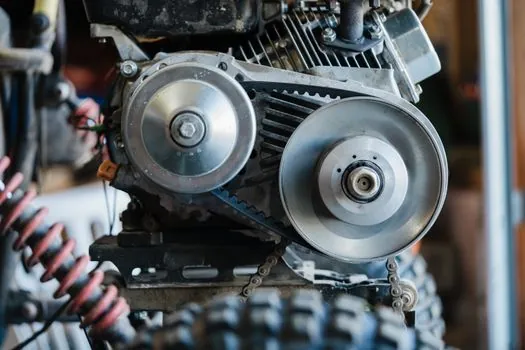
An angled installation reduces the spring's effective vertical force, so the selected rate must be corrected for the mounting angle. The supplied angle correction factors are 0.981 at 10°, 0.962 at 15°, 0.942 at 20°, 0.913 at 25°, 0.873 at 30°, 0.824 at 35°, 0.774 at 40°, and 0.710 at 45° [S1]. Divide the straight-mounted spring rate by the applicable factor; a 200 lb/in spring mounted at 30° requires approximately 230 lb/in to deliver the equivalent straight-mounted force [S1].
For a pivoting arm, calculate the mechanical advantage from the geometry rather than copying a spring catalog rate. The tensioner spring force acts at its own attachment point, while belt force acts through the pulley or idler arm. The moment balance must include both distances and the angle between the force vectors. An adjustable idler can change the moment arm and belt direction, so its spring requirement should be checked at the intended adjustment range, not only at the midpoint.
Use the belt tensioner geometry as part of the calculation, not as an afterthought. The installation angle, free spring length, working length, arm ratio, pulley wrap, and belt type all influence the force delivered to the belt.
Spring Types Compared Against Selection Criteria
Compression springs are normally the default for a compact force-generating tensioner, extension springs suit a pull-type arrangement, and constant-force or clock springs suit controlled travel, but the rate and travel requirements determine suitability. [S3]
Spring rate represents the load required to compress a linear coil spring by a specified distance and remains constant as load changes, while an angled installation requires an angle correction factor because the installed spring must be stiffer to support the same weight. A constant-force spring is not automatically superior; it is useful only when its output band matches the belt's required tension range.
Who Should Not Use the Mainstream Spring Tensioner
A simple spring tensioner is a poor default for a high-acceleration timing-belt positioning system where added elasticity degrades print-head or carriage position accuracy. One documented design discussion identifies the spring rate as far too low and not stiff enough for accurate positioning at high acceleration; it also warns that an undamped spring can absorb motion rather than eliminate backlash [S3].
Spring tensioners also fit poorly where the belt must remain precisely tensioned under rapid reversing loads, wide temperature changes, or frequent load transients. The mechanism can store and release energy, creating oscillation and position variation. For those duties, use a rigid adjustable idler, a screw adjuster, a hydraulic tensioner, or a manufacturer-designed belt tensioning system instead of selecting a stiffer spring as a substitute for damping and position control [S3].
Do not select a spring tensioner for a timing belt solely because the belt is toothed. Teeth transmit motion, but they do not remove the need for tension control or eliminate elastic compliance. The correct decision depends on the required positioning accuracy, speed, acceleration, and tension variation.
Preload, Working Travel, and Failure Limits
Preload determines the minimum tension while the spring is not extending, and working deflection determines how force changes as the idler moves. Calculate the minimum and maximum belt-side forces over the full travel range, then verify that the spring force at both limits remains within the belt requirement. The spring must also avoid coil clash, solid height, overstretch, and excessive initial tension. [S4]
Thermal exposure is a failure mechanism, not just a design check. Springs can lose tension through prolonged heat exposure, and a weakened or broken tensioner spring can allow the belt to slip [S2]. Check the spring material, corrosion exposure, duty cycle, and operating temperature against the spring supplier's limits. A spring washer is not a substitute for the primary tension spring, and a retaining element must be specified for the selected spring and connection design.
Installation also affects life. A V-belt should be installed without rolling or prying it onto a pulley because low initial tension promotes slip and heat, while prying can damage the tensile cords [S4]. Establish the specified tension before setting the spring reference position, because otherwise the spring rate can be correct while the final belt force is wrong.
Validation and Sourcing Record
Record the belt type, span length, pulley-center distance, pulley sizes, transmitted load, measured or specified belt force, tensioner lever geometry, spring mounting angle, free length, installed length, preload, working deflection, minimum and maximum spring force, material, temperature rating, and adjustment range. These values make the selection auditable and allow the spring supplier's rate, travel, and load limits to be checked directly. [S4]
For a V-belt, use the force-deflection method with the belt manufacturer's tension chart: measure pulley-center span, calculate 1/64 in of deflection per inch of span, and apply the listed force at the midpoint [S4]. For timing belts, use the belt or machine supplier's tension and positioning requirements rather than substituting a generic V-belt chart. The spring-rate selection guide provides the core calculation sequence: determine spring force, apply angle correction if required, and then use force and deflection to choose the rate [S1][S6].
Shortlist Logic for Spring Rate Selection
The correct spring is the one that produces the required belt-side force at the installed geometry, maintains that force through the intended travel, and survives the temperature and duty cycle. Select the lowest rate that satisfies the force range and preload requirements, then verify the spring's free length, solid height, working deflection, initial tension, fatigue rating, and material limits with the manufacturer. [S1]
For a fixed V-belt drive, specify the required belt tension first, measure the span, calculate the spring-side force, and test the assembled idler with a belt tension gauge. For a high-acceleration timing drive, reject an ordinary spring tensioner unless the position-control and damping behavior have been validated. The procurement record should end with one selected spring rate, one installed force target, and one acceptable force band.