
A belt tensioner is a sprung or hydraulically loaded idler that maintains a defined tension in a belt loop, and its design must be matched to the belt profile and the duty cycle it sees. The 2026 aftermarket part-number landscape spans dedicated V-ribbed belt units (e.g. TOPRAN 401 405 for the MERCEDES-BENZ 271 200 02 70 engine) [S1], A/C-drive assemblies, and combined timing-belt tensioner-and-pulley modules for OHC engines [S3][S6].
On the industrial side, the same physical job — keeping the belt on the tight side — is performed by gravity-arm, screw-take-up, and constant-force spring units, with a stated rule that the tensioner must sit on the belt's tight (tensioned) side and that rope/cord belts and flat belts behave differently from V-section belts in such mechanisms [S2]. Selecting the wrong class is the single most common cause of premature belt stretch, slip, or bearing failure across automotive, HVAC, and conveyor service.
Classification by Actuation Principle
Spring-automatic (mechanical) tensioners use a coiled torsional or helical spring to push the pulley against the belt, with a one-way clutch or friction damper controlling recovery. They dominate automotive serpentine and timing-belt applications because they are compact, maintenance-free, and tolerate the small stretch that occurs as the belt seats. Hydraulic-damping tensioners add an oil-filled dashpot to the spring path, slowing oscillation during load transients — a design widely used on long-span serpentine drives and on automatic belt-tensioner pulleys such as ACDelco 38166 (US $149.71 retail, 1999-2002 Oldsmobile Intrigue / Aurora fitment) where crank torsional vibration is significant [S5].
Mechanical-adjustable (fixed-take-up) tensioners rely on a bolt, eccentric, or screw to set position and lock it; no spring is in the load path. They appear on industrial belt-conveyor drives, stationary engines, and older V-belt accessories where a technician can re-tension during scheduled service. A belt-tensioner spec sheet should state actuation type, the spring rate (N/mm) or hydraulic damping coefficient, the total angular travel, and the mounting-bolt pattern, because the same pulley OD can hide incompatible internal mechanisms between part families.
Classification by Belt Type and Pulley Geometry
V-belt tensioners pair with classical V-belts and use a deep-groove sheave matched to the belt's top width and angle; they are common on industrial drives, agricultural PTOs, and older accessory drives. Multi-rib (serpentine) tensioners carry a smooth-faced pulley running on the back of a ribbed-belt so the ribs drive from the ribbed side and the smooth back contacts the idler — a geometry confirmed in cross-reference listings for v-ribbed belt tensioners covering MERCEDES-BENZ C-Class (W203/W204), E-Class (W211), CLK, SLK R171, and Sprinter 906 platforms [S1].
Timing-belt tensioners hold a toothed or smooth idler that bears against the back of a timing-belt to maintain tooth mesh; on Mitsubishi OHC engines the tensioner is often sold as a combined tensioner-and-pulley assembly, with CENS.com listing the part under the "Mitsubishi Timing Belt Tensioner & Pulley" category [S6]. Flat-belt tensioners, used on flat-belt and rope-belt drives, are typically a crowned idler on a spring arm and are excluded from V-belt service because the contact mechanics differ [S2]. The same assembly name (e.g. "belt tensioner") therefore implies different bearing loads, different pulley surface treatments, and different OE cross-reference logic depending on the belt profile it serves.
Aftermarket Part-Number Map (2024-2026 Listings)
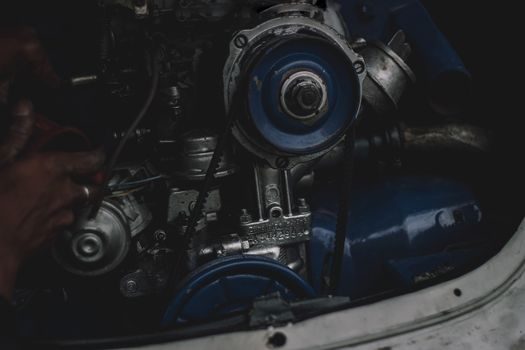
Recent cross-reference data shows the breadth of v-ribbed belt tensioner coverage in the European aftermarket, with TOPRAN 401 405 (MERCEDES-BENZ 271 200 02 70, C/E/CLK/SLK/Sprinter) cross-referencing CALIBER 66265, TRISCAN 8641 113029, KM International FI16780/FI21500, LYNXauto PT-3201, SASIC 1626062, FARE SA 4339, and TRISCAN 8641 233014 — all explicitly labelled "Belt Tensioner, v-ribbed belt" [S1]. For Toyota, the 16620-31021 RWD reference covers 2005-2012 Avalon applications at a US $37.36 aftermarket price point [S9].
For Mazda SkyActiv platforms, the PE03-15-980B tensioner covers 2.0 L and 2.5 L Mazda 3, 6, CX-3, CX-5, and CX-9 applications at US $56.54 per unit [S7]. Chrysler / Dodge / Jeep / Mitsubishi shared platforms (Aspen, Nitro, Liberty, Raider) use a single tensioner SKU at US $41.59 [S8], and GM applications such as Chevrolet Impala, Monte Carlo, Buick Regal, and Pontiac Grand Prix list at US $33.06 per unit [S4]. The pricing spread — roughly US $33 to US $150 — reflects bearing quality, integrated pulley vs. tensioner-only, and hydraulic vs. mechanical damping, not fitment class alone.
Selection Criteria and Decision Table
Four criteria reliably sort the field: belt type, drive span, load transients, and service interval. Match them against the four common classes — spring-automatic, hydraulic-damping, mechanical-adjustable, and combined tensioner-pulley — to lock the spec before pulling a part number. [S1]
Spring-automatic suits short-span, low-vibration serpentine accessory drives (alternator, A/C, PS) and is the default for most modern automotive ribbed-belt loops [S1]. Hydraulic-damping is the right pick for crank-driven serpentine spans, long multi-rib drives, and any timing-belt application where torsional oscillation is measurable; ACDelco 38166 is a representative OEM-spec unit for 1999-2002 Oldsmobile Intrigue/Aurora [S5]. Mechanical-adjustable is correct for industrial v-belt drives, conveyors, and any serviceable drive where re-tension during PM is acceptable [S2]. Combined tensioner-pulley assemblies are mandatory on toothed-belt OHC drives such as the Mitsubishi timing-belt tensioner-and-pulley [S6], because the pulley diameter and tooth count are part of the timing geometry, not just a bearing surface.
Limitations, Failure Modes, and Misuse
Every tensioner class has a defined end-of-life: spring-automatic units lose preload as the spring stress-relaxes and the internal damping bushing wears, typically between 80,000 km and 160,000 km on passenger-car serpentine drives. Hydraulic-damping units can leak oil past the seal, after which the damping curve collapses and the belt will oscillate audibly at idle — a common cause of repeated A/C belt complaints on older GM V6 platforms. Mechanical-adjustable tensioners require scheduled re-tension; if they are left unadjusted on an industrial drive, they will not compensate for belt-tensioner stretch and the belt will walk off the sheave. [S1]
Three documented misuse patterns repeat across the spec data: (1) fitting a V-belt tensioner pulley to a ribbed-belt drive, where the deep V-groove will crack the belt ribs and the smooth back will not grip; (2) installing a flat-belt rope-belt style arm on a V-belt loop, which contradicts the mechanical rule that the tensioner must be on the tight side and that the geometry differs between flat and V-section belts [S2]; and (3) reusing a combined tensioner-pulley assembly as a standalone idler on a non-timing drive, which discards the bearing rating matched to the timing case. Cross-check OE part number, belt profile, and actuation class before substitution — even when the pulley OD visually matches.
Sourcing Signals and Standards Anchors
Buyers should anchor sourcing to three verifiable signals: the OE part number printed on the existing arm (e.g. MERCEDES-BENZ 271 200 02 70, GM 38166, Mazda PE03-15-980B, Toyota 16620-31021, Mitsubishi OE-equivalent timing-belt tensioner-pulley) [S1][S5][S6][S7][S9]; the labelled belt profile (v-ribbed, V-belt, timing, flat) on both the existing tensioner and the cross-reference listing; and the vendor's stated country of origin and brand (ACDelco, TOPRAN, TRUCKTEC AUTOMOTIVE 07.19.150, LYNXauto, KM International, CALIBER, TRISCAN, SASIC, FARE SA) [S1]. Generic aftermarket listings at US $33.06 to US $56.54 [S4][S7][S8] should be cross-checked against an OEM-spec listing at the US $149.71 ACDelco price point [S5] to confirm the bearing, damping, and pulley-surface spec before substitution on a critical accessory or timing drive.
Trackable next nodes: the next revision of the MERCEDES-BENZ 271 200 02 70 cross-reference family, any 2026 update to the Mitsubishi timing-belt tensioner-and-pulley catalogue [S6], and any new ACDelco / GM 38166-class supersessions for late-1990s / early-2000s V6 accessory drives [S5]. For a broader view of related drivetrain components used in industrial service, see the Circular Saw Specs for Demolition: Power, Blade, and Duty-Class Map reference for adjacent power-transmission spec practice.