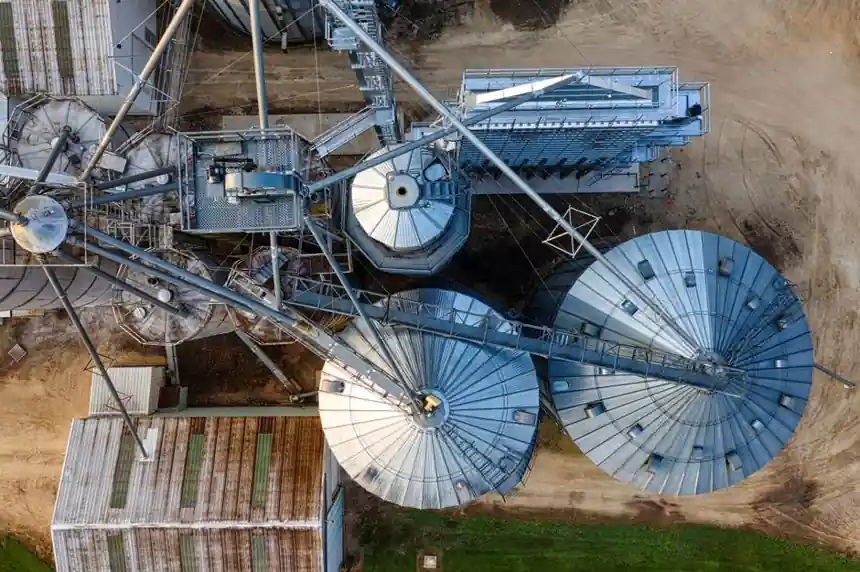
Belt bucket elevators are typically the lowest-cost, lowest-noise option for light-to-moderate, free-flowing bulk solids at ambient temperature, with centrifugal designs reaching capacities up to 5,000 cu ft (roughly 150 tons) per hour at belt speeds of 225-300 ft/min [S1].
Chain bucket elevators carry the heavy-duty loads: hot clinker, coarse ore, abrasive catalyst, and lifts where belt tension would be impractical, trading higher upfront cost and operating noise for longer service life under continuous duty [S2][S3][S5].
Drive Configuration and Component Layout
Both styles share the same skeleton: head and boot pulleys, a drive system, buckets, and an endless tension member, with the tension member being the only fundamental difference [S4]. In a belt elevator, buckets are bolted to a heavy-duty rubber or PVC belt running over lagged or stainless head/tail pulleys; in a chain elevator, buckets mount to single or double chain via steel link attachments driven by a chain and sprocket [S4][S5].
Belt units therefore depend on friction and pulley lagging to transmit torque, while chain units transmit torque through positive mesh on the sprocket, which is the mechanical reason chain units tolerate shock loading and reverse-tension events that would slip or stretch a belt [S5]. Centrifugal discharge designs, whether belt- or chain-driven, throw material out of the bucket at the head pulley, while continuous (gravity) discharge designs run at roughly half that speed for fragile or abrasive products [S1].
Capacity, Speed, and Throughput Envelope
Centrifugal belt bucket elevators are the throughput leaders, with belt speeds of 225-300 ft/min and capacities reaching 5,000 cu ft/h, and the configuration is widely used in grain terminals, cement raw feed, sand plants, and fertilizer handling [S1][S3][S5]. Continuous-bucket designs run at roughly half the speed of centrifugal units, so their capacities are correspondingly lower, but the slower discharge is preferred for friable or abrasive materials because the product simply tips out by gravity rather than being flung [S1].
Chain units can match centrifugal belt speeds in equivalent centrifugal-discharge designs, but the application envelope is shifted toward high-density, high-temperature, or lumpy material where belt life, not peak throughput, governs the decision [S3].
Material Compatibility: Temperature, Abrasiveness, and Particle Size

Belt elevators are not suitable with hot materials or large particles, which can lodge between the bucket and the belt, and standard rubber belts have temperature limitations unless upgraded to high-temperature belting [S5]. Chain elevators, by contrast, are specifically chosen for hot clinker, coal, potash, and catalyst service, and for ore or aggregate transport where large lump sizes would damage a belt [S5].
For corrosive or chemical applications, belt elevators can be specified with plastic buckets, lagged or stainless pulleys, and chemical-resistant belting, which is a common configuration in fertilizer and chemical plants [S2][S5]. Chain elevators tolerate abrasion better but are louder and require sprocket and chain-link wear monitoring rather than splice and belt-tracking checks [S5]. A useful side reference for moving corrosive bulk to and from the elevator boot is the chain conveyor family, which shares the same positive-drive logic on horizontal runs.
Footprint, Lift Height, and Structural Limits
Bucket elevators are the standard answer when vertical lift exceeds the practical 10-20 ft limit of most mechanical conveyors, and they deliver that lift in a small footprint because the unit only occupies the vertical column plus head and boot clearance [S1][S4]. Belt units are generally limited to moderate discharge heights; chain units are preferred when vertical lift height is extreme, because belt tension and stretch become impractical on very tall legs [S5].
Most bucket elevators are unidirectional, vertical only, but a few designs use buckets that swivel to remain horizontal through direction changes, forming S- or L-shaped layouts in the plant [S1]. For plants comparing vertical lift against inclined transport, the bucket elevator category page summarises the head-room and boot-access constraints common to both belt and chain types.
Maintenance, Wear, and Total Cost of Ownership
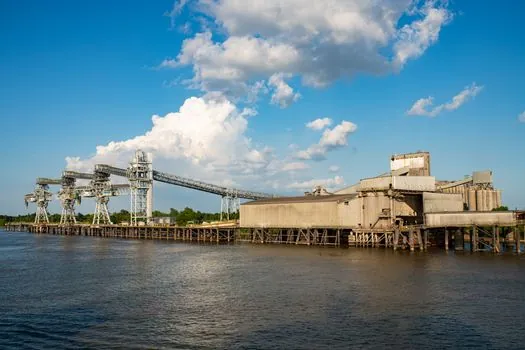
Maintenance requirements are broadly comparable between belt and chain elevators, but the inspection items differ: belt elevators need regular tension checks, belt tracking, splice-point inspection, and bucket-to-belt connection checks, while chain elevators focus on chain and sprocket wear [S5]. Chains are heavier and stretch less under shock, so a chain unit generally offers a longer service life in harsh service when properly maintained, which matters most where unplanned downtime is the dominant cost [S2][S5].
Take-up design is critical on both styles because belts and chains stretch in service, and modern bucket elevators can be fitted with low-cost instrumentation that monitors belt alignment, speed, bearing temperature, and material plugging to give early warning before a catastrophic failure [S1]. For plants standardising on rubber-PVC belt drive, a useful sanity check is to confirm the elevator head pulley is a lagged or stainless steel drum; a smooth, unlagged pulley is a common cause of belt slip on start-up under load [S5].
Selection Matrix: Belt vs Chain by Application
For cement raw-material feed, sand, light fertilizer, and free-flowing grain at ambient temperature and lift heights under roughly 30-40 m, the belt elevator is the default: lower cost, lower noise, and corrosion-resistant options exist, and capacities up to 5,000 cu ft/h are realistic [S1][S2][S5]. For clinker cooling, potash, catalyst, ore, and aggregate, or any application with hot material, shock loading, large lumps, or extreme lift height, the chain elevator is the safer spec despite higher upfront cost and noise [S3][S5].
Continuous (gravity) discharge variants of either drive type should be selected for fragile, flaky, or highly abrasive products where centrifugal throw would generate unacceptable degradation or dust [S1]. Two adjacent reference reads that pair well with this decision are the construction machinery and equipment index for upstream feed arrangements, and the chain belt note for plants retrofitting worn tension members. A useful external comparison point on the drive decision for high-inertia vertical lifts is this AC torque motor vs induction motor spec breakdown.
Common Spec Errors and Failure Modes
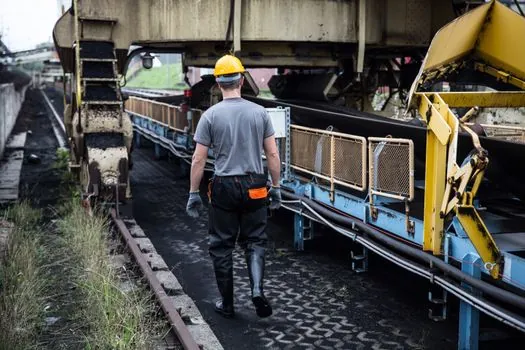
The most common belt-elevator failure is splice separation or bucket-bolt loosening after a shock event, both of which are detectable with simple belt-alignment and speed monitoring before a tear develops [S1][S5]. The most common chain-elevator failure is sprocket-tooth wear or chain-pin elongation on abrasive service, which shows up as timing irregularity at the head and can be caught with the same speed-monitoring instruments used on belt units [S1][S5].
A spec error seen repeatedly is selecting a belt elevator for a high-temperature service (typical hot clinker or cement kiln feed) on the assumption that "high-temp belting" is a universal fix; the rating must be confirmed bucket-by-bucket, because the bucket attachment bolts and pulley lagging are usually the first components to fail, not the belt carcass itself [S5]. A second recurring error is undersizing the boot access, since buckets fill by pushing through a pile of material at the bottom inlet, and the boot is the highest-wear zone in either configuration [S1].
For plants planning to expand, the watch-items through 2026 are the broader conveyor and bulk-handling capital rotation cycle tracked in AM consolidation 2026: exits, insolvencies, and capital rotation, and any shift in OEM standard offering toward higher-temperature belt carcass ratings for cement and minerals service, which would re-open the belt-vs-chain decision at the margin for moderate-temperature lifts.