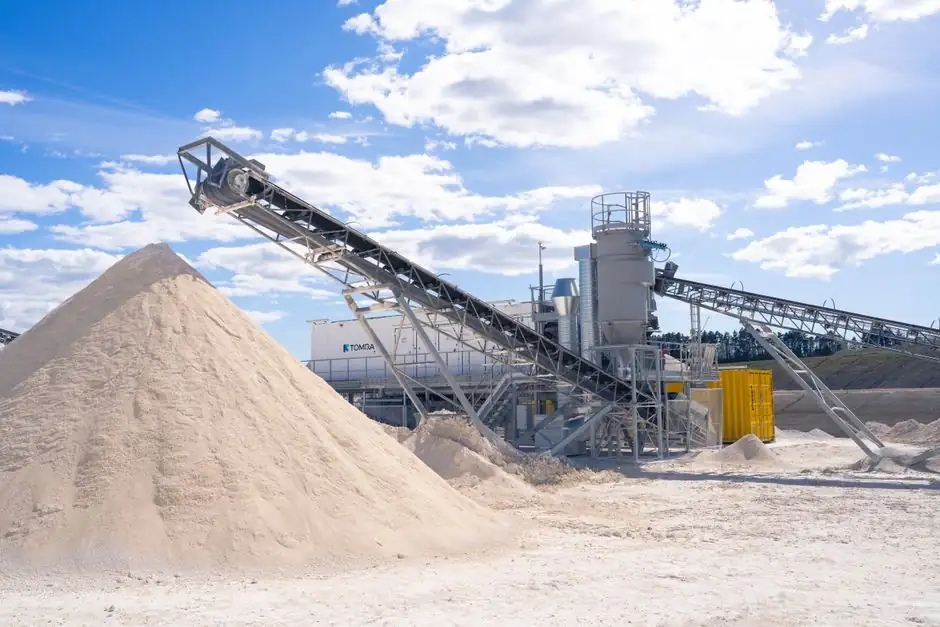
For enclosed transfer of dusty powders, granules, and wet cake, a horizontal or inclined screw conveyor is the default process-engineering pick because the rotating helix runs inside a sealed trough or tube, can be purged or put under vacuum, and exposes only end-shaft bearings to the operator [S1][S2].
Typical screw-conveyor lengths cap out near 60 to 80 ft before drive-shaft torque becomes limiting, while belt conveyors routinely run to 10 miles and handle larger lump sizes that would bind a screw flight [S2]. Standard trough loadings sit at 15%, 30%, or 45% by cross-section, with 45% reserved for light, free-flowing, non-abrasive dusts and 15% to 30% for denser or more abrasive bulk solids [S3].
Where Each Type Wins on Decision Criteria
The first decision axis is containment: a totally enclosed screw conveyor with sealed covers allows purge or vacuum operation for severe-duty dust or hazardous powders, whereas enclosing a belt conveyor is "theoretically possible but very expensive and for the most part not feasible" for the same duty [S2]. A belt conveyor still has hundreds to thousands of exposed moving parts, so operator guarding rather than dust control is the second reason most indoor dusty-material jobs default to the screw design [S2].
Belt conveyors handle long-distance runs (S2 cites a 2-mile ore transfer example) and larger, non-granular material that screw conveyors cannot easily move, while per the KWS engineering guide screw conveyors for inclined applications can be configured with tubular housings and reduced-pitch flights to hold capacity at those angles [S3]. In short, a screw conveyor is a short-haul, dusty, sealed feeder, not a long-run trunk conveyor.
Capacity, Throughput, and Loading Limits
Screw conveyors are designed for dry to semi-fluid bulk materials at 15% to 45% trough loading, with 45% used only for light, free-flowing, non-abrasive dusts, and 15% to 30% used for denser, sluggish, or more abrasive materials [S3]. The inlet is always control-fed by another device such as a screw feeder, rotary airlock, or gravimetric feeder, and the drive is recommended on the discharge end so each screw section sits in tension rather than compression during running [S3].
A belt conveyor carries a wider cross-section on a flat or troughed surface and generally delivers higher volumetric throughput, but that throughput advantage disappears the moment the job calls for a sealed enclosure for combustible or toxic dust.
Dust Control and Operator Exposure
Dust containment is the screw conveyor's defining advantage for enclosed dusty-material service: it is "completely enclosed with a sealed cover and can even be purged or put under vacuum for severe containment applications" [S2]. On a screw conveyor, the only exposed moving parts are the shaft and bearings at the trough ends, both of which can be mechanically enclosed; on a belt conveyor, the same dust job requires covers, skirting, and a separate dust extraction system to approach comparable containment [S2].
For an indoor chemical or pharmaceutical line where a combustible dust is in scope, this difference in baseline sealing drives most of the equipment-room layout, ATEX zoning, and housekeeping strategy, because the screw design removes most of the airborne release points at the source rather than capturing dust after it has escaped the belt edge.
Material Behaviour: Abrasive, Sticky, or Fragile
Abrasive wet cakes and sludge fines shear, mix, and wear the screw flight and trough liner, so the screw design questions become pitch, shaft type, speed, material of construction, drive torque, and clean-out access, not just "can the screw move it" [S1]. Shaftless screw conveyors and tubular drag conveyors are the usual answers when product integrity matters, since a traditional screw flight can abrade or degrade friable bulk solids [S6].
Belt conveyors are generally gentler for fragile, friable, or degradation-sensitive product because the flat, continuous surface of the belt slides rather than scrapes the material, and a flat belt configured slow and shallow keeps breakage rates low on food-grade and packaging lines [S4][S5]. Where breakage is the failure mode, the belt wins; where dusting or operator exposure is the failure mode, the screw wins.
Inclines, Vertical Lifts, and Layout Fit
Inclined screw conveyors operate from slightly above horizontal to 45 degrees, with above-45-degree units classified as vertical screw conveyors and treated as a separate design class; for the 20 to 30 degree band, KWS specifies tubular housing plus reduced-pitch (1/2 or 2/3) flights and additional horsepower to recover capacity from gravity fall-back [S3]. Vertical screw conveyors are specialized dust-tight units for very steep or fully vertical lifts and are commonly used to feed dryers, silos, or reactors from a lower mezzanine [S9].
A belt conveyor, by contrast, holds its capacity on moderate inclines and is the better long-haul trunk, but on a steep indoor lift with combustible dust the screw is again the lower-risk pick because the run stays sealed and short. Most process plants run a hybrid: belt conveyors in the open, dusty-intolerant sections, and enclosed screw conveyors at every dusty indoor transition, including dryer feed, dryer discharge, and bagging or silo charge.
Maintenance, Spare Parts, and Cost Posture
Screw conveyors cost less up front because the parts are modular and stocked in volume, while belt conveyor frames are custom-built per application, so a belt quote is almost always higher than a screw quote for a comparable short-run duty [S2]. Over a long run, however, belt conveyors are claimed to be less expensive due to higher efficiency, versatility, and lower maintenance demand, because the flat belt surface sees less wear per ton than the screw's bearings, hanger bearings, and seals [S5].
The dominant maintenance items differ by equipment class: a screw conveyor watches screw flight wear, trough wear, hanger bearings, seals, and the drive; a belt conveyor watches belt tracking, rollers, pulleys, skirting, and belt wear [S1]. For dusty-material service, expect the screw's seals and hanger bearings to be the recurring spend, and the belt's skirting and dust-collection ductwork to be the recurring spend on the belt side.
Selection Rule of Thumb for Enclosed Dusty Material
The practical rule: if the run is under 60 to 80 ft, the material is dry powder, granule, wet cake, or sludge, the dust is combustible, toxic, or simply objectionable, and the layout is compact, specify a totally enclosed horizontal or inclined screw conveyor with sealed covers, end-shaft guarding, and either purge or vacuum on the casing if the dust hazard demands it [S1][S2]. Specify a belt conveyor only when the run exceeds the screw's torque-limited distance, the lump size rules out a screw, or the product is too fragile for a helical flight [S2][S4].
For process engineers weighing the two side by side, a mesh belt conveyor covers the gentler, dryer-end niche, while the ribbed belt and belt tensioner choices matter on the long-run trunk line, not on the sealed dusty transfer itself. The next node is the dust-hazard classification (combustible dust class, MIE, Kst) and the ATEX or NFPA zone, since that zone rating, not the conveyor type alone, sets the motor and enclosure spec. A practical signal to watch in 2026 is how more OEMs are pairing enclosed tubular screw conveyors with integrated rotary valves at dryer discharge to cut the last fugitive-dust leak path.
For related coverage, see Automatic vs Manual Induction on Cross-Belt Sorters: Spec-Driven Selection.