The U.S. Department of Energy's Office of Electricity launched the Storage Design STEP Prize on 2026-07-14, putting US$200,000 of top prize money behind storage concepts that prove manufacturability and supply-chain resilience before scale-up [S1]. The move signals a federal pivot: storage chemistry alone is no longer the gating factor, line design and bill-of-process are [S1].
Demand for that line-design discipline is being driven by greenfield factory economics, where industrial demand charges now run 30–50% of total electricity bills and time-of-use spreads have widened to roughly 4x between off-peak and on-peak tariffs [S5]. Storage retrofits after plant start-up cost 5–10x more than designs that integrate a storage rack and pack architecture from day one, which is why line builders are now selling full BESS assembly systems, not loose stations [S5][S3].
What a BESS Assembly Line Actually Contains
A BESS assembly line is a specialized production system that integrates cells, modules, battery management systems, thermal management units, and power conversion systems into a finished, certifiable unit, typically meeting IEC, UL, and ISO requirements [S3]. Throughput is commonly expressed in kWh per year rather than units per shift, because pack capacity drives both cycle time and station count [S3].
The line splits cleanly into two segments: a Module Segment that turns bare cells into tested modules, and a PACK Segment that bolts modules into racks, cabinets, or containerized enclosures [S3]. Material handling between segments is a hidden bottleneck; the storage handling subsystem feeding the cell stackers often caps throughput before welding or EOL test does [S3].
Core Stations: Cell Stacking, OCV, Adhesive, and EOL Test
Module Segment workflow: cells are auto-loaded, barcode-scanned, OCV-tested, grouped, adhesive-applied, then robotically stacked, followed by manual steel-band application, module laser-welding, and EOL capacity and insulation testing [S3]. OCV testing at station 2 is the only place a bad cell can be rejected before value-add labor is spent, so its sensor accuracy sets the line's first-pass yield [S3].
PACK Segment workflow: EOL-tested modules are loaded into racks or cabinets, then BMS and PCS are integrated, high-voltage and communication wiring is routed, thermal management lines are plumbed, and the finished pack goes through a final EOL test covering voltage, capacity, insulation, and communication handshake with the PCS [S3]. Molding line discipline on enclosure fit-out, not cell quality, is the most common cause of pack-level rework, because cabinet tolerances stack across module, BMS, and door-seal interfaces [S3].
SKD Assembly as a Capital-Efficient Alternative
SKD (semi-knocked-down) assembly ships major BESS subassemblies separately and integrates them at a regional facility, reducing capex on buildings and equipment while keeping design and system architecture under OEM control [S4]. SKD supports faster ramp, lower fixed-cost exposure, and the option to scale pilot, low-volume, and serial production on the same footprint [S4].
SKD is best suited to OEMs that already have enclosure, cabling, and electromechanical assembly competence and want to defer full in-house cell-to-pack investment; it is not a fit for integrators that need to own cell formation or to control electrode-level IP [S4]. A storage cage designed for SKD kitting must protect modules during long-haul transport, since vibration and humidity excursions are the dominant pre-arrival failure modes [S4].
Greenfield Plant Sizing: 2–8 hr BESS, 4–24 hr TES, Milliseconds for Flywheel
For greenfield plants, the three dominant 2026 storage technologies split cleanly by use case: BESS for peak shaving at 2–8 hr duration and seconds-class response; thermal energy storage for process heat at 4–24 hr duration and minute-class response; flywheel for UPS and power quality at 15 s to 5 min and sub-250 ms ride-through [S5]. Peak demand reduction of 40% from BESS is a typical design target, sized against the facility's 15- or 30-minute demand-charge interval [S5].
Economic inputs have hardened: industrial demand charges sit at 30–50% of total bills, TOU spread is roughly 4x (for example $0.08/kWh off-peak vs. $0.35/kWh on-peak), and IRA Section 48 ITC at 30–50% applies to standalone storage with bonus adders [S5]. A 5 MW BESS enrolled in PJM, ERCOT, or CAISO demand response can stack an additional US$200,000–US$500,000 per year in capacity revenue on top of behind-the-meter savings [S5].
Software and Digital-Twin Layer Across the Line
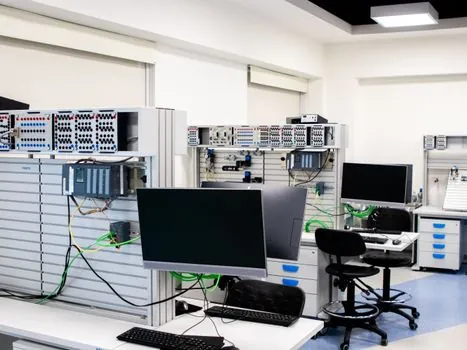
Siemens' BESS engineering stack centers on Simcenter Amesim for system simulation covering thermal management, safety, and energy forecasting, plus a seven-step assembly planning framework that unifies design and manufacturing data and runs process simulation before line build-out [S2]. Manufacturing operations management (MOM) and digital-twin capabilities are positioned as the operational backbone for cell-to-pack accuracy and cost control [S2].
NVIDIA's developer guidance for AI-factory power architecture treats BESS as a production-validated, real-time grid asset, not a passive UPS, which pushes line designers to embed BMS, PCS, and grid-forming controls testing into EOL rather than field commissioning [S6]. Detailed layer-by-layer control architecture for BESS is mapped in BESS process control and instrumentation: BMS, PCS, PPC, EIS layers compared, while the cost stack that line designers must hit is dissected in BESS Cost Breakdown 2026: Cells, BOS, LCOS Drivers.
STEP Prize Mechanics: Two Phases, US$360,000 Total
Phase 1 of the Storage Design STEP Prize rewards up to three Champions with US$20,000 each and up to nine Finalists with US$10,000 each, focused on identifying manufacturability and supply-chain barriers and proposing design mitigations [S1]. Phase 1 winners advance to Phase 2, where up to two Champions receive US$100,000 each and up to three Finalists receive US$50,000 each, against plans for cost reduction, scalability, and supply-chain resilience [S1].
All Phase 1 winners also receive priority access to the Grid Storage Launchpad (GSL) at Pacific Northwest National Laboratory for later testing and validation, which is a rare public-route to independent cell, module, and pack-level data without building in-house test stands [S1]. The broader AI-BMS and digital-twin adoption curve that STEP winners will have to design into their lines is charted in Energy Storage Industry 4.0: AI-BMS, Digital Twins, and the 2026 Adoption Curve.
Decision Map: Who Should Build Which Line Type
Decision criteria for line builders sit across four axes: capex tolerance, in-house IP depth, target annual kWh, and target geography [S3][S4][S5].
Fully integrated cell-to-pack lines suit vertically integrated cell makers with deep IP and high capex tolerance, typically above 1 GWh/yr; SKD integration suits OEMs with strong electromechanical and cabling know-how that want to defer cell investment and scale regionally; SKD-plus-EOL-test suits contract manufacturers serving multiple BESS brands from a single floor; greenfield plant operators are not line builders at all, but should spec turnkey BESS-plus-TES-plus-flywheel packages with the line builder pre-engineered in [S3][S4][S5].
Trackable signals over the next reporting cycle: DOE STEP Prize Phase 1 awardee list and PNNL GSL access dates, IRA Section 48 ITC final guidance for standalone storage, and any UL 9540A or IEC 62619 test-capacity expansion announced by major certification bodies, all of which will reset line build-out lead times [S1][S3].