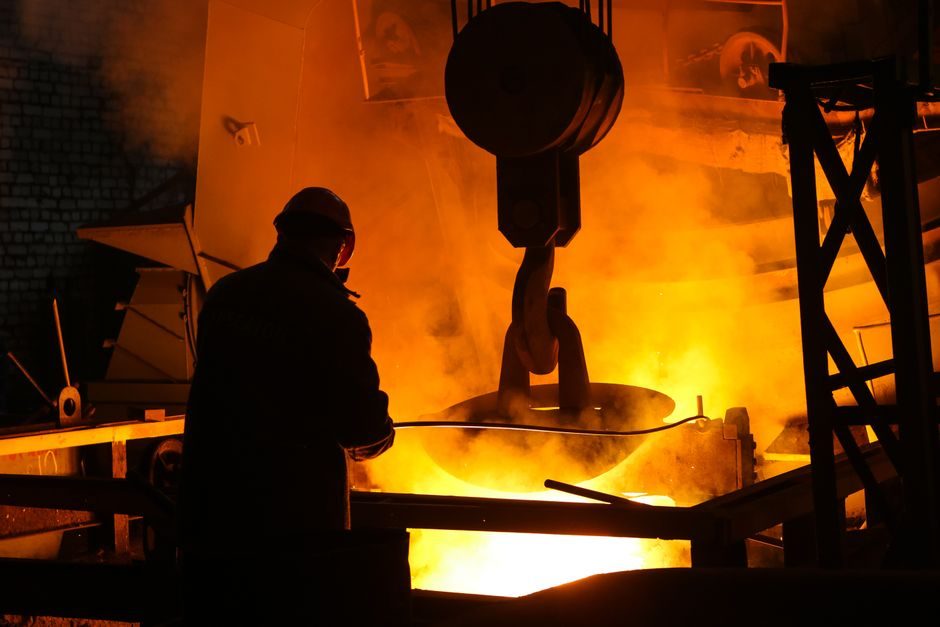
For aerospace billet and ingot production in 2026, the best gas-fired aluminum melting furnace is a stationary reverberatory with regenerative or oxy-fuel burners, 25–60 t/h melt rate, 720–760 °C bath control, and refractory stack rated for 1100 °C hot-face service [S1][S2].
This platform dominates because aerospace alloys — 2xxx, 6xxx, 7xxx, Al-Li — sit inside a narrow melt window above liquidus, and reverberatory geometry gives the bath volume and surface-area ratio required for MgO-soluble melt programs without exceeding melt loss budgets [S1]. In a typical 50 t furnace running EN AB-46100 / AA6063-grade feed, total metal loss from oxidation is held at 0.8–1.4% of charge weight, with air-fuel excess O2 the dominant lever [S1].
Melt Window, Atmosphere, and Burner Architecture
Air-fuel versus oxy-fuel burner selection defines both the thermal efficiency ceiling and the oxide-rate floor for any gas-fired aluminum melting furnace line aimed at aerospace work [S1]. Small-scale AlMg crucible tests (0–5% Mg, 65 g samples, 10 min–6 h, 700–760 °C) found air-fuel furnace atmospheres raise melt loss by 18–35% versus oxy-fuel when excess O2 is held in the 3–5% range [S1]. A 200–500 ppm Be addition suppresses the Mg-driven oxide spike but does not eliminate it, so a low-excess-O2 air-fuel design is the first design choice, not a Be habit.
For a 50 t gas-fired aluminum melting furnace running 16 h shifts, the burner pair and valve sequencing cycle on 30–60 s intervals, with the bed-pair switching off a single SiC or corundum honeycomb of about 1.2–1.8 m³. That pair swaps sensible heat back into the incoming combustion air, and the bath-side benefit is a stable 720–760 °C window with no cold corner above the skim bay. Bath temperature variance of ±5 °C is the practical acceptance band for tight-melt aerospace work; wider swing pulls Li-bearing Al-Li alloys into Li-oxide raft formation on the bath skin.
Refractory Stack: Castable, Brick, and Backup
A high-MgO castable (≥90% MgO, ≤4% CaO, 3–6% spinel additive) is the workhorse hot-face lining for any gas-fired aluminum melting furnace serving aerospace melt, because it survives the 1100 °C flame envelope and resists Al-MgO spinel formation that dissolves ordinary alumina refractories [S1]. A working lining of 200–250 mm monolithic castable over a 65–115 mm fired brick insulating backup is a common 2026 specification for 30–80 t reverberatory vessels in Chinese casthouse builds; this pairing holds shell temperature at 90–140 °C during steady-state melt and keeps energy loss through the wall to roughly 1.4–2.1 kW/m².
Two failure modes drive lining service life: (1) MgO-Al2O3 spinel growth in the castable above 950 °C, which the MgO-rich formulation slows but does not stop, and (2) alkali attack from K/Na-bearing fluxes added during flux-package or rotary-injector degassing. Hard-fired magnesia-chrome brick is sometimes specified at the bath-sidewall hot-face, particularly at the burner-belt line where the flame-impingement zone concentrates heat flux. For a 30 t furnace on a 2-shift aerospace pattern, hot-face campaigns of 4–6 years are normal; for a 60–80 t vessel, 5–7 years is the realistic range with mid-campaign patching of the burner-impingement band.
Throughput, Furnace Class, and Selection Trade-Off
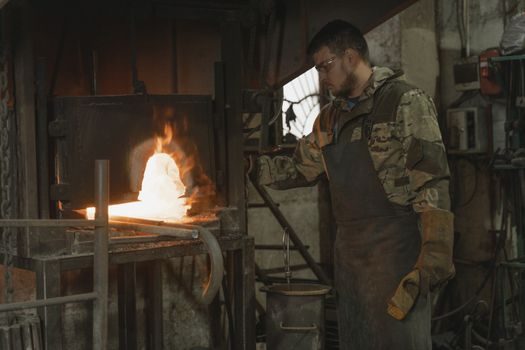
Four furnace architectures compete for aerospace-grade aluminum gas melting. A stationary reverberatory holds the most melt per footprint and tolerates the largest bath-temp window, making it the right pick for billet/ingot plants producing 10,000–80,000 t/year. A tilting reverberatory trades footprint for melt-rate flexibility and is the choice for 2,000–15,000 t/year job-shop casthouses feeding extrusion or forging stock. A shaft or stack-melter raises thermal efficiency to 70–80% by preheating the charge against offgas, but it forces tight chemistry control and is uncommon below 50,000 t/year. A rotary barrel furnace is the natural pick for clean-scrap-heavy aerospace reclaim, but its MgO attack rate is higher and bath-temperature stability is the worst of the four. [S1]
For a 30,000 t/year aerospace-grade build, a tilting reverberatory is the typical spec, and for a 60,000+ t/year build a shaft or stack-melter is the realistic answer. The stationary reverberatory is the right pick only when capital spend is constrained below $12 M USD for the furnace scope, and that is uncommon in 2026.
Sourcing Map and Indicative Cost Bands
The Chinese OEM landscape for gas-fired aluminum melting furnace lines is dominated by Henan-based fabricators with custom-engineering capacity, led by HongTeng Group (founded 2012, registered capital above RMB 30 M, OEM/ODM-certified) and Luoyang Shennai Power Equipment Co., Ltd., both listing 2006/42/EC machinery compliance on their export lines [S3][S5]. Indicative FOB China prices for 300 kg–500 kg batch-class gas-fired tilt furnaces land in the US$ 1,750–67,000 range per set; 10–30 t industrial reverberatory systems move the band up to US$ 180,000–720,000 per set, depending on refractory spec, burner platform (air-fuel vs oxy-fuel vs regenerative), and emissions package [S3][S5]. Western OEMs, including RAYTEQ in the electric-melting segment, are not the natural pick for a gas-fired line but remain a useful reference for power-density benchmarking and demand-side software [S4].
Budget-allocations on a 30 t aerospace-grade gas-fired aluminum melting furnace, in 2026 prices, fall roughly as: shell and structure 18–24%, refractory stack 12–18%, burner system 14–22%, exhaust and recuperative/regenerative heat-recovery 8–14%, flux/degassing station 6–10%, emissions train (NOx, CO, particulate) 10–18%, and commissioning + controls 6–10%.
Standards, Compliance, and Inspection Touchpoints
Aerospace casthouse acceptance for a gas-fired aluminum melting furnace typically references the machinery-safety frame 2006/42/EC, the ATEX 2014/34/EU framework for the burners and the degassing station, and ISO 9001 / AS9100 for the quality system of the OEM [S5]. For the refractory hot-face, ASTM C401 (castable classification) and ISO 2245 (shaped refractory classification) are the typical cited tests; for the burner, EN 676 (forced-draft gas burners) is the harmonized standard under the Gas Appliances Regulation (EU) 2016/426. The aerospace melt itself is not a refractory standard but a process control: AMS 2770 for heat treatment and AMS-QQ-A-250/5 for sheet stock guide the upstream process window, while the furnace-side operating procedure is the melting furnace specifier's responsibility. Buyers should expect EN 746 (industrial thermoprocessing equipment) and ISO 13577 (safety of furnace equipment) on the safety file.
Inspection points at the FAT stage: burner thermal mapping, refractory density and porosity (typically 2.7–3.0 g/cm³ and 14–18% for MgO-rich castable), shell leak-rate at operating draft, and PLC/control loop step-response on bath-temperature PID. SAT points at the casthouse: cold-to-hot ramp cycle within the OEM-stated 36–72 h window, melt-rate test at design tonnage, hold-temperature test at 720 °C ± 5 °C for 6 h minimum, and emissions verification at full load against the project permit. Aerospace-grade plants typically add a bath-chemistry verification at 1, 3, and 6 h into the first melt, with a H2-derived oxide-inclusion count on a filtered sample; this is a process step, not a furnace spec, but it belongs in the commissioning plan.
How Specforge Frames the Trade-Off
Spec-driven buyers should anchor the gas-fired aluminum melting furnace selection on five numbers, in this order: bath volume and melt rate, melt window tightness (720–760 °C ± 5 °C target for aerospace), burner thermal efficiency target (55–70% for regenerative, 30–40% for conventional air-fuel), refractory hot-face temperature limit (≥1100 °C on the castable), and shell heat-loss ceiling (≤2.0 kW/m² at steady state) [S1][S2]. Against those, shaft/stack-melter architecture is the most efficient but forces a minimum 50,000 t/year throughput, and rotary-barrel is the wrong pick for clean aerospace spec. The aerospace-grade gas-fired gas aluminum melting furnace buyer in 2026 is therefore the 30,000 t/year or larger casthouse that wants tight melt-rate flexibility and refractory longevity; the aerospace aluminum alloy specifier who needs anything below 30,000 t/year should consider an electric platform, where RAYTEQ-class OEM lines are the more natural reference [S4].
Trackable signals to watch over the next two quarters: (1) Chinese OEM price index for 30–60 t reverberatory furnace shipments, which is moving with steel-plate and MgO cost, and (2) the EU NO2/NOx permitted levels for the industrial thermoprocessing sector, which is on a 2026–2028 review track under the Industrial Emissions Directive. A move of either lever changes the all-in spec.
For related coverage, see Dry-Mix Mortar Suppliers 2026: China Maker Map, Line Types and Sourcing Levers.