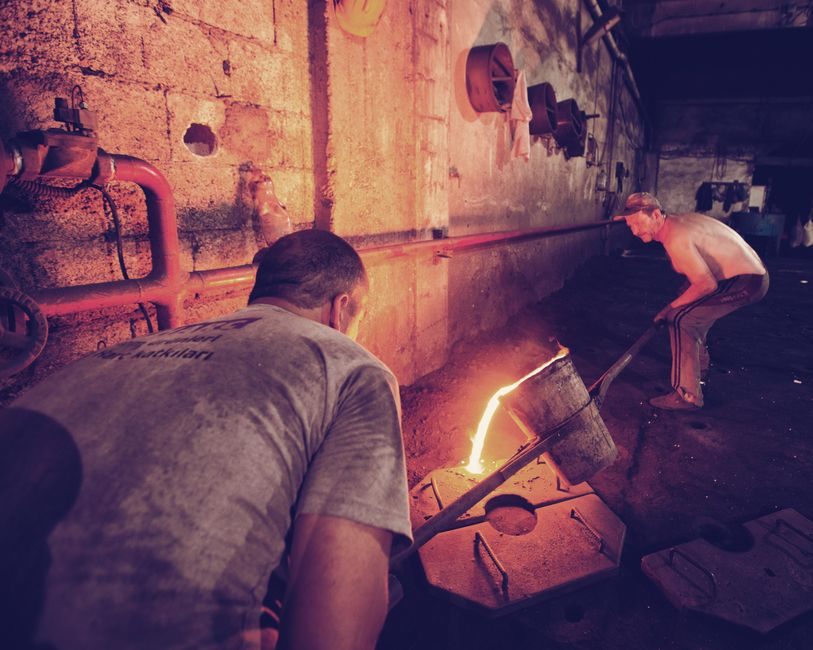
Line-frequency induction furnaces operating directly off 50/60 Hz mains are the workhorse choice for marine foundries pouring 1-10 t steel, copper-nickel, bronze and aluminium castings for ship-repair, offshore and navy yards, with coreless designs dominating over 1 t/h class and channel furnaces reserved for holding duty [S1][S7].
For a procurement engineer scoping 2026 marine-yard capacity, the line-frequency (LF) variant pairs with 500-3,000 kW mains-fed rectifier banks, while medium-frequency (MF, 1-10 kHz) and high-frequency (HF, 30-200 kHz) units cover smaller melts; FOB China pricing on a 500 kg MF steel-shell tilting furnace for iron/copper/aluminium scrap was listed in the US$11,600-12,500 range per piece in late May 2026 [S1][S5].
Why Line-Frequency Fits the Marine Deck Plate
Line-frequency furnaces skip the static frequency-conversion stage, so a 50/60 Hz supply feeds the water-cooled copper coil directly, removing the SCR or IGBT inverter losses (typically 5-8% of input kWh) and shrinking the spare-parts list for a yard that cannot wait six weeks for an IGBT module [S4][S7].
For marine duty the trade-off is coil current: at 50 Hz a furnace holding 5-8 t of molten metal draws coil currents in the 4,000-8,000 A range, so busbars, water-flexes and contactor plating have to be rated for sustained high-amperage service, and the inherent stirring effect of the 50 Hz field is actually a benefit when desulphurising marine-grade steel under slag [S1][S4]. Reference architecture and operating envelope of the induction furnace family are detailed in the encyclopedia entry.
Coreless vs Channel: Which One for a Shipyard Melt Deck
For ship-repair yards pouring 0.5-10 t of steel, copper alloy or aluminium per heat, a coreless line-frequency furnace is the default pick because it tilts, empties completely between heats, and accepts mixed scrap without channel-block damage [S1][S7].
Channel furnaces (also called submerged-arc or induction-channel) keep a heel of molten metal, give 95%+ electrical efficiency at 50/60 Hz, and are typically paired with a smaller coreless melter as a duplex; the channel holds and superheats, the coreless unit melts the scrap feed [S7].
Comparative picks for a 2026 shipyard tender:
- Coreless LF (0.5-10 t, 50/60 Hz): best for varied scrap, propeller-bronze, Cu-Ni, marine-grade aluminium; cold-start capable, lower refractory life (~200-400 heats) [S1].
- Channel furnace holding 10-40 t: best as a holding/ duplex vessel fed by a separate coreless melter, with efficiency gains of 5-10% versus a coreless-only line on continuous duty [S7].
- Coreless MF (1-10 kHz, 100-1,500 kg class): best for small batches and rapid alloy changeover where the marine yard also runs ferrous and non-ferrous on the same shift; 500 kg steel-shell units in the US$11,600-12,500 FOB band per May 2026 [S1][S5].
Spec Boundaries That Decide the Order
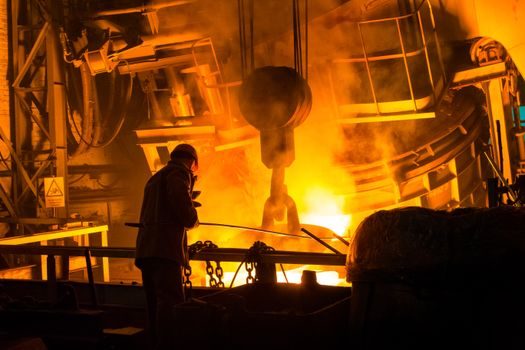
Five engineering gates lock in the line-frequency spec for a marine installation: mains frequency (50 Hz IEC/Asia, 60 Hz Americas and parts of US Navy yard supply), melt mass per heat, refractory strategy, cooling-water heat-load, and yard-side emissions/Noise (typically <85 dB(A) at 1 m) [S4][S7].
A 5 t coreless 50 Hz furnace holding 1,450 °C steel draws roughly 3,500-4,500 kW at 0.95-0.98 power factor, needs 80-120 m³/h of cooling water with a 30-40 °C delta-T, and consumes about 560-600 kWh/t on a hot-charge marine-scrap feed versus 700-740 kWh/t on a cold-start batch [S1][S4].
Spec-driven procurement guidance for furnace selection across the whole LF/MF/HF spectrum, including capacity-to-frequency mapping, is consolidated in How to Choose an Induction Furnace: Frequency, Capacity and Sourcing Levers, which pairs naturally with this article's marine-duty lens. For OEM landscape and capacity bands the complementary Induction Furnace Suppliers 2026: Maker Map, Capacity Bands and Sourcing Levers covers the maker side.
What to Verify Before Signing a Marine-Yard PO
Three contractual items separate a usable marine-yard line-frequency furnace from a stalled installation: a refractory dry-out schedule baked into the commissioning price (typically 72-120 h of staged heating for a magnesia or alumina-spinel lining), a cooling-water interlock that trips the coil above 55 °C outlet, and a harmonics compliance clause for the yard's shore-power bus [S4][S7].
Marine yards fed from shaft generators or shore-power frequency converters see harmonic distortion that distorts the 50/60 Hz waveform; specifying a soft-start contactor and verifying the rectifier cabinet's short-circuit rating against the yard's transformer impedance prevents nuisance trips during melt-down [S1][S4].
Documentation that should accompany the OEM data pack: type-test reports for coil-to-water insulation (>1 MΩ at 500 V), refractory CE/ISO certification, harmonic-emission test data to IEEE 519 limits, and a full set of routine spares (coil leads, contactor tips, water-flow switches) priced per piece [S1][S7].
Marine-Specific Failure Modes to Engineer Out
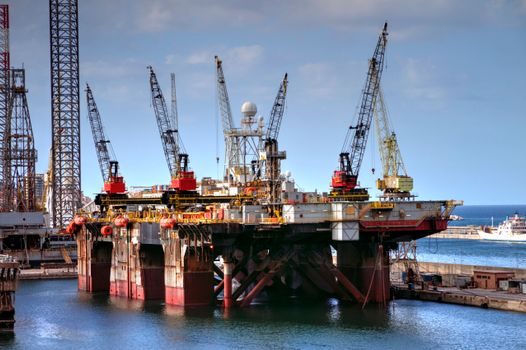
Line-frequency furnaces on shipyard or offshore platforms fail in three predictable ways: water-into-coil leaks caused by vibration and salinity in the yard's cooling supply, refractory erosion under high-throughput Cu-Ni pouring, and busbar joint fatigue on units that tilt 90°+ for each pour [S1][S4].
Specifying Cu-Ni 90/10 or 70/30 cooling piping, bronze or stainless water manifolds, and weekly torque checks on the tilting-busbar bolts addresses two of the three; the third needs a refractory programme tied to the tap count, typically 200-400 heats for an alumina-spinel lining before re-lining is required [S1].
For a yard also handling repair of large marine diesel engine blocks and pump housings, the duplex option (coreless melter + channel holder) is worth the extra capex because the channel furnace's holding efficiency keeps the melt ready for the next pour and protects the coreless refractory from the thermal cycling that kills it fastest on intermittent yard shifts [S7].
Sourcing Map and 2026 Price Bands
China remains the dominant OEM base for both LF and MF marine-duty induction furnaces, with audited manufacturers on Made-in-China quoting 500 kg MF tilting steel-shell units in the US$11,600-12,500 FOB band, mid-power MF units in the US$10,000-100,000 band, and smaller non-ferrous MF units as low as US$1,280-19,800 per set as of late May 2026 [S1][S5].
A complete LF coreless 3-5 t line for a marine yard, including coil, water-cooling skid, hydraulic tilting, refractory dry-out and commissioning, typically lands in the US$180,000-450,000 CIF band depending on power rating and options; a duplex line with 8 t coreless melter and 25 t channel holder typically lands in the US$600,000-1,200,000 CIF band, again per 2026-05 OEM quote patterns [S1][S5][S7].
The classification of these units under the HS heading 8514 covers electric induction and dielectric heating equipment, with import tariffs varying by destination market and free-trade-agreement status [S3]. General metallurgical background on induction melting, including the "heat in the material, not in a container" principle that drives scrap-melt efficiency on shipyards, is documented in the induction furnace encyclopedia entry.
Trackable procurement signals for the next sourcing window: revised CE marking under the 2014/34/EU ATEX framework for furnace control cabinets installed in shipyard hazardous-zone boundaries, and updated IEC 60079 series guidance on purge-pressurisation of rectifier cabinets placed adjacent to fuel-handling bays - both items to confirm with the OEM before issuing a marine-yard PO [S4][S7].
For component-level specifications, see line frequency furnace, and molding line.